
Essentials of Genetics Klug 2014 Exam Question with 100 Correct Answers 2026
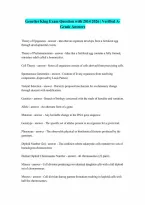
Genetics Klug Exam Question with | Verified A-Grade Answers Theory of Epigenesis - answer - Idea that an organism develops from a fertilized egg through developmental events. Theory of Preformationism - answer - Idea that a fertilized egg contains a fully formed, miniature adult called a homunculus. Cell Theory - answer - States all organisms consist of cells derived from preexisting cells. Spontaneous Generation - answer - Creation of living organisms from nonliving components, disproved by Louis Pasteur. Natural Selection - answer - Darwin's proposed mechanism for evolutionary change through descent with modification. Genetics - answer - Branch of biology concerned with the study of heredity and variation. Allele - answer - An alternate form of a gene. Mutation - answer - Any heritable change in the DNA gene sequence. Genotype - answer - The specific set of alleles present in an organism for a given trait. Phenotype - answer - The observable physical or biochemical features produced by the genotype. Diploid Number (2n) - answer - The condition where eukaryotic cells contain two sets of homologous chromosomes. Human Diploid Chromosome Number - answer - 46 chromosomes (23 pairs). Mitosis - answer - Cell division producing two identical daughter cells with a full diploid set of chromosomes. Meiosis - answer - Cell division during gamete formation resulting in haploid cells with half the chromosomes. Chromosome Theory of Inheritance - answer - States that inherited traits are controlled by genes residing on chromosomes transmitted via gametes. Avery, MacLeod, and McCarty Experiment (1944) - answer - Proved that DNA, not protein, is the carrier of genetic information in bacteria. Watson and Crick (1953) - answer - Discovered the double helix structure of DNA. Four Nitrogenous Bases in DNA - answer - Adenine, Guanine, Thymine, and Cytosine. Central Dogma of Molecular Biology - answer - DNA is transcribed into mRNA, which is translated into functional proteins. Transcription - answer - The process of copying a gene's DNA sequence into a single-stranded mRNA. Translation - answer - The synthesis of a polypeptide protein chain from an mRNA molecule by ribosomes. Molecular Cause of Sickle-Cell Anemia - answer - A single-nucleotide DNA mutation changing mRNA codon GAG to GUG, altering protein structure. Restriction Endonucleases (RE) - answer - Enzymes that cut viral DNA at specific nucleotide sequences. Vector (DNA Cloning) - answer - A carrier DNA molecule used to transfer recombinant DNA into host cells. Biotechnology - answer - Use of recombinant DNA technology and molecular techniques to create products. Transgenic Organism - answer - An organism modified by inserting genes from another species. Nuclear Transfer (Cloning) - answer - Transferring an adult cell nucleus into an unfertilized egg lacking a nucleus. CRISPR/Cas - answer - A precise molecular tool used for gene editing. Characteristics of Model Organisms - answer - Easy to grow, short life cycle, produce many offspring, straightforward genetic analysis. Examples of Model Organisms - answer - Fruit fly (Drosophila), mouse (Mus musculus), bacterium (E. coli), yeast (S. cerevisiae). William Harvey - answer - 17th-century scientist who proposed the theory of epigenesis. Schleiden and Schwann - answer - Formulated the cell theory in 1830. Alfred Russel Wallace - answer - Independently proposed evolution by natural selection alongside Charles Darwin. Karyotype - answer - An arranged display or photo of an individual's complete set of chromosomes. Walter Sutton and Theodor Boveri - answer - Independently formulated the Chromosome Theory of Inheritance. Hydrogen Bonds in DNA - answer - Weak chemical bonds holding complementary nitrogenous base pairs together in the double helix. Enzymes - answer - The largest category of proteins, serving as biological catalysts for chemical reactions. Dolly the Sheep (1996) - answer - First cloned m
Información del documento
- Subido en
- 16 de octubre de 2026
- Número de páginas
- 3
- Escrito en
- 2026/2027
- Tipo
- Examen
- Contiene
- Preguntas y respuestas

