
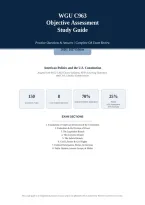
WGU C963
Objective Assessment
Study Guide
Practice Questions & Answers | Complete OA Exam Review
Edition
American Politics and the U.S. Constitution
Aligned with WGU C963 Course Syllabus, APSA Learning Outcomes,
and Civic Literacy Competencies
150 8 70% 25%
Questions Total Core Subject Sections Scenario-Based Application Recall
50% Application
25% Analysis
EXAM SECTIONS
1. Foundations of American Democracy & the Constitution
2. Federalism & the Division of Power
3. The Legislative Branch
4. The Executive Branch
5. The Judicial Branch
6. Civil Liberties & Civil Rights
7. Political Participation, Parties, & Elections
8. Public Opinion, Interest Groups, & Media
This study guide is an independent practice resource and is not affiliated with or endorsed by Western Governors University.
,WGU C963 Objective Assessment Study Guide | Practice Questions & Answers
| Complete OA Exam Review 2026/2027
American Politics and the U.S. Constitution | 150 Practice Questions with Detailed Rationales
WGU C963
Aligned with WGU C963 Course Syllabus, APSA Learning Outcomes, and Civic Literacy Competencies
Objective Assessment
Study Guide
Section 1: Foundations of American Democracy & the Constitution
Practice Questions & Answers | Complete OA Exam Review
Q1: Which principle, foundational to the U.S. Constitution, holds that legitimate governmental authority derives from the consent
of the people?
Edition
A. States' rights
B. Divine right of kings
C. Popular sovereignty *[CORRECT]*
D. Judicial review
American Politics and the U.S. Constitution
Correct Answer: C Aligned with WGU C963 Course Syllabus, APSA Learning Outcomes,
Rationale: Popular sovereignty, articulated by Locke and
and Civic Literacy
Rousseau, Competencies
holds that legitimate government authority flows from the consent of the
governed—a principle explicitly invoked in the Declaration of Independence and embedded in the Constitution's Preamble ("We the People"). Divine
right was rejected by American founders (A). Judicial review was established later in Marbury v. Madison (1803) (C). States' rights concerns
federalism, not the source of legitimacy (D). WGU C963 emphasizes popular sovereignty as one of five foundational constitutional principles.
150 8 70%
Q2: A state passes a constitutional amendment allowing citizens to directly vote on all major legislation via a smartphone app, 25%
bypassing the legislature entirely. This system most closely resembles which form of government?
Questions Total Core Subject Sections Scenario-Based Application Recall
50% Application
A. Direct democracy *[CORRECT]* 25% Analysis
B. Oligarchy
C. Representative democracy
D. Constitutional republic EXAM SECTIONS
Correct Answer: A
1. Foundations of American Democracy & the Constitution
Rationale: Direct democracy allows citizens to vote on laws directly
2. Federalism rather
& the thanofthrough
Division Power elected representatives, as in ancient Athens or modern
Swiss referenda. The scenario eliminates the legislative intermediary entirely.Branch
3. The Legislative Representative democracy (A) and constitutional republic (B) both
require elected representatives to make laws. Oligarchy (D) is rule Executive
4. The by a smallBranch
elite. WGU C963 contrasts direct democracy with the representative
system chosen by the Framers, who viewed pure democracy as5.prone to factional
The Judicial Branchtyranny (Federalist No. 10).
6. Civil Liberties & Civil Rights
7. Political Participation, Parties, & Elections
Q3: John Locke's social contract theory argues 8.that individuals
Public voluntarily
Opinion, Interest Groups,surrender
& Media some freedoms to government in exchange
for protection of which rights?
A. Life, liberty, and pursuit of happiness
B. Order, security, and equality
C. Wealth, power, and prestige
D. Life, liberty, and property *[CORRECT]*
Correct Answer: D
Rationale: Locke's Second Treatise (1689) identifies natural rights as life, liberty, and property—the trio individuals retain in the state of nature and
surrender only partially to government for protection. Jefferson adapted Locke's formulation in the Declaration of Independence, substituting "pursuit
of happiness" for "property" (B). Options C and D conflate modern political values with Locke's specific philosophical framework. WGU C963 maps
Locke's influence directly onto the Declaration's natural rights philosophy.
This study guide is an independent practice resource and is not affiliated with or endorsed by Western Governors University.
,WGU C963 Objective Assessment Study Guide | 2026/2027 Edition Complete OA Exam Review
Q4: Under the Articles of Confederation, the federal government's inability to levy taxes directly led to
which crisis, exposing the need for constitutional reform?
A. The Boston Massacre
B. Shays' Rebellion *[CORRECT]*
C. The Whiskey Rebellion
D. Bacon's Rebellion
Correct Answer: B
Rationale: Shays' Rebellion (1786–1787) was an armed uprising of Massachusetts farmers protesting debt and taxes;
the weak Confederation Congress could not raise a federal army or funds to suppress it, exposing fatal flaws in the
Articles. The Boston Massacre (A, 1770) preceded the Articles. The Whiskey Rebellion (C, 1794) occurred under the
new Constitution and was suppressed by federal authority. Bacon's Rebellion (D, 1676) was a Virginia colonial
conflict. WGU C963 frames Shays' Rebellion as the catalyst for the Constitutional Convention.
Q5: At the 1787 Constitutional Convention, the Virginia Plan and New Jersey Plan differed
fundamentally on the basis of representation. Which compromise resolved the impasse?
A. The Slave Trade Compromise
B. The Three-Fifths Compromise
C. The Connecticut (Great) Compromise *[CORRECT]*
D. The Commerce Compromise
Correct Answer: C
Rationale: The Connecticut Compromise (Great Compromise), proposed by Roger Sherman, created a bicameral
Congress with the House apportioned by population (Virginia Plan) and the Senate granting equal representation per
state (New Jersey Plan). The Three-Fifths Compromise (A) addressed enslaved persons in apportionment separately.
The Commerce and Slave Trade Compromises (C, D) dealt with trade regulation. WGU C963 identifies the Great
Compromise as the structural foundation of Article I's bicameralism.
Q6: A city council passes an ordinance banning all public religious displays, including privately funded
ones in public parks. Residents argue the ordinance violates constitutional principles of limited
government. Which principle most directly limits such government action?
A. Rule of law *[CORRECT]*
B. Judicial review
C. Separation of powers
D. Federalism
Correct Answer: A
Rationale: The rule of law principle holds that government itself is bound by law and must act within constitutional
constraints—here, the First Amendment's limits on government speech regulation. Separation of powers (A) concerns
the division among branches. Federalism (B) concerns state–federal division. Judicial review (D) is the mechanism to
enforce limits but not the principle itself. WGU C963 treats rule of law as the principle that no official, including
legislative majorities, is above constitutional constraints.
Page 3
, WGU C963 Objective Assessment Study Guide | 2026/2027 Edition Complete OA Exam Review
Q7: In Federalist No. 10, Madison argues that the most dangerous threat to popular government is:
A. Factions *[CORRECT]*
B. Judicial overreach
C. Executive tyranny
D. Foreign invasion
Correct Answer: A
Rationale: Federalist No. 10 defines a faction as a group united by a common interest adverse to the rights of others or
the public good; Madison argues large republics control faction's effects through representation and competing
interests. Foreign invasion (A), judicial overreach (C), and executive tyranny (D) are addressed elsewhere in The
Federalist Papers but are not the central concern of No. 10. WGU C963 uses Federalist No. 10 to teach the republican
remedy for factionalism.
Q8: Federalist No. 51 famously states, "Ambition must be made to counteract ambition." This phrase
most directly justifies which constitutional mechanism?
A. The supremacy clause
B. Checks and balances *[CORRECT]*
C. The necessary and proper clause
D. The full faith and credit clause
Correct Answer: B
Rationale: Madison's argument in Federalist No. 51 is that each branch must have the constitutional means and
personal motives to resist encroachments by the others—the essence of checks and balances. The supremacy clause (A)
addresses federal law's primacy. The necessary and proper clause (C) grants implied powers to Congress. Full faith and
credit (D) governs interstate recognition of acts. WGU C963 pairs Federalist No. 51 with the structural separation of
powers in Articles I–III.
Q9: Federalist No. 78, written by Hamilton, describes which branch as the "least dangerous" because it
has "no influence over either the sword or the purse"?
A. The state legislatures
B. The legislative branch
C. The executive branch
D. The judicial branch *[CORRECT]*
Correct Answer: D
Rationale: Federalist No. 78 argues the judiciary is the least dangerous branch because it controls neither force
(executive) nor funding (legislative), relying on judgment alone. Hamilton used this argument to defend lifetime tenure
and judicial review. The legislative (A) and executive (B) branches wield the powers Hamilton contrasts. State
legislatures (D) are outside the federal structure Hamilton discusses. WGU C963 uses Federalist No. 78 to introduce
the judiciary's designed weakness and the concept of judicial review.
Page 4
Objective Assessment
Study Guide
Practice Questions & Answers | Complete OA Exam Review
Edition
American Politics and the U.S. Constitution
Aligned with WGU C963 Course Syllabus, APSA Learning Outcomes,
and Civic Literacy Competencies
150 8 70% 25%
Questions Total Core Subject Sections Scenario-Based Application Recall
50% Application
25% Analysis
EXAM SECTIONS
1. Foundations of American Democracy & the Constitution
2. Federalism & the Division of Power
3. The Legislative Branch
4. The Executive Branch
5. The Judicial Branch
6. Civil Liberties & Civil Rights
7. Political Participation, Parties, & Elections
8. Public Opinion, Interest Groups, & Media
This study guide is an independent practice resource and is not affiliated with or endorsed by Western Governors University.
,WGU C963 Objective Assessment Study Guide | Practice Questions & Answers
| Complete OA Exam Review 2026/2027
American Politics and the U.S. Constitution | 150 Practice Questions with Detailed Rationales
WGU C963
Aligned with WGU C963 Course Syllabus, APSA Learning Outcomes, and Civic Literacy Competencies
Objective Assessment
Study Guide
Section 1: Foundations of American Democracy & the Constitution
Practice Questions & Answers | Complete OA Exam Review
Q1: Which principle, foundational to the U.S. Constitution, holds that legitimate governmental authority derives from the consent
of the people?
Edition
A. States' rights
B. Divine right of kings
C. Popular sovereignty *[CORRECT]*
D. Judicial review
American Politics and the U.S. Constitution
Correct Answer: C Aligned with WGU C963 Course Syllabus, APSA Learning Outcomes,
Rationale: Popular sovereignty, articulated by Locke and
and Civic Literacy
Rousseau, Competencies
holds that legitimate government authority flows from the consent of the
governed—a principle explicitly invoked in the Declaration of Independence and embedded in the Constitution's Preamble ("We the People"). Divine
right was rejected by American founders (A). Judicial review was established later in Marbury v. Madison (1803) (C). States' rights concerns
federalism, not the source of legitimacy (D). WGU C963 emphasizes popular sovereignty as one of five foundational constitutional principles.
150 8 70%
Q2: A state passes a constitutional amendment allowing citizens to directly vote on all major legislation via a smartphone app, 25%
bypassing the legislature entirely. This system most closely resembles which form of government?
Questions Total Core Subject Sections Scenario-Based Application Recall
50% Application
A. Direct democracy *[CORRECT]* 25% Analysis
B. Oligarchy
C. Representative democracy
D. Constitutional republic EXAM SECTIONS
Correct Answer: A
1. Foundations of American Democracy & the Constitution
Rationale: Direct democracy allows citizens to vote on laws directly
2. Federalism rather
& the thanofthrough
Division Power elected representatives, as in ancient Athens or modern
Swiss referenda. The scenario eliminates the legislative intermediary entirely.Branch
3. The Legislative Representative democracy (A) and constitutional republic (B) both
require elected representatives to make laws. Oligarchy (D) is rule Executive
4. The by a smallBranch
elite. WGU C963 contrasts direct democracy with the representative
system chosen by the Framers, who viewed pure democracy as5.prone to factional
The Judicial Branchtyranny (Federalist No. 10).
6. Civil Liberties & Civil Rights
7. Political Participation, Parties, & Elections
Q3: John Locke's social contract theory argues 8.that individuals
Public voluntarily
Opinion, Interest Groups,surrender
& Media some freedoms to government in exchange
for protection of which rights?
A. Life, liberty, and pursuit of happiness
B. Order, security, and equality
C. Wealth, power, and prestige
D. Life, liberty, and property *[CORRECT]*
Correct Answer: D
Rationale: Locke's Second Treatise (1689) identifies natural rights as life, liberty, and property—the trio individuals retain in the state of nature and
surrender only partially to government for protection. Jefferson adapted Locke's formulation in the Declaration of Independence, substituting "pursuit
of happiness" for "property" (B). Options C and D conflate modern political values with Locke's specific philosophical framework. WGU C963 maps
Locke's influence directly onto the Declaration's natural rights philosophy.
This study guide is an independent practice resource and is not affiliated with or endorsed by Western Governors University.
,WGU C963 Objective Assessment Study Guide | 2026/2027 Edition Complete OA Exam Review
Q4: Under the Articles of Confederation, the federal government's inability to levy taxes directly led to
which crisis, exposing the need for constitutional reform?
A. The Boston Massacre
B. Shays' Rebellion *[CORRECT]*
C. The Whiskey Rebellion
D. Bacon's Rebellion
Correct Answer: B
Rationale: Shays' Rebellion (1786–1787) was an armed uprising of Massachusetts farmers protesting debt and taxes;
the weak Confederation Congress could not raise a federal army or funds to suppress it, exposing fatal flaws in the
Articles. The Boston Massacre (A, 1770) preceded the Articles. The Whiskey Rebellion (C, 1794) occurred under the
new Constitution and was suppressed by federal authority. Bacon's Rebellion (D, 1676) was a Virginia colonial
conflict. WGU C963 frames Shays' Rebellion as the catalyst for the Constitutional Convention.
Q5: At the 1787 Constitutional Convention, the Virginia Plan and New Jersey Plan differed
fundamentally on the basis of representation. Which compromise resolved the impasse?
A. The Slave Trade Compromise
B. The Three-Fifths Compromise
C. The Connecticut (Great) Compromise *[CORRECT]*
D. The Commerce Compromise
Correct Answer: C
Rationale: The Connecticut Compromise (Great Compromise), proposed by Roger Sherman, created a bicameral
Congress with the House apportioned by population (Virginia Plan) and the Senate granting equal representation per
state (New Jersey Plan). The Three-Fifths Compromise (A) addressed enslaved persons in apportionment separately.
The Commerce and Slave Trade Compromises (C, D) dealt with trade regulation. WGU C963 identifies the Great
Compromise as the structural foundation of Article I's bicameralism.
Q6: A city council passes an ordinance banning all public religious displays, including privately funded
ones in public parks. Residents argue the ordinance violates constitutional principles of limited
government. Which principle most directly limits such government action?
A. Rule of law *[CORRECT]*
B. Judicial review
C. Separation of powers
D. Federalism
Correct Answer: A
Rationale: The rule of law principle holds that government itself is bound by law and must act within constitutional
constraints—here, the First Amendment's limits on government speech regulation. Separation of powers (A) concerns
the division among branches. Federalism (B) concerns state–federal division. Judicial review (D) is the mechanism to
enforce limits but not the principle itself. WGU C963 treats rule of law as the principle that no official, including
legislative majorities, is above constitutional constraints.
Page 3
, WGU C963 Objective Assessment Study Guide | 2026/2027 Edition Complete OA Exam Review
Q7: In Federalist No. 10, Madison argues that the most dangerous threat to popular government is:
A. Factions *[CORRECT]*
B. Judicial overreach
C. Executive tyranny
D. Foreign invasion
Correct Answer: A
Rationale: Federalist No. 10 defines a faction as a group united by a common interest adverse to the rights of others or
the public good; Madison argues large republics control faction's effects through representation and competing
interests. Foreign invasion (A), judicial overreach (C), and executive tyranny (D) are addressed elsewhere in The
Federalist Papers but are not the central concern of No. 10. WGU C963 uses Federalist No. 10 to teach the republican
remedy for factionalism.
Q8: Federalist No. 51 famously states, "Ambition must be made to counteract ambition." This phrase
most directly justifies which constitutional mechanism?
A. The supremacy clause
B. Checks and balances *[CORRECT]*
C. The necessary and proper clause
D. The full faith and credit clause
Correct Answer: B
Rationale: Madison's argument in Federalist No. 51 is that each branch must have the constitutional means and
personal motives to resist encroachments by the others—the essence of checks and balances. The supremacy clause (A)
addresses federal law's primacy. The necessary and proper clause (C) grants implied powers to Congress. Full faith and
credit (D) governs interstate recognition of acts. WGU C963 pairs Federalist No. 51 with the structural separation of
powers in Articles I–III.
Q9: Federalist No. 78, written by Hamilton, describes which branch as the "least dangerous" because it
has "no influence over either the sword or the purse"?
A. The state legislatures
B. The legislative branch
C. The executive branch
D. The judicial branch *[CORRECT]*
Correct Answer: D
Rationale: Federalist No. 78 argues the judiciary is the least dangerous branch because it controls neither force
(executive) nor funding (legislative), relying on judgment alone. Hamilton used this argument to defend lifetime tenure
and judicial review. The legislative (A) and executive (B) branches wield the powers Hamilton contrasts. State
legislatures (D) are outside the federal structure Hamilton discusses. WGU C963 uses Federalist No. 78 to introduce
the judiciary's designed weakness and the concept of judicial review.
Page 4

