
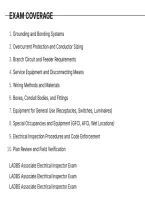
EXAM COVERAGE
1. Grounding and Bonding Systems
2. Overcurrent Protection and Conductor Sizing
3. Branch Circuit and Feeder Requirements
4. Service Equipment and Disconnecting Means
5. Wiring Methods and Materials
6. Boxes, Conduit Bodies, and Fittings
7. Equipment for General Use (Receptacles, Switches, Luminaires)
8. Special Occupancies and Equipment (GFCI, AFCI, Wet Locations)
9. Electrical Inspection Procedures and Code Enforcement
10. Plan Review and Field Verification
LADBS Associate Electrical Inspector Exam
LADBS Associate Electrical Inspector Exam
LADBS Associate Electrical Inspector Exam
,LADBS Associate Electrical Inspector Exam
LADBS Associate Electrical Inspector Exam
1. Which of the following best describes the primary purpose of the equipment
grounding conductor in an electrical installation?
A. To carry normal operating current during balanced conditions
B. To provide a low-impedance path for fault current to facilitate overcurrent
device operation
C. To improve voltage regulation at the load end of a branch circuit
D. To reduce electromagnetic interference in sensitive electronic equipment
B. To provide a low-impedance path for fault current to facilitate overcurrent
device operation
Rationale: The equipment grounding conductor is specifically designed to
provide a low-impedance fault current path, enabling overcurrent devices to
operate rapidly and clear faults, thereby reducing shock hazards 2 .
,2. When inspecting a service entrance, an electrical inspector observes that
the main bonding jumper is missing. What is the most significant safety
consequence of this condition?
A. The building will experience increased voltage drop during peak demand
periods
B. Normal return current may flow on metal raceways and equipment grounding
conductors
C. The service disconnecting means will not be able to interrupt fault current
D. The grounding electrode system will become electrically isolated from earth
B. Normal return current may flow on metal raceways and equipment grounding
conductors
Rationale: The main bonding jumper connects the grounded conductor to the
equipment grounding system at the service, preventing normal return current
from flowing on metal raceways and equipment grounding conductors 4 .
3. An inspector finds that a 20-ampere branch circuit is protected by a 30-
ampere circuit breaker. What is the primary hazard associated with this
, condition?
A. The circuit will experience nuisance tripping during normal operation
B. Conductors may overheat because the overcurrent device will not protect
them adequately
C. The voltage at the load will be significantly reduced due to increased
resistance
D. The circuit breaker will not be able to detect ground faults effectively
B. Conductors may overheat because the overcurrent device will not protect
them adequately
Rationale: Oversized breakers may not protect conductors from overcurrent
conditions, resulting in overheating, insulation damage, and fire hazards 2 .
4. Which of the following installation practices is specifically required when
aluminum conductors are used for branch circuit or feeder connections?
A. Aluminum conductors must always be one size larger than equivalent copper
conductors
B. Antioxidant compound must be applied and terminals must be properly

