
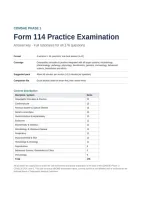
COMSAE PHASE 1
Form 114 Practice Examination
Answer key · Full rationales for all 176 questions
Format 4 sections × 44 questions; one best answer (A–E)
Coverage Osteopathic principles & practice integrated with all organ systems, microbiology,
pharmacology, pathology, physiology, biochemistry, genetics, immunology, behavioral
science, biostatistics and ethics
Suggested pace About 65 minutes per section (≈1.5 minutes per question)
Companion file Exam booklet (take the exam first, then review here)
Content distribution
Discipline / system Items
Osteopathic Principles & Practice 22
Cardiovascular 15
Nervous System & Special Senses 15
Renal & Acid–Base 13
Gastrointestinal & Hepatobiliary 13
Endocrine 12
Biochemistry & Genetics 12
Microbiology & Infectious Disease 12
Respiratory 12
Musculoskeletal & Skin 12
Hematology & Oncology 11
Reproductive 9
Behavioral Science, Biostatistics & Ethics 9
Immunology 9
Total 176
All questions are original items written for self-assessment and board preparation in the style of the COMSAE Phase 1 /
COMLEX-USA Level 1. They are not actual NBOME examination items, and this booklet is not affiliated with or endorsed by the
National Board of Osteopathic Medical Examiners.
,COMSAE Phase 1 · Form 114 — Answer Key & Rationales Quick answer key
Quick answer key
Check your answer sheet against this grid, then work through the full rationales that follow.
Section 1 Section 2 Section 3 Section 4
1 E 45 B 89 E 133 B
2 A 46 C 90 B 134 B
3 D 47 D 91 A 135 B
4 E 48 E 92 E 136 B
5 E 49 D 93 E 137 C
6 A 50 D 94 A 138 A
7 D 51 D 95 A 139 E
8 A 52 A 96 B 140 C
9 D 53 A 97 B 141 B
10 B 54 B 98 A 142 E
11 E 55 D 99 B 143 D
12 B 56 B 100 E 144 B
13 A 57 E 101 A 145 C
14 C 58 B 102 D 146 A
15 D 59 E 103 E 147 C
16 C 60 D 104 A 148 D
17 C 61 E 105 C 149 C
18 A 62 D 106 A 150 A
19 C 63 A 107 B 151 C
20 D 64 D 108 C 152 C
21 B 65 D 109 C 153 D
22 C 66 B 110 B 154 E
23 C 67 B 111 A 155 A
24 B 68 C 112 A 156 B
25 A 69 C 113 C 157 E
26 B 70 D 114 C 158 A
27 D 71 C 115 D 159 D
28 D 72 C 116 E 160 D
29 D 73 A 117 C 161 D
30 D 74 A 118 D 162 A
31 B 75 C 119 C 163 D
32 E 76 C 120 C 164 E
33 E 77 C 121 C 165 D
34 C 78 E 122 E 166 D
35 D 79 A 123 B 167 B
36 A 80 D 124 E 168 E
37 C 81 B 125 E 169 E
38 B 82 E 126 B 170 C
39 A 83 E 127 B 171 E
40 C 84 A 128 A 172 E
41 E 85 C 129 B 173 D
42 B 86 E 130 E 174 B
43 A 87 B 131 C 175 E
44 A 88 A 132 D 176 A
Original practice items for self-assessment. Not NBOME material. Page 2
,COMSAE Phase 1 · Form 114 — Answer Key & Rationales Performance by discipline
Performance by discipline
Circle the questions you missed, then total your correct answers in each row. A percentage below about 65–70% in any row marks a
priority area for review.
Discipline / system Question numbers Items Correct %
Osteopathic Principles & 1, 14, 25, 28, 35, 42, 58, 64, 66, 71, 82, 86, 90, 114, 22
Practice 123, 126, 132, 135, 141, 150, 152, 155
Cardiovascular 3, 12, 20, 29, 45, 81, 88, 93, 101, 127, 131, 136, 140, 15
148, 172
Nervous System & Special 11, 23, 33, 47, 60, 67, 80, 95, 116, 119, 130, 133, 15
Senses 147, 154, 174
Renal & Acid–Base 6, 15, 19, 21, 48, 59, 70, 98, 109, 115, 138, 159, 162 13
Gastrointestinal & 7, 16, 41, 50, 68, 73, 76, 89, 106, 108, 134, 169, 171 13
Hepatobiliary
Endocrine 2, 4, 17, 46, 51, 62, 117, 122, 129, 146, 149, 167 12
Biochemistry & Genetics 5, 26, 40, 52, 54, 87, 102, 105, 120, 143, 151, 153 12
Microbiology & Infectious 8, 13, 44, 69, 74, 83, 94, 121, 128, 157, 160, 176 12
Disease
Respiratory 27, 31, 34, 61, 63, 72, 103, 113, 124, 139, 164, 173 12
Musculoskeletal & Skin 32, 36, 38, 53, 55, 85, 96, 104, 107, 142, 156, 163 12
Hematology & Oncology 10, 22, 43, 49, 77, 91, 100, 111, 145, 161, 168 11
Reproductive 9, 37, 56, 65, 84, 92, 99, 137, 144 9
Behavioral Science, 18, 30, 75, 79, 110, 125, 158, 165, 170 9
Biostatistics & Ethics
Immunology 24, 39, 57, 78, 97, 112, 118, 166, 175 9
Total 176
How to use the rationales
• Each entry repeats the question, marks the correct answer in green, and explains the reasoning step by step.
• "Why the other options are wrong" explains every distractor – often the fastest way to learn the neighboring
high-yield facts.
• The amber "High-yield takeaway" box condenses the facts most likely to reappear on the COMLEX-USA Level 1.
Re-read these boxes in the final week before your exam.
Original practice items for self-assessment. Not NBOME material. Page 3
,COMSAE Phase 1 · Form 114 — Answer Key & Rationales Section 1 rationales · Q1–44
Section 1 — Answers & Rationales
Questions 1–44
Question 1 Osteopathic Principles & Practice
Topic: Viscerosomatic reflexes – sympathetic and parasympathetic levels for the gallbladder
A 47-year-old woman is evaluated in the emergency department because of a 10-hour history of constant right upper
quadrant pain that began 1 hour after a fried-food dinner. Temperature is 38.4°C (101.1°F). Inspiratory arrest occurs
during deep palpation of the right subcostal region. Ultrasonography shows gallstones, a thickened gallbladder wall,
and pericholecystic fluid. While awaiting surgical consultation, the osteopathic physician performs a palpatory
examination looking for viscerosomatic reflex changes.
Which of the following combinations of findings is most likely?
(A) Left T1–T4 paraspinal tissue texture changes and somatic dysfunction of the sacrum
(B) Left T5–T9 paraspinal tissue texture changes and somatic dysfunction of the sacrum
(C) Bilateral T12–L2 paraspinal tissue texture changes and occipitoatlantal/upper cervical somatic dysfunction
(D) Right T10–T11 paraspinal tissue texture changes and somatic dysfunction of the sacrum
(E) Right T5–T9 paraspinal tissue texture changes and occipitoatlantal/upper cervical somatic dysfunction
Correct answer: (E) Right T5–T9 paraspinal tissue texture changes and occipitoatlantal/upper cervical
somatic dysfunction
Explanation
This patient has acute calculous cholecystitis (postprandial RUQ pain, fever, positive Murphy sign and the classic
ultrasonographic triad). Viscerosomatic reflexes occur because visceral afferent fibers enter the spinal cord at the same
segments that supply the organ's sympathetic innervation; convergence on dorsal horn interneurons facilitates the
corresponding somatic segment, producing paraspinal tissue texture changes (acute: warm, boggy, hypertonic, tender). The
liver, gallbladder, stomach, duodenum, pancreas and spleen ('upper GI' organs derived from the foregut) receive
sympathetic innervation from T5–T9 via the greater splanchnic nerve and celiac ganglion. Because the gallbladder and liver
lie on the right, the reflex changes are found on the RIGHT at T5–T9 (many texts narrow the gallbladder to right T6–T9).
Parasympathetic innervation of the gallbladder is from the vagus nerve (CN X), which supplies all viscera down to the distal
third of the transverse colon. The vagus exits the skull through the jugular foramen, adjacent to the occipitomastoid suture,
so vagal viscerosomatic changes are palpated at the occipitoatlantal (OA), atlantoaxial and C2 region. Hence: right T5–T9
plus OA/upper cervical findings. Recognizing these patterns lets the physician both localize visceral disease and treat the
associated somatic dysfunction (e.g., rib raising or paraspinal inhibition to normalize sympathetic tone, and suboccipital
release for vagal balance).
Why the other options are wrong
(A) Left T1–T4 paraspinal tissue texture changes and somatic dysfunction of the sacrum
Left T1–T4 (T1–T5) changes are the classic viscerosomatic pattern for the HEART (e.g., myocardial ischemia),
and sacral findings reflect pelvic splanchnic (S2–S4) parasympathetic input to the hindgut and pelvic organs, not
the gallbladder.
(B) Left T5–T9 paraspinal tissue texture changes and somatic dysfunction of the sacrum
T5–T9 is the correct sympathetic level, but LEFT-sided changes favor the stomach or spleen, and the sacrum
reflects S2–S4 parasympathetic outflow. The gallbladder's parasympathetic supply is vagal, not pelvic splanchnic.
Original practice items for self-assessment. Not NBOME material. Page 4
,COMSAE Phase 1 · Form 114 — Answer Key & Rationales Section 1 rationales · Q1–44
(C) Bilateral T12–L2 paraspinal tissue texture changes and occipitoatlantal/upper cervical somatic dysfunction
T12–L2 corresponds to the lower GI tract (distal transverse colon to rectum), bladder, prostate and lower
extremities. Although the OA finding would fit vagal input, the thoracolumbar level is wrong for the gallbladder.
(D) Right T10–T11 paraspinal tissue texture changes and somatic dysfunction of the sacrum
T10–T11 is the sympathetic level of the kidneys, gonads and the midgut (small intestine through the proximal
two-thirds of the transverse colon, via the superior mesenteric ganglion). Sacral (S2–S4) parasympathetic input
does not supply the gallbladder.
HIGH-YIELD TAKEAWAY
Sympathetic viscerosomatic levels: heart T1–T5 (left); lungs T2–T7; foregut (liver, gallbladder, stomach, pancreas,
spleen, duodenum) T5–T9; midgut, kidney, gonads T10–T11; hindgut, bladder, prostate T12–L2. Parasympathetic:
vagus (OA/AA/C2) to the proximal two-thirds of the transverse colon; pelvic splanchnics (sacrum, S2–S4) beyond.
Question 2 Endocrine
Topic: SGLT2 inhibitors – euglycemic diabetic ketoacidosis
A 56-year-old woman with type 2 diabetes mellitus treated with metformin and empagliflozin undergoes an elective
laparoscopic cholecystectomy. She ate very little for 2 days before surgery and did not stop either medication. On
postoperative day 1 she has nausea, vomiting, abdominal pain and rapid deep breathing. Serum glucose is 188 mg/dL,
bicarbonate is 9 mEq/L, anion gap is 26 mEq/L, and serum beta-hydroxybutyrate is markedly elevated. Lactate is
normal.
Which of the following best explains why this patient's glucose concentration is only modestly elevated despite
severe ketoacidosis?
(A) Empagliflozin causes glycosuria by blocking proximal tubular glucose reabsorption
(B) Metformin-induced lactate production that consumed circulating glucose
(C) Empagliflozin directly stimulates insulin secretion from pancreatic beta cells
(D) Surgical stress decreased cortisol and glucagon secretion
(E) Empagliflozin inhibits hepatic gluconeogenesis via AMP-activated protein kinase
Correct answer: (A) Empagliflozin causes glycosuria by blocking proximal tubular glucose reabsorption
Explanation
EMPAGLIFLOZIN (like dapagliflozin and canagliflozin) inhibits SODIUM–GLUCOSE COTRANSPORTER 2 (SGLT2)
in the S1 segment of the PROXIMAL CONVOLUTED TUBULE, which normally reabsorbs about 90% of filtered glucose.
Blocking it lowers the renal threshold for glucose and causes GLYCOSURIA, lowering blood glucose independent of
insulin. EUGLYCEMIC DKA (glucose <250 mg/dL with anion gap ketoacidosis) occurs because: (1) ongoing glycosuria
keeps glucose relatively low even as the patient becomes insulin-deficient; (2) lower glucose leads to lower insulin secretion
or doses, while glucagon secretion increases (SGLT2 inhibitors also act on alpha cells), shifting metabolism toward lipolysis
and hepatic KETOGENESIS; (3) reduced renal ketone clearance. Precipitants include surgery, fasting or low-carbohydrate
diets, acute illness, alcohol and reductions in insulin dose. Because glucose is not dramatically elevated, diagnosis is often
delayed. Prevention: hold SGLT2 inhibitors at least 3 days before elective surgery (4 days for ertugliflozin). Treatment is
standard DKA management (insulin with dextrose, fluids, potassium). Other adverse effects: genital mycotic infections,
urinary tract infections, Fournier gangrene (necrotizing fasciitis of the perineum), volume depletion. Benefits: reduced heart
failure hospitalization and slower CKD progression.
Original practice items for self-assessment. Not NBOME material. Page 5
,COMSAE Phase 1 · Form 114 — Answer Key & Rationales Section 1 rationales · Q1–44
Why the other options are wrong
(B) Metformin-induced lactate production that consumed circulating glucose
Lactic acidosis from metformin would show elevated lactate; this patient has ketoacidosis with a normal lactate,
and lactate production does not 'consume' glucose to lower serum levels.
(C) Empagliflozin directly stimulates insulin secretion from pancreatic beta cells
SGLT2 inhibitors do not stimulate insulin secretion; sulfonylureas and meglitinides (K-ATP channel closers) and
GLP-1 agonists (glucose-dependent) do.
(D) Surgical stress decreased cortisol and glucagon secretion
Surgical stress INCREASES counterregulatory hormones (cortisol, glucagon, catecholamines), which promote
ketogenesis and hyperglycemia; it does not decrease them.
(E) Empagliflozin inhibits hepatic gluconeogenesis via AMP-activated protein kinase
AMP-activated protein kinase–mediated inhibition of hepatic gluconeogenesis is the mechanism of METFORMIN,
which does not cause ketoacidosis (it can rarely cause lactic acidosis, but lactate is normal here).
HIGH-YIELD TAKEAWAY
SGLT2 inhibitors (-gliflozins): PCT glycosuria; euglycemic DKA (hold 3 days before surgery), genital infections, UTIs,
Fournier gangrene; cardiorenal benefit. Metformin: ↓ hepatic gluconeogenesis (AMPK), lactic acidosis risk, B12
deficiency.
Question 3 Cardiovascular
Topic: Antiarrhythmics – class IC agent and structural heart disease
A 28-year-old woman has recurrent episodes of palpitations lasting several hours. An ECG during an episode shows
atrial fibrillation with a ventricular rate of 132/min; the episodes terminate spontaneously. Transthoracic
echocardiography is normal, and there is no history of coronary artery disease. She is prescribed an antiarrhythmic drug
to take as a single oral dose at the onset of symptoms ('pill-in-the-pocket'), along with an AV nodal blocking agent. The
drug binds sodium channels in the open state and dissociates very slowly, markedly depressing the phase 0 upstroke in
ventricular myocytes while having little effect on action potential duration. The drug should be avoided in patients with
prior myocardial infarction because it increases mortality in that setting.
Which of the following drugs was most likely prescribed?
(A) Procainamide
(B) Sotalol
(C) Amiodarone
(D) Flecainide
(E) Lidocaine
Correct answer: (D) Flecainide
Explanation
Class I antiarrhythmics block fast sodium channels and are subdivided by their dissociation kinetics and effect on action
potential duration (APD). Class IA (quinidine, procainamide, disopyramide) – intermediate dissociation, moderate phase 0
depression, INCREASE APD and the QT interval (they also block K+ channels). Class IB (lidocaine, mexiletine) – fast
dissociation, preferentially affect depolarized/ischemic tissue, DECREASE APD. Class IC (FLECAINIDE, propafenone) –
very SLOW dissociation (marked use dependence), the greatest depression of phase 0 and conduction velocity (QRS
widening), with little or no change in APD. Flecainide (or propafenone) is used as a 'pill-in-the-pocket' to convert
Original practice items for self-assessment. Not NBOME material. Page 6
,COMSAE Phase 1 · Form 114 — Answer Key & Rationales Section 1 rationales · Q1–44
paroxysmal atrial fibrillation in patients WITHOUT structural or ischemic heart disease, usually with a beta-blocker or
nondihydropyridine calcium channel blocker to prevent rapid AV conduction if the drug organizes AF into atrial flutter with
1:1 conduction. The Cardiac Arrhythmia Suppression Trial (CAST) showed that class IC drugs increase mortality
(proarrhythmic sudden death) after myocardial infarction, so they are contraindicated in ischemic or structural heart disease.
Why the other options are wrong
(A) Procainamide
Procainamide (class IA) prolongs APD and QT. It is used in WPW-associated AF and wide-complex tachycardias;
chronic use causes drug-induced lupus (anti-histone antibodies).
(B) Sotalol
Sotalol is a class III potassium channel blocker with nonselective beta-blocking activity. It PROLONGS APD and
QT (risk of torsades de pointes) rather than selectively depressing phase 0.
(C) Amiodarone
Amiodarone is a class III agent with class I, II and IV effects; it prolongs APD and QT, is safe in structural heart
disease, and has a very long half-life with pulmonary, thyroid, hepatic, corneal and skin toxicity. It is not
characterized by isolated marked phase 0 depression without APD change.
(E) Lidocaine
Lidocaine (class IB) dissociates rapidly, shortens APD and acts mainly on ischemic or depolarized ventricular
tissue. It is given intravenously for ventricular arrhythmias and has little effect on atrial tissue.
HIGH-YIELD TAKEAWAY
IA – ↑ APD (quinidine, procainamide); IB – ↓ APD, ischemic tissue (lidocaine); IC – no APD change, greatest phase 0
depression, contraindicated post-MI/structural disease (flecainide, propafenone). CAST trial → IC drugs increase
post-MI mortality.
Original practice items for self-assessment. Not NBOME material. Page 7
,COMSAE Phase 1 · Form 114 — Answer Key & Rationales Section 1 rationales · Q1–44
Question 4 Endocrine
Topic: Hypoglycemia – factitious insulin administration
A 31-year-old nurse is brought to the emergency department after being found confused and diaphoretic at work.
Fingerstick glucose is 34 mg/dL, and her symptoms resolve with intravenous dextrose. She has had three similar
episodes in the past 2 months. She does not have diabetes mellitus. Blood drawn during the hypoglycemic episode
shows:
Study Result
Glucose 36 mg/dL
Insulin 68 μU/mL (elevated)
C-peptide <0.1 ng/mL (low)
Proinsulin Low
Beta-hydroxybutyrate Low
Sulfonylurea/meglitinide screen Negative
Which of the following is the most likely cause of her hypoglycemia?
(A) Insulin autoimmune syndrome
(B) Insulinoma
(C) Non–islet cell tumor secreting insulin-like growth factor II
(D) Surreptitious sulfonylurea ingestion
(E) Exogenous insulin administration
Correct answer: (E) Exogenous insulin administration
Explanation
The diagnosis of hypoglycemia requires Whipple triad: symptoms of hypoglycemia, a low plasma glucose and relief with
glucose administration. Proinsulin is cleaved in beta-cell granules into insulin and C-PEPTIDE in equimolar amounts, so
endogenous insulin secretion raises both. Commercial insulin preparations contain NO C-peptide. Exogenous insulin raises
insulin, and the resulting hypoglycemia suppresses endogenous secretion, so C-PEPTIDE and PROINSULIN are LOW.
This pattern – high insulin, low C-peptide, negative secretagogue screen – indicates EXOGENOUS (FACTITIOUS OR
MALICIOUS) INSULIN ADMINISTRATION, most often seen in health-care workers or relatives of patients with diabetes
(factitious disorder). Low beta-hydroxybutyrate confirms insulin effect (insulin suppresses ketogenesis). Interpretation
table: insulinoma – high insulin, high C-peptide, high proinsulin, negative screen; sulfonylurea or meglitinide – high insulin,
high C-peptide, POSITIVE screen; IGF-II–secreting tumor – low insulin and C-peptide, low beta-hydroxybutyrate; insulin
autoimmune syndrome – very high total insulin with high C-peptide due to antibodies binding insulin.
Why the other options are wrong
(A) Insulin autoimmune syndrome
Insulin autoimmune syndrome (antibodies against endogenous insulin, often after exposure to sulfhydryl drugs,
more common in East Asian populations) causes very high insulin levels with HIGH C-peptide and often
postprandial hypoglycemia.
(B) Insulinoma
Insulinoma produces ENDOGENOUS insulin, so C-peptide and proinsulin are elevated (proinsulin often
disproportionately). It is associated with MEN1.
Original practice items for self-assessment. Not NBOME material. Page 8

