
NUR 631 Midterm Exam Questions & Answers PDF
| Advanced Pathophysiology Complete Practice
Test | Latest 2026–2027
Play your way to mastery with fun games
Match Blocks Charms NEW
Terms in this set (242)
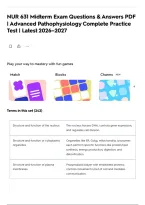
Structure and function of the nucleus The nucleus houses DNA, controls gene expression,
and regulates cell division.
Structure and function of cytoplasmic Organelles like ER, Golgi, mitochondria, lysosomes
organelles each perform specific functions like protein/lipid
synthesis, energy production, digestion, and
detoxification.
Structure and function of plasma Phospholipid bilayer with embedded proteins;
membranes controls movement in/out of cell and mediates
communication.
, Structure and function of cellular Proteins that bind ligands (e.g., hormones),
receptors triggering intracellular signaling for responses.
Structure and function of nucleolus Dense area in the nucleus that synthesizes rRNA and
assembles ribosomal subunits.
Structure and function of Powerhouse of the cell; generates ATP through
mitochondria oxidative phosphorylation.
Structure and function of ribosomes Sites of protein synthesis; translate mRNA into
polypeptides.
Structure and function of lysosomes Contain digestive enzymes; break down waste,
pathogens, and cellular debris.
Structure and function of lipid bilayer Double layer of phospholipids; forms selective
barrier and maintains membrane fluidity.
Function of proteins in cells Structural support, enzymatic reactions, signaling,
transport, movement, and immune defense.
Gap junctions Direct connections between cells allowing ion/small
molecule transfer for coordination.
Cell growth and proliferation Cells increase in size or number; regulated by
growth signals and cell cycle checkpoints.
| Advanced Pathophysiology Complete Practice
Test | Latest 2026–2027
Play your way to mastery with fun games
Match Blocks Charms NEW
Terms in this set (242)
Structure and function of the nucleus The nucleus houses DNA, controls gene expression,
and regulates cell division.
Structure and function of cytoplasmic Organelles like ER, Golgi, mitochondria, lysosomes
organelles each perform specific functions like protein/lipid
synthesis, energy production, digestion, and
detoxification.
Structure and function of plasma Phospholipid bilayer with embedded proteins;
membranes controls movement in/out of cell and mediates
communication.
, Structure and function of cellular Proteins that bind ligands (e.g., hormones),
receptors triggering intracellular signaling for responses.
Structure and function of nucleolus Dense area in the nucleus that synthesizes rRNA and
assembles ribosomal subunits.
Structure and function of Powerhouse of the cell; generates ATP through
mitochondria oxidative phosphorylation.
Structure and function of ribosomes Sites of protein synthesis; translate mRNA into
polypeptides.
Structure and function of lysosomes Contain digestive enzymes; break down waste,
pathogens, and cellular debris.
Structure and function of lipid bilayer Double layer of phospholipids; forms selective
barrier and maintains membrane fluidity.
Function of proteins in cells Structural support, enzymatic reactions, signaling,
transport, movement, and immune defense.
Gap junctions Direct connections between cells allowing ion/small
molecule transfer for coordination.
Cell growth and proliferation Cells increase in size or number; regulated by
growth signals and cell cycle checkpoints.

