
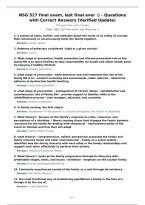
NSG 527 final exam, last final ever :) - Questions
with Correct Answers (Verified Update)
195 questions with answers
Topic: NSG 527 final exam, last final ever :)
1. a system of ideas, beliefs, and attitudes about the worst of an entity of concept
that consciously or unconsciously binds the family together.
Answer: Family values
2. Patterns of behaviors considered "right in a given society"
Answer: norms
3. What stage or prevention: health promotion and disease prevention role of the
family RN is to teach families to take responsibility for health and attain health goals
by enjoying a healthy lifestyle
Answer: primary prevention
4. what stage of prevention: -early detection and and treatment the role of the
family RN is to: -conduct screening and assessments -make referrals - determine
patterns of dysfunction health teaching
Answer: secondary prevention
5. what stage of prevention: - management of chronic illness - rehabilitation and
convalescence role of family RN: - provide support to families while in the
rehabilitation process - case manager, advocate, and counselor
Answer: tertiary prevention
6. in family nursing, the first step is
Answer: assessment ***assessment is constant throughout the course of treatment
7. What theory?: -focuses on the family's response to crisis, resources, and
perceptions of a situation. - illness causing stress that changes the family dynamic -
resources for the family for dealing with stressor(s) - implications/reality of the
event on families and how they will adapt
Answer: Family Stress Theory
8. what theory?: -comprehensive, holistic perspective assessing the family and
family universe (inner and outer environments) - family as a social system -
identifies how the family interacts with each other in the family relationships and
support each other effectively to perform their actions
Answer: structural functional theory
9. What theory?: -looks at the family progression through its lifecycles with
predictable stages, tasks, and issues - limitation - emphasis on the nuclear family
Answer: Family developmental theory
10. Commonly experienced events of the family as a unit through its existence
Answer: the family lifecycle
11. the most functional way of maintaining equilibrium a family in the face of a
change is by the use of
Answer: in role flexibility
Page 1
,12. role changes create during transition
Answer: stress
13. most important way in which we identify social class
Answer: occupation
14. what are the three ways in which we identify social class?
Answer: 1. occupation - most important 2. income 3. education - ranked highest in the
process of analysis for determining health status outcomes
15. defined as a unit with distinct part and boundaries, extending over a period of
time and with some identified purpose(s)
Answer: system
16. the central nervous system consists of the and
Answer: brain and spinal cord
17. lobe that is associated with working memory, planning, and insight into our
problems
Answer: frontal lobe
18. primitive part of the brain - involved in swallowing, arousal, and breathing
Answer: brainstem
19. puts emotional meaning on a stimulus, forms environmental memories and is
involved in rage and fear
Answer: amygdala
20. involved in learning, processing information into memories, and assigning the
time and the place to memories
Answer: hippocampus
21. involved with emotions - made up of the rim of the medial (innermost) portions
of the frontal, parietal, and temporal lobes and overlies the brainstem
Answer: limbic system
22. carry sensory information TOWARD the central nervous system and brain
Answer: atterent neurons
23. carry motor information AWAY from the central nervous system and toward
muscles to cause movemenet
Answer: etterent neurons
24. inhibitory neurotransmitter in the nervous system
Answer: Gamma-aminobutyric acid (GABA)
25. excitatory neurotransmitter in the nervous system
Answer: glutamate
26. responsible for myelin formation in the CNS
Answer: oligodendroglia cells
Page 2
, 27. disease of the nerve cells that lead into the basal ganglia resulting in shuffled
gait, tremors, rigidity, etc.
Answer: Parkinson's disease
28. termination of a neurotransmitter action in SNS requires uptake into a
Answer: presynaptic neuron
29. recovery emerges from
Answer: hope
30. emotional bond to another person
Answer: attachment
31. the first attachment theorist
Answer: John Bowlby
32. Attachment style?: marked by distress when separated from caregivers and are
joy when the caregiver returns. these children feel secure and able to depend on
their adult caregivers. When the adult leaves, the child may be upset but he or she
feels assured that the parent or caregiver will return.
Answer: secure attachment
33. Attachment style?: -avoids parents and caregivers -shows no preference for
parent of stranger - possibly a result of abuse/neglect
Answer: avoidant attachment
34. attachment style?: -fear of abandonment - constantly needing reassurance,
hates separations, even for a few hours - sees them as a threat to relationship,
constantly checking, and can fall in love in days
Answer: ambivalent attachment
35. attachment style?: lived n chronic fear and emotional turmoil as a child does not
know how to function in relationships was severely abused as a child and will date
those that abuse them or become abusers
Answer: disorganized attachment
36. THEORY: constitutes a way of explaining a unit such as a family as it relates to
and interacts with other systems it explain how each variable affects the whole and
how the whole affects each part
Answer: systems theory
37. one unit in totality for analysis; interdependency; the structure is the
organization of the parts needed for effective function and measurable outcomes.
Answer: system
38. what are these?: Health: Make informed, healthy choices that support physical
and emotional well-being. Home: Have a stable and safe place to live. Purpose:
Engage in meaningful daily activities, such as a job or school, volunteering, caring
for your family, or being creative. Work for independence, income, and resources to
participate in society. Community: Build relationships and social networks that
provide support.
Answer: SAMHSA dimensions of recovery
Page 3
with Correct Answers (Verified Update)
195 questions with answers
Topic: NSG 527 final exam, last final ever :)
1. a system of ideas, beliefs, and attitudes about the worst of an entity of concept
that consciously or unconsciously binds the family together.
Answer: Family values
2. Patterns of behaviors considered "right in a given society"
Answer: norms
3. What stage or prevention: health promotion and disease prevention role of the
family RN is to teach families to take responsibility for health and attain health goals
by enjoying a healthy lifestyle
Answer: primary prevention
4. what stage of prevention: -early detection and and treatment the role of the
family RN is to: -conduct screening and assessments -make referrals - determine
patterns of dysfunction health teaching
Answer: secondary prevention
5. what stage of prevention: - management of chronic illness - rehabilitation and
convalescence role of family RN: - provide support to families while in the
rehabilitation process - case manager, advocate, and counselor
Answer: tertiary prevention
6. in family nursing, the first step is
Answer: assessment ***assessment is constant throughout the course of treatment
7. What theory?: -focuses on the family's response to crisis, resources, and
perceptions of a situation. - illness causing stress that changes the family dynamic -
resources for the family for dealing with stressor(s) - implications/reality of the
event on families and how they will adapt
Answer: Family Stress Theory
8. what theory?: -comprehensive, holistic perspective assessing the family and
family universe (inner and outer environments) - family as a social system -
identifies how the family interacts with each other in the family relationships and
support each other effectively to perform their actions
Answer: structural functional theory
9. What theory?: -looks at the family progression through its lifecycles with
predictable stages, tasks, and issues - limitation - emphasis on the nuclear family
Answer: Family developmental theory
10. Commonly experienced events of the family as a unit through its existence
Answer: the family lifecycle
11. the most functional way of maintaining equilibrium a family in the face of a
change is by the use of
Answer: in role flexibility
Page 1
,12. role changes create during transition
Answer: stress
13. most important way in which we identify social class
Answer: occupation
14. what are the three ways in which we identify social class?
Answer: 1. occupation - most important 2. income 3. education - ranked highest in the
process of analysis for determining health status outcomes
15. defined as a unit with distinct part and boundaries, extending over a period of
time and with some identified purpose(s)
Answer: system
16. the central nervous system consists of the and
Answer: brain and spinal cord
17. lobe that is associated with working memory, planning, and insight into our
problems
Answer: frontal lobe
18. primitive part of the brain - involved in swallowing, arousal, and breathing
Answer: brainstem
19. puts emotional meaning on a stimulus, forms environmental memories and is
involved in rage and fear
Answer: amygdala
20. involved in learning, processing information into memories, and assigning the
time and the place to memories
Answer: hippocampus
21. involved with emotions - made up of the rim of the medial (innermost) portions
of the frontal, parietal, and temporal lobes and overlies the brainstem
Answer: limbic system
22. carry sensory information TOWARD the central nervous system and brain
Answer: atterent neurons
23. carry motor information AWAY from the central nervous system and toward
muscles to cause movemenet
Answer: etterent neurons
24. inhibitory neurotransmitter in the nervous system
Answer: Gamma-aminobutyric acid (GABA)
25. excitatory neurotransmitter in the nervous system
Answer: glutamate
26. responsible for myelin formation in the CNS
Answer: oligodendroglia cells
Page 2
, 27. disease of the nerve cells that lead into the basal ganglia resulting in shuffled
gait, tremors, rigidity, etc.
Answer: Parkinson's disease
28. termination of a neurotransmitter action in SNS requires uptake into a
Answer: presynaptic neuron
29. recovery emerges from
Answer: hope
30. emotional bond to another person
Answer: attachment
31. the first attachment theorist
Answer: John Bowlby
32. Attachment style?: marked by distress when separated from caregivers and are
joy when the caregiver returns. these children feel secure and able to depend on
their adult caregivers. When the adult leaves, the child may be upset but he or she
feels assured that the parent or caregiver will return.
Answer: secure attachment
33. Attachment style?: -avoids parents and caregivers -shows no preference for
parent of stranger - possibly a result of abuse/neglect
Answer: avoidant attachment
34. attachment style?: -fear of abandonment - constantly needing reassurance,
hates separations, even for a few hours - sees them as a threat to relationship,
constantly checking, and can fall in love in days
Answer: ambivalent attachment
35. attachment style?: lived n chronic fear and emotional turmoil as a child does not
know how to function in relationships was severely abused as a child and will date
those that abuse them or become abusers
Answer: disorganized attachment
36. THEORY: constitutes a way of explaining a unit such as a family as it relates to
and interacts with other systems it explain how each variable affects the whole and
how the whole affects each part
Answer: systems theory
37. one unit in totality for analysis; interdependency; the structure is the
organization of the parts needed for effective function and measurable outcomes.
Answer: system
38. what are these?: Health: Make informed, healthy choices that support physical
and emotional well-being. Home: Have a stable and safe place to live. Purpose:
Engage in meaningful daily activities, such as a job or school, volunteering, caring
for your family, or being creative. Work for independence, income, and resources to
participate in society. Community: Build relationships and social networks that
provide support.
Answer: SAMHSA dimensions of recovery
Page 3

