Adult Health 2 Final Exam – Questions & Accurate
Answers
Add to calendar
Play your way to mastery with fun games
Match Blocks Charms NEW
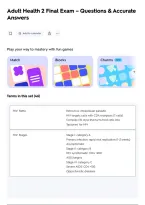
Terms in this set (46)
HIV: Patho Retrovirus: intracellular parasite
HIV targets cells with CD4 receptors (T cells)
Complex life style that turns host cells into
'factories' for HIV
HIV: Stages Stage I: category A
Primary infection: rapid viral replication (1-3 weeks)
Asymptomatic
Stage II: category B
HIV symptomatic: CD4 <200
AIDS begins
Stage III: category C
Severe AIDS: CD4 <100
Opportunistic diseases
, HIV: risk factors Sharing needles
Having sexual relations with infected individuals
Infants born to mothers with HIV or breast- fed by
them
People who received organ transplants or infected
blood products
HIV: labs EIA: antibodies are detected- positive results
marking end of window period
Western blot: used to confirm EIA
Viral load: measures HIV RNA in plasma
CD4/ CD8: impaired immune system
OraQuick: at home test
HIV: nurses role Screening process:
Pre and post test screening
Sequence due to ‘window period’
Retesting essential at 3wk, 6wk, 3mo
May have a false negative
Counseling
Focus on clients own unique circumstances/ risks
Acknowledge steps already made
Enhance self- perception of risk
Use explicit language
Help client set goal to reduce chance of acquiring/
transmitting HIV
Use protection during intercoure
HIV: Treatment Antiretroviral therapy (ART)
Prevent or decrease complications
Detect and treat
Prevent transmission
Reduce morbidity