
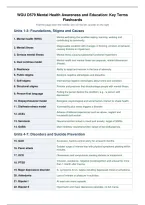
WGU D579 Mental Health Awareness and Education: Key Terms
Flashcards
Fold the page down the middle: term on the left, answer on the right
Units 1-3: Foundations, Stigma and Causes
Mental well-being that enables coping, learning, working and
1. Mental health (WHO)
contributing to community.
Diagnosable condition with changes in thinking, emotion or behavior
2. Mental illness
causing distress or impairment.
3. Serious mental illness Mental illness causing substantial functional impairment.
Mental health and mental illness are separate, related dimensions
4. Dual continua model
(Keyes).
5. Resilience Ability to adapt and recover in the face of adversity.
6. Public stigma Society's negative stereotypes and prejudice.
7. Self-stigma Internalizing negative stereotypes about one's own condition.
8. Structural stigma Policies and practices that disadvantage people with mental illness.
Putting the person before the condition, e.g., 'a person with
9. Person-first language
depression.'
10. Biopsychosocial model Biological, psychological and social factors interact to shape health.
11. Diathesis-stress model Vulnerability plus stress triggers a disorder.
Adverse childhood experiences such as abuse, neglect and
12. ACEs
household dysfunction.
13. Serotonin Neurotransmitter linked to mood and anxiety; target of SSRIs.
14. GABA Main inhibitory neurotransmitter; target of benzodiazepines.
Units 4-7: Disorders and Suicide Prevention
15. GAD Excessive, hard-to-control worry for at least 6 months.
Sudden surge of intense fear with physical symptoms peaking within
16. Panic attack
minutes.
17. OCD Obsessions and compulsions causing distress or impairment.
Intrusion, avoidance, negative mood/cognition and arousal for more
18. PTSD
than 1 month after trauma.
19. Major depressive disorder 5+ symptoms for 2+ weeks including depressed mood or anhedonia.
20. Anhedonia Loss of interest or pleasure in activities.
21. Bipolar I At least one manic episode.
22. Bipolar II Hypomanic and major depressive episodes, no full mania.
Flashcards
Fold the page down the middle: term on the left, answer on the right
Units 1-3: Foundations, Stigma and Causes
Mental well-being that enables coping, learning, working and
1. Mental health (WHO)
contributing to community.
Diagnosable condition with changes in thinking, emotion or behavior
2. Mental illness
causing distress or impairment.
3. Serious mental illness Mental illness causing substantial functional impairment.
Mental health and mental illness are separate, related dimensions
4. Dual continua model
(Keyes).
5. Resilience Ability to adapt and recover in the face of adversity.
6. Public stigma Society's negative stereotypes and prejudice.
7. Self-stigma Internalizing negative stereotypes about one's own condition.
8. Structural stigma Policies and practices that disadvantage people with mental illness.
Putting the person before the condition, e.g., 'a person with
9. Person-first language
depression.'
10. Biopsychosocial model Biological, psychological and social factors interact to shape health.
11. Diathesis-stress model Vulnerability plus stress triggers a disorder.
Adverse childhood experiences such as abuse, neglect and
12. ACEs
household dysfunction.
13. Serotonin Neurotransmitter linked to mood and anxiety; target of SSRIs.
14. GABA Main inhibitory neurotransmitter; target of benzodiazepines.
Units 4-7: Disorders and Suicide Prevention
15. GAD Excessive, hard-to-control worry for at least 6 months.
Sudden surge of intense fear with physical symptoms peaking within
16. Panic attack
minutes.
17. OCD Obsessions and compulsions causing distress or impairment.
Intrusion, avoidance, negative mood/cognition and arousal for more
18. PTSD
than 1 month after trauma.
19. Major depressive disorder 5+ symptoms for 2+ weeks including depressed mood or anhedonia.
20. Anhedonia Loss of interest or pleasure in activities.
21. Bipolar I At least one manic episode.
22. Bipolar II Hypomanic and major depressive episodes, no full mania.

