
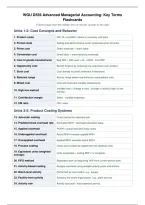
WGU D559 Advanced Managerial Accounting: Key Terms
Flashcards
Fold the page down the middle: term on the left, answer on the right
Units 1-2: Cost Concepts and Behavior
1. Product costs DM, DL and MOH; attach to inventory until sold.
2. Period costs Selling and administrative costs; expensed when incurred.
3. Prime cost Direct materials + direct labor.
4. Conversion cost Direct labor + manufacturing overhead.
5. Cost of goods manufactured Beg WIP + DM used + DL + MOH - End WIP.
6. Opportunity cost Benefit forgone by choosing one alternative over another.
7. Sunk cost Cost already incurred; irrelevant to decisions.
8. Relevant range Activity range where cost behavior assumptions hold.
9. Mixed cost Cost with fixed and variable components.
Variable rate = change in cost / change in activity (high vs low
10. High-low method
activity).
11. Contribution margin Sales - variable expenses.
12. CM ratio CM / sales.
Units 3-5: Product Costing Systems
13. Job-order costing Costs tracked by individual job.
14. Predetermined overhead rate Estimated MOH / estimated allocation base.
15. Applied overhead POHR x actual allocation base used.
16. Underapplied overhead Actual MOH exceeds applied MOH.
17. Overapplied overhead Applied MOH exceeds actual MOH.
18. Process costing Costs accumulated by department for identical units.
19. Equivalent units (weighted
Units completed + ending WIP x % complete.
average)
20. FIFO method Separates work on beginning WIP from current-period work.
21. Activity-based costing Assigns overhead using multiple activity pools and drivers.
22. Batch-level activity Performed for each batch, e.g., setups.
23. Facility-level activity Sustains the whole organization, e.g., plant security.
24. Activity rate Activity cost pool / total expected activity.
Flashcards
Fold the page down the middle: term on the left, answer on the right
Units 1-2: Cost Concepts and Behavior
1. Product costs DM, DL and MOH; attach to inventory until sold.
2. Period costs Selling and administrative costs; expensed when incurred.
3. Prime cost Direct materials + direct labor.
4. Conversion cost Direct labor + manufacturing overhead.
5. Cost of goods manufactured Beg WIP + DM used + DL + MOH - End WIP.
6. Opportunity cost Benefit forgone by choosing one alternative over another.
7. Sunk cost Cost already incurred; irrelevant to decisions.
8. Relevant range Activity range where cost behavior assumptions hold.
9. Mixed cost Cost with fixed and variable components.
Variable rate = change in cost / change in activity (high vs low
10. High-low method
activity).
11. Contribution margin Sales - variable expenses.
12. CM ratio CM / sales.
Units 3-5: Product Costing Systems
13. Job-order costing Costs tracked by individual job.
14. Predetermined overhead rate Estimated MOH / estimated allocation base.
15. Applied overhead POHR x actual allocation base used.
16. Underapplied overhead Actual MOH exceeds applied MOH.
17. Overapplied overhead Applied MOH exceeds actual MOH.
18. Process costing Costs accumulated by department for identical units.
19. Equivalent units (weighted
Units completed + ending WIP x % complete.
average)
20. FIFO method Separates work on beginning WIP from current-period work.
21. Activity-based costing Assigns overhead using multiple activity pools and drivers.
22. Batch-level activity Performed for each batch, e.g., setups.
23. Facility-level activity Sustains the whole organization, e.g., plant security.
24. Activity rate Activity cost pool / total expected activity.

