
[STUDY GUIDE] • HIGH-YIELD PRACTICE & REVIEW EDITION
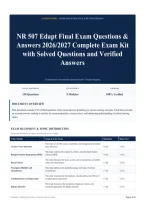
NR 507 Edapt Final Exam Questions &
Answers 2026/2027 Complete Exam Kit
with Solved Questions and Verified
Answers
Comprehensive Examination Question Bank • Concept Mapping
TOTAL QUESTIONS EXAM TOPICS ANSWERS
138 Questions 8 Modules 100% Verified
DOCUMENT OVERVIEW
This document contains 138 verified questions with correct answers pertaining to various nursing concepts. Each item provides
an accurate answer, making it suitable for exam preparation, course review, and enhancing understanding of critical nursing
topics.
EXAM BLUEPRINT & TOPIC DISTRIBUTION
Systematic breakdown of subject domains and exam coverage.
Topic Module Scope & Core Focus Questions Share (%)
This topic covers the causes, symptoms, and management of urinary
Urinary Tract Infections tract infections. 18 Qs 13.0%
This topic explores the symptoms, effects, and treatment options
Benign Prostatic Hyperplasia (BPH) related to BPH. 18 Qs 13.0%
This topic discusses the types, causes, and complications associated
Renal Failure with acute renal failure. 17 Qs 12.3%
Neurogenic Bladder and This topic addresses the pathophysiology and types of urinary
Incontinence incontinence. 17 Qs 12.3%
This topic examines the mechanisms, classifications, and effects of
Antidepressants and Depression antidepressant medications. 17 Qs 12.3%
This topic focuses on the symptoms, diagnostic criteria, and
Bipolar Disorder treatment approaches for bipolar disorder. 17 Qs 12.3%
Confidential • Student Study Edition • Practice & Review Guide Page 1 of 31
,STUDENT STUDY & MASTERY EDITION PRACTICE & REVIEW GUIDE
This topic discusses the characteristics, symptoms, and treatment of
Generalized Anxiety Disorder generalized anxiety disorder. 17 Qs 12.3%
This topic covers the symptoms, phases, and cognitive aspects of
Schizophrenia schizophrenia. 17 Qs 12.3%
Total Exam Coverage 8 Integrated Topic Modules 138 Qs 100.0%
TOPIC 1: URINARY TRACT INFECTIONS
18 Questions • 13.0% of Exam • This topic covers the causes, symptoms, and management of urinary tract infections.
QUESTION 1
Which of the following is true regarding a complicated urinary tract infection?
Answer: Can be caused by a structural urinary tract disorder.
QUESTION 2
Which of the following is a risk factor for the development of a urinary tract infection (UTI)?
Answer: Pregnancy.
QUESTION 3
Women are at a higher risk for the development of a UTI because of having a shorter urethra.
Answer: True.
QUESTION 4
Uncomplicated UTI
Answer: Occurs in the normal urinary tract
Responds well to short course of antibiotic therapy Simple cystitis in non-pregnant women without any urologic
abnormalities.
Confidential • Student Study Edition • Practice & Review Guide Page 2 of 31
,STUDENT STUDY & MASTERY EDITION PRACTICE & REVIEW GUIDE
QUESTION 5
Complicated UTI
Answer: UTI extends beyond the bladder
Caused by structural or functional urinary tract abnormalities or untreated UTI Infants and older adults affected
Associated with: indwelling catheters, renal calculi, diabetes, pregnancy.
QUESTION 6
The urinalysis of a patient with a complicated UTI will show WBCs and casts
Answer: True.
QUESTION 7
A 21-year-old patient reports to the primary care clinic complaining of urinary urgency,
frequency and burning.
She also reports a small amount of vaginal discharge that contains an odor. It is likely that the NP
will perform a vaginal exam at this visit.
Answer: True.
QUESTION 8
The NP would know that the patient most likely has an uncomplicated UTI because:
Answer: The UTI responds well to a short course of antibiotic therapy.
QUESTION 9
The patient most often develops symptoms of BPH when:
Answer: The prostatic urethra becomes obstructed.
Confidential • Student Study Edition • Practice & Review Guide Page 3 of 31
, STUDENT STUDY & MASTERY EDITION PRACTICE & REVIEW GUIDE
QUESTION 10
The action of a 5-Alpha-reductase inhibitor causes:
Answer: Shrinkage of the prostate gland.
QUESTION 11
The type of stone that forms due to a urinary tract infection is:
Answer: Struvite stone.
QUESTION 12
One of the first pathophysiological responses to the decreased GFR in acute renal failure is:
Answer: Activation of the renin-angiotensin-aldosterone system.
QUESTION 13
The anemia seen in renal failure is due to the lack or iron.
Answer: False (Anemia occurs because there is a reduced production of erythropoietin which is responsible for triggering
the production of RBCs rather than the lack of iron or a decrease in the RBCs)
QUESTION 14
Dysthymia is a persistent depressive disorder used to describe milder symptoms of depression
that happen over longer periods of time.
Answer: True.
QUESTION 15
Selective Serotonin Reuptake Inhibitors (SSRIs) block the reabsorption or inhibits the reuptake
of serotonin that allows for more of it in the synaptic cleft.
Answer: True.
Confidential • Student Study Edition • Practice & Review Guide Page 4 of 31
NR 507 Edapt Final Exam Questions &
Answers 2026/2027 Complete Exam Kit
with Solved Questions and Verified
Answers
Comprehensive Examination Question Bank • Concept Mapping
TOTAL QUESTIONS EXAM TOPICS ANSWERS
138 Questions 8 Modules 100% Verified
DOCUMENT OVERVIEW
This document contains 138 verified questions with correct answers pertaining to various nursing concepts. Each item provides
an accurate answer, making it suitable for exam preparation, course review, and enhancing understanding of critical nursing
topics.
EXAM BLUEPRINT & TOPIC DISTRIBUTION
Systematic breakdown of subject domains and exam coverage.
Topic Module Scope & Core Focus Questions Share (%)
This topic covers the causes, symptoms, and management of urinary
Urinary Tract Infections tract infections. 18 Qs 13.0%
This topic explores the symptoms, effects, and treatment options
Benign Prostatic Hyperplasia (BPH) related to BPH. 18 Qs 13.0%
This topic discusses the types, causes, and complications associated
Renal Failure with acute renal failure. 17 Qs 12.3%
Neurogenic Bladder and This topic addresses the pathophysiology and types of urinary
Incontinence incontinence. 17 Qs 12.3%
This topic examines the mechanisms, classifications, and effects of
Antidepressants and Depression antidepressant medications. 17 Qs 12.3%
This topic focuses on the symptoms, diagnostic criteria, and
Bipolar Disorder treatment approaches for bipolar disorder. 17 Qs 12.3%
Confidential • Student Study Edition • Practice & Review Guide Page 1 of 31
,STUDENT STUDY & MASTERY EDITION PRACTICE & REVIEW GUIDE
This topic discusses the characteristics, symptoms, and treatment of
Generalized Anxiety Disorder generalized anxiety disorder. 17 Qs 12.3%
This topic covers the symptoms, phases, and cognitive aspects of
Schizophrenia schizophrenia. 17 Qs 12.3%
Total Exam Coverage 8 Integrated Topic Modules 138 Qs 100.0%
TOPIC 1: URINARY TRACT INFECTIONS
18 Questions • 13.0% of Exam • This topic covers the causes, symptoms, and management of urinary tract infections.
QUESTION 1
Which of the following is true regarding a complicated urinary tract infection?
Answer: Can be caused by a structural urinary tract disorder.
QUESTION 2
Which of the following is a risk factor for the development of a urinary tract infection (UTI)?
Answer: Pregnancy.
QUESTION 3
Women are at a higher risk for the development of a UTI because of having a shorter urethra.
Answer: True.
QUESTION 4
Uncomplicated UTI
Answer: Occurs in the normal urinary tract
Responds well to short course of antibiotic therapy Simple cystitis in non-pregnant women without any urologic
abnormalities.
Confidential • Student Study Edition • Practice & Review Guide Page 2 of 31
,STUDENT STUDY & MASTERY EDITION PRACTICE & REVIEW GUIDE
QUESTION 5
Complicated UTI
Answer: UTI extends beyond the bladder
Caused by structural or functional urinary tract abnormalities or untreated UTI Infants and older adults affected
Associated with: indwelling catheters, renal calculi, diabetes, pregnancy.
QUESTION 6
The urinalysis of a patient with a complicated UTI will show WBCs and casts
Answer: True.
QUESTION 7
A 21-year-old patient reports to the primary care clinic complaining of urinary urgency,
frequency and burning.
She also reports a small amount of vaginal discharge that contains an odor. It is likely that the NP
will perform a vaginal exam at this visit.
Answer: True.
QUESTION 8
The NP would know that the patient most likely has an uncomplicated UTI because:
Answer: The UTI responds well to a short course of antibiotic therapy.
QUESTION 9
The patient most often develops symptoms of BPH when:
Answer: The prostatic urethra becomes obstructed.
Confidential • Student Study Edition • Practice & Review Guide Page 3 of 31
, STUDENT STUDY & MASTERY EDITION PRACTICE & REVIEW GUIDE
QUESTION 10
The action of a 5-Alpha-reductase inhibitor causes:
Answer: Shrinkage of the prostate gland.
QUESTION 11
The type of stone that forms due to a urinary tract infection is:
Answer: Struvite stone.
QUESTION 12
One of the first pathophysiological responses to the decreased GFR in acute renal failure is:
Answer: Activation of the renin-angiotensin-aldosterone system.
QUESTION 13
The anemia seen in renal failure is due to the lack or iron.
Answer: False (Anemia occurs because there is a reduced production of erythropoietin which is responsible for triggering
the production of RBCs rather than the lack of iron or a decrease in the RBCs)
QUESTION 14
Dysthymia is a persistent depressive disorder used to describe milder symptoms of depression
that happen over longer periods of time.
Answer: True.
QUESTION 15
Selective Serotonin Reuptake Inhibitors (SSRIs) block the reabsorption or inhibits the reuptake
of serotonin that allows for more of it in the synaptic cleft.
Answer: True.
Confidential • Student Study Edition • Practice & Review Guide Page 4 of 31

