[STUDY GUIDE] • HIGH-YIELD PRACTICE & REVIEW EDITION
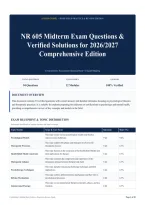
NR 605 Midterm Exam Questions &
Verified Solutions for 2026/2027
Comprehensive Edition
Comprehensive Examination Question Bank • Concept Mapping
TOTAL QUESTIONS EXAM TOPICS ANSWERS
94 Questions 12 Modules 100% Verified
DOCUMENT OVERVIEW
This document contains 94 verified questions with correct answers and detailed rationales focusing on psychological theories
and therapeutic practices. It is suitable for students preparing for midterms or certifications in psychology and mental health,
providing a comprehensive review of key concepts and models in the field.
EXAM BLUEPRINT & TOPIC DISTRIBUTION
Systematic breakdown of subject domains and exam coverage.
Topic Module Scope & Core Focus Questions Share (%)
This topic covers various psychological models and theories
Psychological Models relevant to psychotherapy. 9 Qs 9.6%
This topic explores the phases and strategies involved in the
Therapeutic Processes therapeutic process. 8 Qs 8.5%
This topic focuses on the constructs of the Health Belief Model and
Health Belief Model Constructs their implications for therapy. 8 Qs 8.5%
This topic examines the components and importance of the
Therapeutic Alliance therapeutic alliance between therapist and client. 8 Qs 8.5%
This topic includes various psychotherapy techniques and their
Psychotherapy Techniques applications. 8 Qs 8.5%
This topic outlines different defense mechanisms and their role in
Defense Mechanisms psychological processes. 8 Qs 8.5%
This topic covers interpersonal therapy's principles, phases, and key
Interpersonal Therapy founders. 8 Qs 8.5%
Confidential • Student Study Edition • Practice & Review Guide Page 1 of 30
,STUDENT STUDY & MASTERY EDITION PRACTICE & REVIEW GUIDE
This topic addresses the billing codes related to psychotherapy and
Psychotherapy Billing Codes their significance. 8 Qs 8.5%
This topic discusses resilience and coping strategies in the context
Coping Mechanisms and Resilience of therapy. 8 Qs 8.5%
This topic elaborates on the distinct phases of psychotherapy and
Psychotherapy Phases their objectives. 7 Qs 7.4%
This topic addresses the legal and ethical implications of
Legal and Ethical Considerations psychological practice. 7 Qs 7.4%
Countertransference and This topic explores the concepts of countertransference and
Transference transference in therapy. 7 Qs 7.4%
Total Exam Coverage 12 Integrated Topic Modules 94 Qs 100.0%
TOPIC 1: PSYCHOLOGICAL MODELS
9 Questions • 9.6% of Exam • This topic covers various psychological models and theories relevant to psychotherapy.
QUESTION 1
Explain the difference between the Biomedical model and the Holistic Model
Answer: The Holistic approach is truly the pillar of all recovery care models. This approach ensures that the patient is
treated through
healing. In contrast, in a holistic model, symptoms are seen as a form of communication and are useful for understanding
the meaning of the dysregulation and disharmony that are occurring for this person at a given time.
Holistic therapy respects the complexity of each unique individual, appreciating the relationship between the client's
mind, body, and spirit and recognizing the interdependence of all parts of the human system.
Biomedical's goal is to cure with symptom relief treatment. Medications but it does not give way to view the patient as an
individual with different causations of their symptoms. They just decide to treat the symptoms. Symptoms are often
thought to be the cause of the patient's problem.
QUESTION 2
What are the main goals of psychotherapy?
Answer: Some of the goals of psychotherapy include the reduction of symptoms, improvement of functioning, relapse
prevention, increased empowerment, and achievement of the specific collaborative goals set with the patient.
Confidential • Student Study Edition • Practice & Review Guide Page 2 of 30
, STUDENT STUDY & MASTERY EDITION PRACTICE & REVIEW GUIDE
QUESTION 3
Lets talk about Maslow Hiearchy of needs:
Answer: Maslow states that before higher level needs can be established,, lower level needs have to achieved. For
Example:
Physiological needs- air, food, water, shelter, clothing, sleep
Safety- security of body, employment, morality of family, health, property Love/Belonging- friendship, family, intimacy,
connection with others
Esteem- self esteem, respect, achievement, confidence Self-actualization- morality, creativity, spontaneity, lack of
prejudice, acceptance of facts.
QUESTION 4
What is the treatment hierarchy model for a therapist?
Answer: This is a similar model to Maslows. This model aids the therapist with assessing and drawing up a treatment
plan. So it says that whatever need is not met, it is best to aid the patient with such and then move forward. This model is
not in stone and a patient can progress and regress as such.
QUESTION 5
What theorist is the father of the psychoanalytic psychotherapy? Explain his theory
Answer: Sigman Freud
Freud identified three levels of awareness: the preconscious, the conscious, and the unconscious. His theory postulates that
all actions are based on unconscious sexual or aggressive drives. Psychological symptoms result from conflicts between
three parts of the mind: the id, ego, and superego.
QUESTION 6
Lets go through Erikson's developmental stages
Answer: 1.) Trust vs. Mistrust- Infancy-Hope
2.) Autonomy vs. Shame & Doubt- Early Childhood- Will 3.) Initiative vs. Guilt- 3-6 y.o- Purpose (encouragment) 4.)
Industry vs. Inferiority- 7-11 y.o, Competence 5.) Identity vs. Role Confusion- 12-18- Fidelity 6.) Intimacy vs. Isolation-
19-29- Love 7.) Generativity vs Stagnation- 30-64 years old-Care 8.) Integrity vs. Despair- 65+- wisdom.
Confidential • Student Study Edition • Practice & Review Guide Page 3 of 30