[STUDY GUIDE] • HIGH-YIELD PRACTICE & REVIEW EDITION
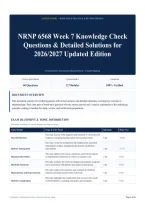
NRNP 6568 Week 7 Knowledge Check
Questions & Detailed Solutions for
2026/2027 Updated Edition
Comprehensive Examination Question Bank • Concept Mapping
TOTAL QUESTIONS EXAM TOPICS ANSWERS
60 Questions 12 Modules 100% Verified
DOCUMENT OVERVIEW
This document contains 60 verified questions with correct answers and detailed rationales covering key concepts in
endocrinology. Each item pairs a board-style question with the correct answer and a concise explanation of the underlying
principle, making it suitable for study, review, and certification preparation.
EXAM BLUEPRINT & TOPIC DISTRIBUTION
Systematic breakdown of subject domains and exam coverage.
Topic Module Scope & Core Focus Questions Share (%)
This topic focuses on the diagnosis and treatment of various thyroid
Thyroid Disorders conditions, including hypothyroidism and hyperthyroidism. 8 Qs 13.3%
This topic covers the management and complications associated
with diabetes mellitus, including insulin therapy and lifestyle
Diabetes Management interventions. 7 Qs 11.7%
This topic addresses the causes, symptoms, and treatment options
Hyperparathyroidism for hyperparathyroidism and its effects on calcium levels. 5 Qs 8.3%
This topic examines the criteria for diagnosing metabolic syndrome
Metabolic Syndrome and its association with diabetes and cardiovascular disease. 5 Qs 8.3%
This topic explores the symptoms and treatment of conditions
Hypocalcemia and Hypercalcemia related to abnormal calcium levels in the body. 5 Qs 8.3%
This topic highlights the complications that can arise from poorly
Diabetic Complications controlled diabetes, including neuropathy and retinopathy. 5 Qs 8.3%
Confidential • Student Study Edition • Practice & Review Guide Page 1 of 26
,STUDENT STUDY & MASTERY EDITION PRACTICE & REVIEW GUIDE
This topic covers the various classes of insulin medications used in
Insulin Medications diabetes treatment and their mechanisms of action. 4 Qs 6.7%
This topic discusses the prognosis and treatment options available
Thyroid Cancer for different types of thyroid cancer. 4 Qs 6.7%
This topic reviews conditions related to adrenal gland function,
Adrenal Disorders including Cushing's syndrome and Addison's disease. 4 Qs 6.7%
This topic focuses on the diagnostic criteria used to identify diabetes
Diagnostic Criteria for Diabetes and its stages. 4 Qs 6.7%
This topic examines the implications of endocrine disorders during
Pregnancy and Endocrine Disorders pregnancy, particularly with diabetes. 4 Qs 6.7%
This topic includes the interpretation of thyroid function tests and
Thyroid Function Tests their clinical significance. 5 Qs 8.3%
Total Exam Coverage 12 Integrated Topic Modules 60 Qs 100.0%
TOPIC 1: THYROID DISORDERS
8 Questions • 13.3% of Exam • This topic focuses on the diagnosis and treatment of various thyroid conditions, including hypothyroidism and
hyperthyroidism.
QUESTION 1
A patient with suspected hypothyroidism is evaluated. What laboratory findings would the NP
expect?
A. Low TSH and high free T4
B. High TSH and low free T4
C. High TSH and high free T4
D. Low TSH and low free T4
Answer: B.
Rationale: Primary hypothyroidism features elevated TSH due to pituitary compensation for low thyroid hormone (low free T4)
production. High TSH with high T4 suggests resistance, low TSH with high T4 indicates hyperthyroidism, and low TSH with low T4
suggests secondary
hypothyroidism. Primary hypothyroidism features elevated TSH due to pituitary compensation for low thyroid hormone (low free T4)
production. High TSH with high T4 suggests resistance, low TSH with high T4 indicates hyperthyroidism, and low TSH with low T4
suggests secondary hypothyroidism.
Confidential • Student Study Edition • Practice & Review Guide Page 2 of 26
, STUDENT STUDY & MASTERY EDITION PRACTICE & REVIEW GUIDE
QUESTION 2
Which symptom is most characteristic of hyperthyroidism?
A. Weight gain and fatigue
B. Heat intolerance and tachycardia
C. Cold intolerance and bradycardia
D. Constipation and dry skin
Answer: B.
Rationale: Hyperthyroidism increases metabolic rate, leading to heat intolerance and sympathetic overactivity (tachycardia).
Hypothyroidism causes the opposite (cold intolerance, bradycardia), while weight gain and dry skin are hypothyroid features.
Hyperthyroidism increases metabolic rate, leading to heat intolerance and sympathetic overactivity (tachycardia). Hypothyroidism
causes the opposite (cold intolerance, bradycardia), while weight gain and dry skin are hypothyroid features.
QUESTION 3
What is a classic sign of Graves' disease, a common cause of hyperthyroidism?
A. Exophthalmos
B. Goiter with tenderness
C. Diffuse alopecia
D. Puffy face
Answer: A.
Rationale: Graves' disease causes pretibial myxedema and exophthalmos due to autoantibodies. Goiter is nontender, alopecia is
hypothyroid, puffy face is myxedema in hypo. Graves' disease causes pretibial myxedema and exophthalmos due to autoantibodies.
Goiter is nontender, alopecia is hypothyroid, puffy face is myxedema in hypo.
Confidential • Student Study Edition • Practice & Review Guide Page 3 of 26