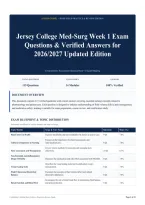
[STUDY GUIDE] • HIGH-YIELD PRACTICE & REVIEW EDITION
Jersey College Med-Surg Week 1 Exam
Questions & Verified Answers for
2026/2027 Updated Edition
Comprehensive Examination Question Bank • Concept Mapping
TOTAL QUESTIONS EXAM TOPICS ANSWERS
115 Questions 14 Modules 100% Verified
DOCUMENT OVERVIEW
This document contains 115 verified questions with correct answers covering essential nursing concepts related to
pharmacology and patient care. Each question is designed to enhance understanding of fluid volume deficit, pain management,
and medication safety, making it suitable for exam preparation, course review, and certification study.
EXAM BLUEPRINT & TOPIC DISTRIBUTION
Systematic breakdown of subject domains and exam coverage.
Topic Module Scope & Core Focus Questions Share (%)
Risk Factors in Health Explores modifiable and non-modifiable risk factors in patient care. 9 Qs 7.8%
Focuses on the importance of cultural assessments and
Cultural Competence in Nursing individualized care. 8 Qs 7.0%
Covers various methods for assessing and managing pain
Pain Assessment and Management effectively. 10 Qs 8.7%
Non-Steroidal Anti-Inflammatory
Drugs (NSAIDs) Discusses the mechanisms and side effects associated with NSAIDs. 8 Qs 7.0%
Describes the visual analog scale and its application in pain
Visual Analog Scale measurement. 8 Qs 7.0%
Fluid Volume and Electrolyte Examines the concepts of fluid volume deficit and related
Balance electrolyte imbalances. 8 Qs 7.0%
Investigates the role of renal blood flow in maintaining fluid balance
Renal Function and Blood Flow and urine production. 8 Qs 7.0%
Confidential • Student Study Edition • Practice & Review Guide Page 1 of 23
,STUDENT STUDY & MASTERY EDITION PRACTICE & REVIEW GUIDE
Highlights the importance of electrolytes and nutrition in patient
Nutritional Considerations health. 8 Qs 7.0%
Medication Administration Focuses on safe medication administration practices and
Guidelines considerations. 8 Qs 7.0%
Clinical Manifestations and Covers the signs and symptoms associated with various medical
Responses conditions. 8 Qs 7.0%
Patient Safety and Quality Emphasizes the importance of patient safety protocols and quality
Improvement care. 8 Qs 7.0%
Explores the physiological mechanisms behind pain and its effects
Pain Physiology on the body. 8 Qs 7.0%
Hormonal Regulation of Fluid and Discusses the role of hormones like aldosterone and antidiuretic
Electrolytes hormone in fluid balance. 8 Qs 7.0%
Focuses on identifying signs and symptoms of dehydration in
Assessment of Dehydration patients. 8 Qs 7.0%
Total Exam Coverage 14 Integrated Topic Modules 115 Qs 100.0%
TOPIC 1: RISK FACTORS IN HEALTH
9 Questions • 7.8% of Exam • Explores modifiable and non-modifiable risk factors in patient care.
QUESTION 1
1 Teach patient about _____________ and ____________ risk factors.
Answer: Modifiable and non modifiable.
QUESTION 2
You should conduct a ____________ assessment prior to initiating health teaching.
Answer: Cultural.
QUESTION 3
The purpose of nursing is to treat the patient ___________ to illness and to use __________
_____________________ to improve out come.
Answer: Response, evidence based practices.
Confidential • Student Study Edition • Practice & Review Guide Page 2 of 23
, STUDENT STUDY & MASTERY EDITION PRACTICE & REVIEW GUIDE
QUESTION 4
Allodynia
Answer: Pain that is associated with a nonnoxious stimulus.
QUESTION 5
________________________________ and_____________________ are the same as addiction
Answer: Physical dependence and tolerance.
QUESTION 6
Magnesium helps with __________________ and ____________________ , affects neuromuscular
function and produces vasodilatlon
Answer: Carbohydrate , protein metabolism.
QUESTION 7
Elevate the head or the bed to _________________ to prevent aspiration in the setting of
_____________________________________________ or tube feedings (unless contraindicated).
Answer: 30-45 Degrees, Mechanical ventilation altered consciousness.
QUESTION 8
Edema could result from an increase in _______________________ or a
_____________________________________
Answer: Hydrostatic pressure, Decrease in oncotic pressure.
QUESTION 9
DSW Is both _____________ and__________________ and should NEVER be used In the
presence of Increased intracranial pressure
Answer: Isotonic and hypotonic.
Confidential • Student Study Edition • Practice & Review Guide Page 3 of 23