[STUDY GUIDE] • HIGH-YIELD PRACTICE & REVIEW EDITION
Jersey College Med Surg Fluid and
Electrolytes Exam Questions & Verified
Answers for 2026/2027 Updated Edition
Comprehensive Examination Question Bank • Concept Mapping
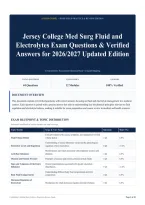
TOTAL QUESTIONS EXAM TOPICS ANSWERS
44 Questions 12 Modules 100% Verified
DOCUMENT OVERVIEW
This document contains 44 verified questions with correct answers focusing on fluid and electrolyte management in a medical
context. Each question is paired with a precise answer that aids in understanding key biochemical principles relevant to fluid
regulation and electrolyte balance, making it suitable for exam preparation and course review in medical and health sciences.
EXAM BLUEPRINT & TOPIC DISTRIBUTION
Systematic breakdown of subject domains and exam coverage.
Topic Module Scope & Core Focus Questions Share (%)
Concepts related to the causes, symptoms, and management of fluid
Fluid Volume Deficit volume deficit. 3 Qs 6.8%
Understanding of normal laboratory values and the physiological
Electrolyte Levels and Regulation regulation of key electrolytes. 6 Qs 13.6%
Manifestations and values associated with respiratory acidosis and
Acid-Base Imbalance alkalosis. 3 Qs 6.8%
Osmosis and Osmotic Pressure Principles of osmosis and osmotic pressure in body fluids. 3 Qs 6.8%
Signs and Symptoms of Electrolyte Clinical manifestations associated with specific electrolyte
Imbalance disturbances. 5 Qs 11.4%
Understanding different body fluid compartments and their
Body Fluid Compartments composition. 3 Qs 6.8%
Hormonal Regulation of
Electrolytes Mechanisms by which hormones regulate electrolyte balance. 3 Qs 6.8%
Confidential • Student Study Edition • Practice & Review Guide Page 1 of 10
, STUDENT STUDY & MASTERY EDITION PRACTICE & REVIEW GUIDE
Fluid Volume Overload and Causes and effects of fluid volume overload and its relation to
Hyponatremia sodium levels. 3 Qs 6.8%
Kidney Functions Role of the kidneys in regulating fluid and electrolyte homeostasis. 3 Qs 6.8%
Urine Characteristics Understanding urine pH and its implications for electrolyte balance. 3 Qs 6.8%
Laboratory Values and
Interpretation Key laboratory values related to fluid and electrolyte management. 6 Qs 13.6%
Management Strategies for Fluid
Balance Approaches to monitoring and managing fluid and electrolyte status. 3 Qs 6.8%
Total Exam Coverage 12 Integrated Topic Modules 44 Qs 100.0%
TOPIC 1: FLUID VOLUME DEFICIT
3 Questions • 6.8% of Exam • Concepts related to the causes, symptoms, and management of fluid volume deficit.
QUESTION 1
Causes of fluid volume deficit
Answer: Fluid loss, vomiting, diarrhea, sweating, GI suctioning, decrease PO intake, burns, ascites, Diabetes, adrenal
insufficiency.
QUESTION 2
Fluid Volume Deficit (FVD)
Answer: Hypovolemia.
QUESTION 3
Fluid volume deficit, or hypovolemia s/sx
Answer: Oliguia, rapid heart rate, vasoconstriction, cool and clammy skin, and muscle weakness.
TOPIC 2: ELECTROLYTE LEVELS AND REGULATION
6 Questions • 13.6% of Exam • Understanding of normal laboratory values and the physiological regulation of key electrolytes.
Confidential • Student Study Edition • Practice & Review Guide Page 2 of 10