
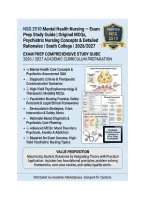
,NSG 2510 Mental Health Nursing — Exam Prep
Study Guide | Original MCQs, Psychiatric
Nursing Concepts & Detailed Rationales |
South College | 2026/2027
Q1. A 24-year-old client is admitted to the psychiatric unit after expressing suicidal ideation
with a specific plan to overdose on prescribed medications. The client's spouse is at the
bedside and asks the nurse what will happen next. Which action should the nurse take first?
A. Ask the spouse to leave the room so the client can rest
B. Initiate suicide precautions and remove all potentially harmful items from the client's room
C. Obtain a signed no-suicide contract from the client
D. Administer a PRN dose of lorazepam for anxiety
Correct Answer: B. Initiate suicide precautions and remove all potentially harmful items from
the client's room
Rationale: When a client expresses suicidal ideation with a specific plan, the priority nursing
action is to ensure immediate safety by initiating suicide precautions and removing all
potentially harmful items from the environment. Option A is incorrect because the spouse
should be involved in safety planning when appropriate and asking them to leave may
increase the client's anxiety. Option C is not appropriate because no-suicide contracts are no
longer recommended as they do not reliably prevent suicide. Option D does not address the
immediate safety risk.
Key Takeaway: Suicidal ideation with a specific plan equals initiate suicide precautions and
remove harmful items first; safety is always the priority.
Q2. A 35-year-old client with major depressive disorder tells the nurse, "I feel like my family
would be better off without me." Which response by the nurse best demonstrates the
therapeutic communication technique of reflecting?
A. Don't say that. Your family loves you very much.
,B. You're feeling like a burden to your family right now. Tell me more about what has brought
this on.
C. Why would you think such a thing about your family?
D. I think we should change the subject and talk about something positive.
Correct Answer: B. You're feeling like a burden to your family right now. Tell me more about
what has brought this on.
Rationale: Reflecting repeats the essential idea of the client's statement, helping the client
identify and explore emotions while validating the experience. Option A offers false
reassurance and minimizes the client's feelings. Option C uses a non-therapeutic "why"
question that promotes defensiveness. Option D changes the topic and ignores the client's
cue, which could indicate suicidal ideation.
Key Takeaway: Reflecting equals mirroring the client's feelings without judgment; this
validates the experience and encourages further exploration.
Q3. A 58-year-old client is admitted with acute mania. The client is pacing, speaking rapidly,
and attempting to reorganize the unit's furniture. Which action should the nurse take first?
A. Offer the client a PRN dose of lithium carbonate
B. Provide a structured, low-stimulation environment and redirect the client to a safe activity
C. Place the client in seclusion until the behavior subsides
D. Ask the client to sit down and participate in a group therapy session
Correct Answer: B. Provide a structured, low-stimulation environment and redirect the client
to a safe activity
Rationale: The priority for a client in acute mania is safety and milieu management. A low-
stimulation environment reduces sensory overload, and redirection to a safe, structured
activity helps channel the client's energy. Option A is not the first action because medications
take time to work and the immediate behavioral crisis must be managed. Option C is a
restrictive intervention that should be used only as a last resort after less restrictive measures
have failed. Option D is inappropriate because the client is unable to participate in group
therapy while acutely manic.
Key Takeaway: Acute mania equals low-stimulation environment plus redirection first; safety
and milieu management take priority.
, Q4. A 28-year-old client is admitted with schizophrenia and is experiencing auditory
hallucinations telling him to hurt himself. The client appears frightened and is pacing in his
room. Which response by the nurse is most therapeutic?
A. Those voices aren't real. You shouldn't listen to them.
B. I know those voices are real to you, but I don't hear them. I'm here to keep you safe.
C. If you hear the voices again, just ignore them and come find me.
D. Why do you think the voices are telling you to hurt yourself?
Correct Answer: B. I know those voices are real to you, but I don't hear them. I'm here to keep
you safe.
Rationale: This response acknowledges the client's experience without reinforcing the
hallucination, presents reality without arguing, and reassures the client of safety. Option A
dismisses the client's experience and can increase anxiety. Option C places the burden on the
client to ignore the voices, which may be impossible during an acute episode. Option D uses a
non-therapeutic "why" question that can increase anxiety and defensiveness.
Key Takeaway: Auditory hallucinations equal acknowledge the experience, present reality
without arguing, and emphasize safety.
Q5. A 42-year-old client with bipolar disorder has been stabilized on lithium carbonate. Which
serum lithium level requires immediate notification of the provider?
A. 0.6 mEq/L
B. 0.9 mEq/L
C. 1.2 mEq/L
D. 1.8 mEq/L
Correct Answer: D. 1.8 mEq/L
Rationale: The therapeutic range for lithium is 0.6 to 1.2 mEq/L. A level of 1.8 mEq/L is above
the therapeutic range and indicates lithium toxicity, which can cause nausea, vomiting,
tremor, ataxia, confusion, and seizures. The nurse should notify the provider immediately.
Options A, B, and C are within the therapeutic range. Lithium toxicity can be life-threatening
and requires immediate intervention.

