
Healthstream – UPDATED Questions with 100% Verified Answers
Healthstream
Study Questions and Answers
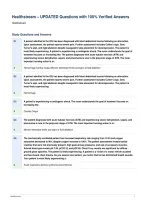
Q1 A patient admitted to the ICU has been diagnosed with blunt abdominal trauma following an altercation.
Upon assessment, the patient reports severe pain. Further assessment includes Cullen's sign, Grey
Turner's sign, and rigid abdomen despite nasogastric tube placement for decompression. The patient is
most likely experiencing: A patient is experiencing a cardiogenic shock. The nurse understands the goal of
treatment focuses on increasing the: The patient diagnosed with acute tubular necrosis (ATN) and
experiencing severe dehydration, sepsis, and pneumonia is now in the polyureic stage of ATN. The most
important nursing action is to:
A Hemorrhage Cardiac Output Monitor electrolyte levels and signs of fluid depletion
Q2 A patient admitted to the ICU has been diagnosed with blunt abdominal trauma following an altercation.
Upon assessment, the patient reports severe pain. Further assessment includes Cullen's sign, Grey
Turner's sign, and rigid abdomen despite nasogastric tube placement for decompression. The patient is
most likely experiencing:
A Hemorrhage
Q3 A patient is experiencing a cardiogenic shock. The nurse understands the goal of treatment focuses on
increasing the:
A Cardiac Output
Q4 The patient diagnosed with acute tubular necrosis (ATN) and experiencing severe dehydration, sepsis, and
pneumonia is now in the polyureic stage of ATN. The most important nursing action is to:
A Monitor electrolyte levels and signs of fluid depletion
Q5 The mechanically ventilated patient has increased respiratory rate ranging from 12-24 and oxygen
saturation decreased to 90% despite oxygen increase to 100%. The patient assessment reveals basilar
crackles that were not previously present, high peak airway pressures, and use of accessory muscles.
Arterial blood gas reveals pH 7.50, pCO2 32, and pO2 49. Chest X-ray results are significant for diffuse
ground glass opacities. The patient is likely experiencing: A patient is a victim of a motor vehicle accident
and has closed chest trauma. As you assess your patient, you notice that he has diminished breath sounds.
Your patient is most likely experiencing a:
A Acute respiratory distress syndrome pneumothorax.
Healthstream 1
, Q6 The mechanically ventilated patient has increased respiratory rate ranging from 12-24 and oxygen
saturation decreased to 90% despite oxygen increase to 100%. The patient assessment reveals basilar
crackles that were not previously present, high peak airway pressures, and use of accessory muscles.
Arterial blood gas reveals pH 7.50, pCO2 32, and pO2 49. Chest X-ray results are significant for diffuse
ground glass opacities. The patient is likely experiencing:
A Acute respiratory distress syndrome
Q7 A patient is a victim of a motor vehicle accident and has closed chest trauma. As you assess your patient,
you notice that he has diminished breath sounds. Your patient is most likely experiencing a:
A pneumothorax.
Q8 Which drug is given first to a patient with pulseless electrical activity (PEA)? What would be the most
effective intervention to be ordered to treat a hemodynamically unstable patient with third-degree heart
block? You are caring for a patient with severe sepsis and third-degree heart block. The patient is
hypotensive. The treatment for this life-threatening rhythm change includes: A patient assessment reveals
distended neck veins, pulsus paradoxus, and decreased systolic pressure. This assessment is most
consistent with:
A Epinephrine Transcutaneous pacing Transcutaneous pacing Cardiac tamponade
Q9 Which drug is given first to a patient with pulseless electrical activity (PEA)?
A Epinephrine
Q10 What would be the most effective intervention to be ordered to treat a hemodynamically unstable patient
with third-degree heart block?
A Transcutaneous pacing
Q11 You are caring for a patient with severe sepsis and third-degree heart block. The patient is hypotensive. The
treatment for this life-threatening rhythm change includes:
A Transcutaneous pacing
Q12 A patient assessment reveals distended neck veins, pulsus paradoxus, and decreased systolic pressure.
This assessment is most consistent with:
A Cardiac tamponade
Q13 A mechanically ventilated patient from the OR is admitted to the ICU following an MVA. The patient
experienced head trauma and blunt trauma to the abdomen. You are assessing this patient and notice that
his heart rate is 130-145 per minute in sinus tachycardia; his CVP is 2. The patient remains hypotensive
despite the use of vasopressors. The patient has a chest tube connected to wall suction and the TAC is
putting out large amounts of bright red blood. You recognize that this patient is most likely experiencing: A
patient has an elevated central venous pressure measurement. The most likely reason is:
Healthstream 2

