
1|P a g e
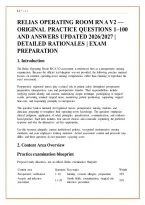
RELIAS OPERATING ROOM RN A V2 —
ORIGINAL PRACTICE QUESTIONS 1–100
AND ANSWERS UPDATED 2026/2027 |
DETAILED RATIONALES | EXAM
PREPARATION
1. Introduction
The Relias Operating Room RN A V2 assessment is referenced here as a perioperative nursing
examination. Because the official test blueprint was not provided, the following practice material
focuses on common operating-room nursing competencies rather than claiming to reproduce the
exact assessment.
Perioperative registered nurses play a critical role in patient safety throughout preoperative
preparation, intraoperative care, and postoperative transfer. Their responsibilities include
verifying patient identity and consent, maintaining aseptic technique, participating in surgical
counts, preventing retained surgical items, monitoring patient positioning, supporting surgical
time-outs, and responding promptly to emergencies.
This question bank is intended for registered nurses, perioperative nursing students, and
clinicians preparing to strengthen their operating-room knowledge. The questions emphasize
clinical judgment, application of safety principles, prioritization, communication, and evidence-
based practice. Each item includes four answer choices and a rationale explaining the preferred
response and why the alternatives are less appropriate.
Use this resource alongside current institutional policies, recognized perioperative nursing
standards, and your employer's training materials. Actual assessment content and protocols may
differ, and these questions do not guarantee a passing score.
2. Content Area Overview
Practice examination blueprint
Proposed study allocation, not an official Relias examination blueprint.
Content area Questions Key topics Weight
Preoperative verification 1–10 Identity, consent, allergies, preparation 10%
Asepsis and infection Sterile fields, contamination, surgical-site
11–20 10%
prevention infection prevention
,2|P a g e
Surgical counts and specimen Counts, discrepancies, labeling, chain of
21–30 10%
management custody
Nerve injury, pressure injury, electrosurgery
Positioning and skin integrity 31–40 10%
safety
Anesthesia and physiological Airway emergencies, hemodynamics,
41–50 10%
monitoring temperature
Hemorrhage, anaphylaxis, malignant
Intraoperative emergencies 51–60 10%
hyperthermia
Surgical workflow and
61–70 Time-out, communication, handoffs 10%
teamwork
Equipment and medication Electrosurgery, medication labeling, device
71–80 10%
safety checks
Recovery and postoperative Handoff, airway, bleeding, pain,
81–90 10%
transfer documentation
Prioritization, risk recognition, patient
Integrated clinical judgment 91–100 10%
advocacy
3. QUESTIONS 1–100
Domain 1: Preoperative Verification and Preparation
Q1: A patient arrives in the operating room for a scheduled right-sided procedure. The consent
form identifies the left side, while the surgeon's schedule identifies the right side. What should
the circulating nurse do?
A) Follow the surgeon's schedule because it is the most recent document.
B) Stop progression toward the procedure and resolve the discrepancy through the approved
verification process before proceeding.
C) Ask the patient to select the side after anesthesia has begun.
D) Proceed with the right side and document the discrepancy afterward.
Rationale: B is correct because conflicting laterality information presents a serious wrong-site
surgery risk. The discrepancy must be resolved before proceeding. A relies on one document
without reconciliation. C delays verification until the patient may be unable to participate
meaningfully. D exposes the patient to preventable harm and treats documentation as a substitute
for verification.
Q2: During preoperative verification, a patient says they took their usual anticoagulant that
morning despite instructions to withhold it. The planned procedure carries substantial bleeding
risk. What is the nurse's priority?
,3|P a g e
A) Tell the patient to stop taking the medication permanently.
B) Continue preparation because the medication was prescribed.
C) Independently administer a reversal agent.
D) Notify the anesthesia and surgical teams, establish the medication details, and ensure the team
reassesses procedural safety.
Rationale: D is correct because anticoagulant exposure may materially affect bleeding risk and
requires assessment by the responsible clinical team. A gives an unauthorized long-term
medication instruction. B ignores a potentially significant risk. C involves an intervention that
requires an appropriate clinical order and assessment.
Q3: A patient scheduled for surgery has a documented severe latex allergy. The operating room's
supply cart contains products whose latex status is unclear. What should the circulating nurse
do?
A) Use the products if the patient has no previous history of intraoperative reactions.
B) Proceed because gloves are the only relevant source of latex.
C) Verify product compatibility and ensure an appropriately prepared latex-safe environment
before exposure.
D) Premedicate the patient and use the available products.
Rationale: C is correct because severe latex allergy requires systematic identification and
avoidance of relevant exposure sources. A mistakes the absence of previous intraoperative
reactions for safety. B overlooks other possible latex-containing products. D does not reliably
prevent a serious allergic reaction and is not a substitute for exposure prevention.
Q4: A patient who received preoperative sedating medication is unable to explain the procedure
or confirm their understanding of consent. The consent form is signed. What should the nurse
do?
A) Treat the signed form as sufficient under all circumstances.
B) Ask a family member to consent automatically.
C) Notify the responsible practitioner and follow policy for assessing consent validity and
decision-making capacity before proceeding.
D) Ask the patient to sign a second form.
, 4|P a g e
Rationale: C is correct because a signature alone does not resolve concerns about whether
informed consent was validly obtained. A ignores the effect of sedation on understanding and
capacity. B assumes family authority without verifying legal status or circumstances. D repeats
the paperwork without addressing the underlying concern.
Q5: During the preoperative assessment, a patient reports that they have not followed the
required fasting instructions. The procedure is scheduled under general anesthesia. What is the
best response?
A) Tell the patient to induce vomiting.
B) Continue because fasting requirements are optional for scheduled procedures.
C) Cancel every procedure automatically without notifying the team.
D) Determine the timing and nature of the intake, inform the anesthesia team, and allow the
responsible clinicians to reassess aspiration risk and timing.
Rationale: D is correct because aspiration risk depends on factors including what was consumed,
when it was consumed, and the patient's clinical circumstances. A is unsafe. B disregards
anesthesia safety. C may be unnecessarily rigid because the appropriate decision depends on
clinical assessment and urgency.
Q6: Immediately before transfer to the operating table, the patient states that the surgeon
described a different procedure from the one listed on the schedule. What should the nurse do?
A) Reassure the patient that the schedule is always correct.
B) Ask the surgeon to explain after induction.
C) Pause the process and arrange clarification with the responsible practitioner while the patient
can participate.
D) Change the procedure name in the chart to match the patient's statement.
Rationale: C is correct because a discrepancy about the intended procedure must be resolved
before proceeding. A dismisses the patient's concern. B postpones clarification until the patient
may be unable to participate. D changes documentation without verification and could create
further error.
Q7: A patient with diabetes is scheduled for surgery and reports taking insulin despite being
instructed to adjust the dose. The current blood glucose is substantially below the patient's usual
range, and the patient is sweating and confused. What is the priority?
A) Begin surgery quickly to reduce fasting time.
RELIAS OPERATING ROOM RN A V2 —
ORIGINAL PRACTICE QUESTIONS 1–100
AND ANSWERS UPDATED 2026/2027 |
DETAILED RATIONALES | EXAM
PREPARATION
1. Introduction
The Relias Operating Room RN A V2 assessment is referenced here as a perioperative nursing
examination. Because the official test blueprint was not provided, the following practice material
focuses on common operating-room nursing competencies rather than claiming to reproduce the
exact assessment.
Perioperative registered nurses play a critical role in patient safety throughout preoperative
preparation, intraoperative care, and postoperative transfer. Their responsibilities include
verifying patient identity and consent, maintaining aseptic technique, participating in surgical
counts, preventing retained surgical items, monitoring patient positioning, supporting surgical
time-outs, and responding promptly to emergencies.
This question bank is intended for registered nurses, perioperative nursing students, and
clinicians preparing to strengthen their operating-room knowledge. The questions emphasize
clinical judgment, application of safety principles, prioritization, communication, and evidence-
based practice. Each item includes four answer choices and a rationale explaining the preferred
response and why the alternatives are less appropriate.
Use this resource alongside current institutional policies, recognized perioperative nursing
standards, and your employer's training materials. Actual assessment content and protocols may
differ, and these questions do not guarantee a passing score.
2. Content Area Overview
Practice examination blueprint
Proposed study allocation, not an official Relias examination blueprint.
Content area Questions Key topics Weight
Preoperative verification 1–10 Identity, consent, allergies, preparation 10%
Asepsis and infection Sterile fields, contamination, surgical-site
11–20 10%
prevention infection prevention
,2|P a g e
Surgical counts and specimen Counts, discrepancies, labeling, chain of
21–30 10%
management custody
Nerve injury, pressure injury, electrosurgery
Positioning and skin integrity 31–40 10%
safety
Anesthesia and physiological Airway emergencies, hemodynamics,
41–50 10%
monitoring temperature
Hemorrhage, anaphylaxis, malignant
Intraoperative emergencies 51–60 10%
hyperthermia
Surgical workflow and
61–70 Time-out, communication, handoffs 10%
teamwork
Equipment and medication Electrosurgery, medication labeling, device
71–80 10%
safety checks
Recovery and postoperative Handoff, airway, bleeding, pain,
81–90 10%
transfer documentation
Prioritization, risk recognition, patient
Integrated clinical judgment 91–100 10%
advocacy
3. QUESTIONS 1–100
Domain 1: Preoperative Verification and Preparation
Q1: A patient arrives in the operating room for a scheduled right-sided procedure. The consent
form identifies the left side, while the surgeon's schedule identifies the right side. What should
the circulating nurse do?
A) Follow the surgeon's schedule because it is the most recent document.
B) Stop progression toward the procedure and resolve the discrepancy through the approved
verification process before proceeding.
C) Ask the patient to select the side after anesthesia has begun.
D) Proceed with the right side and document the discrepancy afterward.
Rationale: B is correct because conflicting laterality information presents a serious wrong-site
surgery risk. The discrepancy must be resolved before proceeding. A relies on one document
without reconciliation. C delays verification until the patient may be unable to participate
meaningfully. D exposes the patient to preventable harm and treats documentation as a substitute
for verification.
Q2: During preoperative verification, a patient says they took their usual anticoagulant that
morning despite instructions to withhold it. The planned procedure carries substantial bleeding
risk. What is the nurse's priority?
,3|P a g e
A) Tell the patient to stop taking the medication permanently.
B) Continue preparation because the medication was prescribed.
C) Independently administer a reversal agent.
D) Notify the anesthesia and surgical teams, establish the medication details, and ensure the team
reassesses procedural safety.
Rationale: D is correct because anticoagulant exposure may materially affect bleeding risk and
requires assessment by the responsible clinical team. A gives an unauthorized long-term
medication instruction. B ignores a potentially significant risk. C involves an intervention that
requires an appropriate clinical order and assessment.
Q3: A patient scheduled for surgery has a documented severe latex allergy. The operating room's
supply cart contains products whose latex status is unclear. What should the circulating nurse
do?
A) Use the products if the patient has no previous history of intraoperative reactions.
B) Proceed because gloves are the only relevant source of latex.
C) Verify product compatibility and ensure an appropriately prepared latex-safe environment
before exposure.
D) Premedicate the patient and use the available products.
Rationale: C is correct because severe latex allergy requires systematic identification and
avoidance of relevant exposure sources. A mistakes the absence of previous intraoperative
reactions for safety. B overlooks other possible latex-containing products. D does not reliably
prevent a serious allergic reaction and is not a substitute for exposure prevention.
Q4: A patient who received preoperative sedating medication is unable to explain the procedure
or confirm their understanding of consent. The consent form is signed. What should the nurse
do?
A) Treat the signed form as sufficient under all circumstances.
B) Ask a family member to consent automatically.
C) Notify the responsible practitioner and follow policy for assessing consent validity and
decision-making capacity before proceeding.
D) Ask the patient to sign a second form.
, 4|P a g e
Rationale: C is correct because a signature alone does not resolve concerns about whether
informed consent was validly obtained. A ignores the effect of sedation on understanding and
capacity. B assumes family authority without verifying legal status or circumstances. D repeats
the paperwork without addressing the underlying concern.
Q5: During the preoperative assessment, a patient reports that they have not followed the
required fasting instructions. The procedure is scheduled under general anesthesia. What is the
best response?
A) Tell the patient to induce vomiting.
B) Continue because fasting requirements are optional for scheduled procedures.
C) Cancel every procedure automatically without notifying the team.
D) Determine the timing and nature of the intake, inform the anesthesia team, and allow the
responsible clinicians to reassess aspiration risk and timing.
Rationale: D is correct because aspiration risk depends on factors including what was consumed,
when it was consumed, and the patient's clinical circumstances. A is unsafe. B disregards
anesthesia safety. C may be unnecessarily rigid because the appropriate decision depends on
clinical assessment and urgency.
Q6: Immediately before transfer to the operating table, the patient states that the surgeon
described a different procedure from the one listed on the schedule. What should the nurse do?
A) Reassure the patient that the schedule is always correct.
B) Ask the surgeon to explain after induction.
C) Pause the process and arrange clarification with the responsible practitioner while the patient
can participate.
D) Change the procedure name in the chart to match the patient's statement.
Rationale: C is correct because a discrepancy about the intended procedure must be resolved
before proceeding. A dismisses the patient's concern. B postpones clarification until the patient
may be unable to participate. D changes documentation without verification and could create
further error.
Q7: A patient with diabetes is scheduled for surgery and reports taking insulin despite being
instructed to adjust the dose. The current blood glucose is substantially below the patient's usual
range, and the patient is sweating and confused. What is the priority?
A) Begin surgery quickly to reduce fasting time.

