
BIO 155 LAB PRACTICAL STUDY GUIDE EXPECTED
QUESTIONS WITH VERIFIED ANSWERS
Question 1.
Describe the process of spectrophotometry
ANSWER
scientists determine the presence and concentration of dissolved chemicals in solutions using
spectrophotometry; a technique based on the principle that each atom, molecule, or chemical
bond absorbs a unique pattern of wavelengths of light;
Question 2.
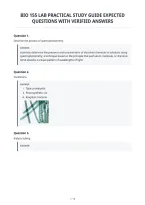
Oscillatoria
ANSWER
i. Type: prokaryotic
ii. Photosynthetic: no
iii. Kingdom: bacteria
Question 3.
dialysis tubing
ANSWER
,Question 4.
low power (10x) lens
ANSWER
Question 5.
Compare and contrast competitive and non-competitive enzyme inhibitors
ANSWER
Competitive Enzyme Inhibitors- when a molecule that is structurally similar to the substrate for
a particular reaction competes for a position at the active site on the enzyme; Non-competitive-
binds to a site that is not the active site, changing the nature of the enzyme so that its catalytic
properties are lost in two ways, physically blocks the access to the active site or conformational
change in the protein.
Question 6.
Phenylthiourea
ANSWER
specific inhibitor used in the experiment, PTU is known to combine with the copper in catechol
oxidase and inhibit its enzymatic activity.
Question 7.
coarse adjustment knob
ANSWER
produces relatively large changes in working distance and can be used with both the scanning
and low power objective lenses
, Question 8.
Paramecium
ANSWER
i. Type: eukaryotic
ii. Photosynthetic: no
iii. Kingdom: protista
Question 9.
total magnification
ANSWER
multiplying the objective lens magnification by the ocular lens magnification

