
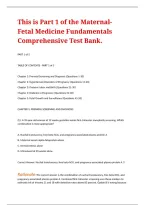
This is Part 1 of the Maternal-
Fetal Medicine Fundamentals
Comprehensive Test Bank.
PART 1 of 5
TABLE OF CONTENTS - PART 1 of 5
Chapter 1: Prenatal Screening and Diagnosis (Questions 1-10)
Chapter 2: Hypertensive Disorders of Pregnancy (Questions 11-20)
Chapter 3: Preterm Labor and Birth (Questions 21-30)
Chapter 4: Diabetes in Pregnancy (Questions 31-40)
Chapter 5: Fetal Growth and Surveillance (Questions 41-50)
CHAPTER 1: PRENATAL SCREENING AND DIAGNOSIS
Q1. A 32-year-old woman at 12 weeks gestation wants first-trimester aneuploidy screening. Which
combination is most appropriate?
A. Nuchal translucency, free beta-hCG, and pregnancy-associated plasma protein A
B. Maternal serum alpha-fetoprotein alone
C. Amniocentesis alone
D. Ultrasound at 20 weeks alone
Correct Answer: Nuchal translucency, free beta-hCG, and pregnancy-associated plasma protein A ✅
Rationale: The correct answer is the combination of nuchal translucency, free beta-hCG, and
pregnancy-associated plasma protein A. Combined first-trimester screening uses these markers to
estimate risk of trisomy 21 and 18 with detection rates above 85 percent. Option B is wrong because
,alpha-fetoprotein is a second-trimester marker for neural tube defects and does not provide first-
trimester aneuploidy risk. Option C is wrong because amniocentesis is diagnostic, not screening, and
carries procedure-related risk. Option D is wrong because a 20-week scan is too late for first-
trimester screening. The governing concept is that first-trimester combined screening provides early
risk stratification and guides decisions about diagnostic testing.
Q2. A 36-year-old woman has a cell-free DNA test showing high risk for trisomy 21. Which next step
is most appropriate?
A. Diagnostic testing with chorionic villus sampling or amniocentesis
B. Repeat cell-free DNA testing
C. No further testing
D. Ultrasound at 20 weeks only
Correct Answer: Diagnostic testing with chorionic villus sampling or amniocentesis ✅
Rationale: The correct answer is diagnostic testing with chorionic villus sampling or
amniocentesis. Cell-free DNA is a screening test, and a high-risk result requires confirmatory
diagnostic testing by karyotype or chromosomal microarray. Option B is wrong because repeating the
same screening test does not confirm the diagnosis. Option C is wrong because confirmatory testing
is needed before irreversible decisions. Option D is wrong because ultrasound alone cannot diagnose
aneuploidy. The governing concept is that screening tests estimate risk while diagnostic tests
establish the diagnosis.
Q3. A 28-year-old woman has a maternal serum alpha-fetoprotein level above the 2.5 multiples of
the median. Which condition is most important to exclude?
A. Neural tube defect
B. Down syndrome
C. Turner syndrome
D. Cystic fibrosis
Correct Answer: Neural tube defect ✅
,Rationale: The correct answer is neural tube defect. Elevated maternal serum alpha-
fetoprotein in the second trimester is associated with open neural tube defects and requires targeted
ultrasound and possible amniotic fluid acetylcholinesterase testing. Option B is wrong because Down
syndrome typically lowers alpha-fetoprotein. Option C is wrong because Turner syndrome does not
cause elevated alpha-fetoprotein. Option D is wrong because cystic fibrosis is not associated with
alpha-fetoprotein elevation. The governing concept is that alpha-fetoprotein screening identifies
open fetal defects.
Q4. A 30-year-old woman is at 18 weeks gestation and asks about amniocentesis. Which risk is most
important to discuss?
A. Procedure-related pregnancy loss
B. Maternal hypertension
C. Gestational diabetes
D. Preterm labor only
Correct Answer: Procedure-related pregnancy loss ✅
Rationale: The correct answer is procedure-related pregnancy loss. Amniocentesis carries a
small risk of pregnancy loss, currently estimated at approximately 1 in 500 to 1 in 1000 procedures in
experienced hands. Option B is wrong because hypertension is not a recognized complication of
amniocentesis. Option C is wrong because gestational diabetes is unrelated to the procedure. Option
D is wrong because preterm labor is less common than pregnancy loss as a procedure complication.
The governing concept is that invasive diagnostic testing requires informed consent regarding
procedure-related risks.
Q5. A 34-year-old woman is at 11 weeks gestation and requests chorionic villus sampling. Which
advantage is most important?
A. Earlier diagnosis than amniocentesis
B. Lower procedure-related loss than amniocentesis
C. No risk of limb defects
D. No need for confirmatory testing
Correct Answer: Earlier diagnosis than amniocentesis ✅
, Rationale: The correct answer is earlier diagnosis than amniocentesis. Chorionic villus
sampling can be performed at 10 to 13 weeks, providing earlier results than amniocentesis. Option B
is wrong because procedure-related loss rates are similar or slightly higher than amniocentesis.
Option C is wrong because chorionic villus sampling performed before 10 weeks is associated with
limb defects. Option D is wrong because placental mosaicism may require confirmatory
amniocentesis. The governing concept is that chorionic villus sampling offers earlier diagnosis with
specific limitations.
Q6. A 29-year-old woman has a fetal ultrasound showing increased nuchal translucency. Which
condition is most important to exclude?
A. Aneuploidy and congenital heart disease
B. Neural tube defect
C. Cystic fibrosis
D. Sickle cell disease
Correct Answer: Aneuploidy and congenital heart disease ✅
Rationale: The correct answer is aneuploidy and congenital heart disease. Increased nuchal
translucency is associated with trisomies, other chromosomal abnormalities, and structural
anomalies including congenital heart disease. Option B is wrong because neural tube defects are not
associated with increased nuchal translucency. Option C is wrong because cystic fibrosis is not
associated with nuchal translucency. Option D is wrong because sickle cell disease is not associated
with nuchal translucency. The governing concept is that increased nuchal translucency is a marker
requiring comprehensive evaluation.
Q7. A 31-year-old woman has a fetal ultrasound showing echogenic intracardiac focus. Which
interpretation is most appropriate?
A. Soft marker that may increase aneuploidy risk when combined with other findings
B. Definitive diagnosis of aneuploidy
C. Normal variant with no significance
D. Indication for immediate delivery
Fetal Medicine Fundamentals
Comprehensive Test Bank.
PART 1 of 5
TABLE OF CONTENTS - PART 1 of 5
Chapter 1: Prenatal Screening and Diagnosis (Questions 1-10)
Chapter 2: Hypertensive Disorders of Pregnancy (Questions 11-20)
Chapter 3: Preterm Labor and Birth (Questions 21-30)
Chapter 4: Diabetes in Pregnancy (Questions 31-40)
Chapter 5: Fetal Growth and Surveillance (Questions 41-50)
CHAPTER 1: PRENATAL SCREENING AND DIAGNOSIS
Q1. A 32-year-old woman at 12 weeks gestation wants first-trimester aneuploidy screening. Which
combination is most appropriate?
A. Nuchal translucency, free beta-hCG, and pregnancy-associated plasma protein A
B. Maternal serum alpha-fetoprotein alone
C. Amniocentesis alone
D. Ultrasound at 20 weeks alone
Correct Answer: Nuchal translucency, free beta-hCG, and pregnancy-associated plasma protein A ✅
Rationale: The correct answer is the combination of nuchal translucency, free beta-hCG, and
pregnancy-associated plasma protein A. Combined first-trimester screening uses these markers to
estimate risk of trisomy 21 and 18 with detection rates above 85 percent. Option B is wrong because
,alpha-fetoprotein is a second-trimester marker for neural tube defects and does not provide first-
trimester aneuploidy risk. Option C is wrong because amniocentesis is diagnostic, not screening, and
carries procedure-related risk. Option D is wrong because a 20-week scan is too late for first-
trimester screening. The governing concept is that first-trimester combined screening provides early
risk stratification and guides decisions about diagnostic testing.
Q2. A 36-year-old woman has a cell-free DNA test showing high risk for trisomy 21. Which next step
is most appropriate?
A. Diagnostic testing with chorionic villus sampling or amniocentesis
B. Repeat cell-free DNA testing
C. No further testing
D. Ultrasound at 20 weeks only
Correct Answer: Diagnostic testing with chorionic villus sampling or amniocentesis ✅
Rationale: The correct answer is diagnostic testing with chorionic villus sampling or
amniocentesis. Cell-free DNA is a screening test, and a high-risk result requires confirmatory
diagnostic testing by karyotype or chromosomal microarray. Option B is wrong because repeating the
same screening test does not confirm the diagnosis. Option C is wrong because confirmatory testing
is needed before irreversible decisions. Option D is wrong because ultrasound alone cannot diagnose
aneuploidy. The governing concept is that screening tests estimate risk while diagnostic tests
establish the diagnosis.
Q3. A 28-year-old woman has a maternal serum alpha-fetoprotein level above the 2.5 multiples of
the median. Which condition is most important to exclude?
A. Neural tube defect
B. Down syndrome
C. Turner syndrome
D. Cystic fibrosis
Correct Answer: Neural tube defect ✅
,Rationale: The correct answer is neural tube defect. Elevated maternal serum alpha-
fetoprotein in the second trimester is associated with open neural tube defects and requires targeted
ultrasound and possible amniotic fluid acetylcholinesterase testing. Option B is wrong because Down
syndrome typically lowers alpha-fetoprotein. Option C is wrong because Turner syndrome does not
cause elevated alpha-fetoprotein. Option D is wrong because cystic fibrosis is not associated with
alpha-fetoprotein elevation. The governing concept is that alpha-fetoprotein screening identifies
open fetal defects.
Q4. A 30-year-old woman is at 18 weeks gestation and asks about amniocentesis. Which risk is most
important to discuss?
A. Procedure-related pregnancy loss
B. Maternal hypertension
C. Gestational diabetes
D. Preterm labor only
Correct Answer: Procedure-related pregnancy loss ✅
Rationale: The correct answer is procedure-related pregnancy loss. Amniocentesis carries a
small risk of pregnancy loss, currently estimated at approximately 1 in 500 to 1 in 1000 procedures in
experienced hands. Option B is wrong because hypertension is not a recognized complication of
amniocentesis. Option C is wrong because gestational diabetes is unrelated to the procedure. Option
D is wrong because preterm labor is less common than pregnancy loss as a procedure complication.
The governing concept is that invasive diagnostic testing requires informed consent regarding
procedure-related risks.
Q5. A 34-year-old woman is at 11 weeks gestation and requests chorionic villus sampling. Which
advantage is most important?
A. Earlier diagnosis than amniocentesis
B. Lower procedure-related loss than amniocentesis
C. No risk of limb defects
D. No need for confirmatory testing
Correct Answer: Earlier diagnosis than amniocentesis ✅
, Rationale: The correct answer is earlier diagnosis than amniocentesis. Chorionic villus
sampling can be performed at 10 to 13 weeks, providing earlier results than amniocentesis. Option B
is wrong because procedure-related loss rates are similar or slightly higher than amniocentesis.
Option C is wrong because chorionic villus sampling performed before 10 weeks is associated with
limb defects. Option D is wrong because placental mosaicism may require confirmatory
amniocentesis. The governing concept is that chorionic villus sampling offers earlier diagnosis with
specific limitations.
Q6. A 29-year-old woman has a fetal ultrasound showing increased nuchal translucency. Which
condition is most important to exclude?
A. Aneuploidy and congenital heart disease
B. Neural tube defect
C. Cystic fibrosis
D. Sickle cell disease
Correct Answer: Aneuploidy and congenital heart disease ✅
Rationale: The correct answer is aneuploidy and congenital heart disease. Increased nuchal
translucency is associated with trisomies, other chromosomal abnormalities, and structural
anomalies including congenital heart disease. Option B is wrong because neural tube defects are not
associated with increased nuchal translucency. Option C is wrong because cystic fibrosis is not
associated with nuchal translucency. Option D is wrong because sickle cell disease is not associated
with nuchal translucency. The governing concept is that increased nuchal translucency is a marker
requiring comprehensive evaluation.
Q7. A 31-year-old woman has a fetal ultrasound showing echogenic intracardiac focus. Which
interpretation is most appropriate?
A. Soft marker that may increase aneuploidy risk when combined with other findings
B. Definitive diagnosis of aneuploidy
C. Normal variant with no significance
D. Indication for immediate delivery

