
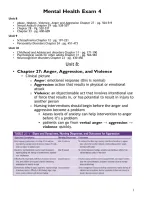
Mental Health Exam 4
Unit 8
• Abuse, Neglect, Violence, Anger and Aggression Chapter 27 - pg. 504-519
• Sexual Assault chapter 29 - pg. 538-551
• Chapter 28 - Pg. 520-537
• Chapter 33 – pg. 600-609
Unit 9
• Schizophrenia Chapter 12 – pg. 191-221
• Personality Disorders Chapter 24 – pg. 451-473
Unit 10
• Childhood and Adolescent disorders Chapter 11 – pg. 171-190
• Psychological needs for other adults Chapter 31 - pg. 566-583
• Neurocognitive disorders Chapter 23 – pg. 430-450
Unit 8:
• Chapter 27: Anger, Aggression, and Violence
• Clinical picture
o Anger: emotional response (this is normal)
o Aggression: action that results in physical or emotional
attack
o Violence: an objectionable act that involves intentional use
of force that results in, or has potential to result in injury to
another person
o Nursing interventions should begin before the anger and
aggression become a problem
▪ Assess levels of anxiety can help intervention to anger
before it’s a problem
▪ patients can go from verbal anger → aggression →
violence quickly.
1
,• Epidemiology
• Nurses are frequently the target of violence
o Frequently in
▪ ED ▪ Geriatric units
▪ Psychiatric ▪ ICU’s
units
• Comorbidity
• PTSD
• Substance use disorders
• Etiology/Risk Factors
• Genetics can predispose someone to anger
• Neurobiological → brain tumors, Alzheimer’s
o Amygdala is the emotion center of the brain
▪ Men sometimes have lowers amygdala volume which
leads to higher levels of aggression
o Less gray matter
• Neurotransmitters → serotonin, dopamine, GABA
o Low levels of serotonin contribute to anger and aggression
o High dopamine → can increase aggressive behavior in
psychosis
o Presence of increase GABA leads to decrease in anger
• Freud → Believed conflict between sexual needs and societal
norms is the source of aggression
• Behaviorist → believed aggression is a learned behavior
• Nursing process
• Assessment
o Trauma informed care
▪ Idea that disruptive patients often have histories that
include violence and victimization. These traumatic
histories can impede patients’ ability to self-soothe,
result in negative coping responses, and create a
vulnerability to coercive interventions (e.g., restraint)
by staff.
o Anger s/s
▪ Red face ▪ Verbal abuse
▪ Irritability ▪ Increased
▪ Hyperactivity demands
▪ Increased
anxiety
2
,• Identify patients triggers
o Loss of control o Paranoia
o Fear o Unmet Needs (food,
o Being ignored bathroom, sleep)
o Pain o Hearing voices
o Withdrawal telling them to
harm
• Always self-assess – recognize your choice of words and tone of
voice
• Conduct a risk assessment:
o Ask:
▪ “Are you thinking about hurting anyone?”
▪ “What is making you angry right now?”
▪ “Do you have a plan?”
▪ “Do you have access to any weapons?”
▪ “Have you hurt anyone before?”
o Patients with:
▪ Impulsivity
▪ Paranoia
▪ Delusions
▪ Psychosis are at higher risk of sudden aggression.
• Assess hx of violence (best predictor of violence)
• Patients who are delusional, hyperactive, and impulsive are at a
higher risk for violence
• Assess hx of limited coping skills
• Patient may have increased demands, irritability, frowning
twisting of hands, speech may be increase in rate and volume
• Assessment can reveal problems before they escalate
• Predictors of violence
3
, • Diagnosis
o Risk for other
directed violence
o Risk for self-directed
violence
o Ineffective coping
o Stress overload
o Impaired impulse
control
4

