
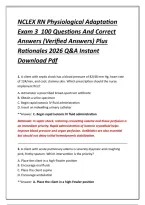
NCLEX RN Physiological Adaptation
Exam 3 100 Questions And Correct
Answers (Verified Answers) Plus
Rationales 2026 Q&A Instant
Download Pdf
1. A client with septic shock has a blood pressure of 82/48 mm Hg, heart rate
of 124/min, and cool, clammy skin. Which prescription should the nurse
implement first?
A. Administer a prescribed broad-spectrum antibiotic
B. Obtain a urine specimen
C. Begin rapid isotonic IV fluid administration
D. Insert an indwelling urinary catheter
**Answer: C. Begin rapid isotonic IV fluid administration
Rationale: In septic shock, restoring circulating volume and tissue perfusion is
an immediate priority. Rapid administration of isotonic crystalloid helps
improve blood pressure and organ perfusion. Antibiotics are also essential
but should not delay initial hemodynamic stabilization.
2. A client with acute pulmonary edema is severely dyspneic and coughing
pink, frothy sputum. Which intervention is the priority?
A. Place the client in a high-Fowler position
B. Encourage oral fluids
C. Place the client supine
D. Encourage ambulation
**Answer: A. Place the client in a high-Fowler position
,Rationale: High-Fowler positioning decreases venous return to the heart and
improves lung expansion, helping reduce pulmonary congestion and improve
oxygenation.
3. A client with diabetic ketoacidosis has a serum potassium of 3.0 mEq/L.
Which prescription should the nurse question?
A. Begin regular insulin infusion
B. Administer IV potassium replacement
C. Initiate isotonic IV fluids
D. Monitor cardiac rhythm
**Answer: A. Begin regular insulin infusion
Rationale: Insulin drives potassium into cells and can cause life-threatening
hypokalemia. When potassium is below 3.3 mEq/L, potassium replacement
should occur before insulin therapy.
4. A client with increased intracranial pressure suddenly develops a widening
pulse pressure, bradycardia, and irregular respirations. How should the nurse
interpret these findings?
A. Neurogenic shock
B. Cushing response
C. Hypovolemic shock
D. Anaphylactic reaction
**Answer: B. Cushing response
Rationale: The Cushing response consists of hypertension with widening pulse
pressure, bradycardia, and abnormal respirations. It indicates significantly
increased intracranial pressure and possible brainstem compression.
5. A client with a traumatic brain injury has a Glasgow Coma Scale score of 7.
Which action is the priority?
,A. Assess bowel sounds
B. Maintain a patent airway
C. Encourage oral fluids
D. Place the client in Trendelenburg position
**Answer: B. Maintain a patent airway
Rationale: A Glasgow Coma Scale score of 8 or less indicates severe
neurologic impairment and a high risk for loss of airway protection. Airway
and ventilation take priority.
6. A client with a spinal cord injury develops severe hypertension, pounding
headache, flushing above the level of injury, and bradycardia. What should the
nurse do first?
A. Place the client flat
B. Sit the client upright
C. Administer a sedative
D. Increase IV fluids
**Answer: B. Sit the client upright
Rationale: These findings indicate autonomic dysreflexia. The immediate
intervention is to place the client upright to lower blood pressure while
identifying and removing the triggering stimulus, commonly bladder or bowel
distention.
7. A client with a chest tube suddenly has increased respiratory distress and
absent breath sounds on the affected side. Which action should the nurse take
first?
A. Clamp the chest tube
B. Assess the tubing for obstruction or disconnection
C. Remove the chest tube
D. Increase the suction pressure
**Answer: B. Assess the tubing for obstruction or disconnection
, Rationale: Sudden respiratory deterioration may indicate a chest-tube system
problem or recurrent pneumothorax. The nurse should immediately assess
the system for kinks, obstruction, or disconnection while supporting
oxygenation.
8. A client with a tension pneumothorax is becoming hypotensive and severely
dyspneic. Which intervention should the nurse anticipate?
A. Immediate needle decompression
B. Oral bronchodilator therapy
C. Incentive spirometry
D. Routine chest physiotherapy
**Answer: A. Immediate needle decompression
Rationale: Tension pneumothorax causes pressure that compromises lung
expansion and venous return. Immediate decompression is lifesaving and
should not be delayed.
9. A client with acute respiratory distress syndrome has severe hypoxemia
despite supplemental oxygen. Which intervention should the nurse anticipate?
A. Mechanical ventilation with positive end-expiratory pressure
B. Restricting all oxygen therapy
C. Encouraging vigorous ambulation
D. Administering oral fluids rapidly
**Answer: A. Mechanical ventilation with positive end-expiratory pressure
Rationale: ARDS causes severe impaired oxygen exchange. Mechanical
ventilation with PEEP can improve alveolar recruitment and oxygenation.
10. A client with a tracheostomy becomes restless, cyanotic, and has
diminished breath sounds. What should the nurse do first?
A. Remove the tracheostomy tube permanently
B. Assess the tracheostomy for obstruction

