
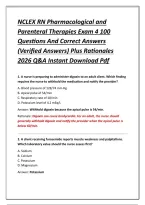
NCLEX RN Pharmacological and
Parenteral Therapies Exam 4 100
Questions And Correct Answers
(Verified Answers) Plus Rationales
2026 Q&A Instant Download Pdf
1. A nurse is preparing to administer digoxin to an adult client. Which finding
requires the nurse to withhold the medication and notify the provider?
A. Blood pressure of 128/74 mm Hg
B. Apical pulse of 54/min
C. Respiratory rate of 18/min
D. Potassium level of 4.2 mEq/L
Answer: Withhold digoxin because the apical pulse is 54/min.
Rationale: Digoxin can cause bradycardia. For an adult, the nurse should
generally withhold digoxin and notify the provider when the apical pulse is
below 60/min.
2. A client receiving furosemide reports muscle weakness and palpitations.
Which laboratory value should the nurse assess first?
A. Sodium
B. Calcium
C. Potassium
D. Magnesium
Answer: Potassium
,Rationale: Furosemide is a loop diuretic that can cause potassium loss.
Hypokalemia can produce muscle weakness and potentially dangerous
cardiac dysrhythmias.
3. Which statement by a client taking warfarin indicates correct
understanding of discharge teaching?
A. “I should avoid all foods containing vitamin K.”
B. “I can take aspirin whenever I have a headache.”
C. “I should keep my intake of vitamin K-containing foods consistent.”
D. “I do not need blood tests while taking this medication.”
Answer: “I should keep my intake of vitamin K-containing foods consistent.”
Rationale: Warfarin therapy requires consistent vitamin K intake because
sudden changes can alter the medication's anticoagulant effect. INR
monitoring is also required.
4. A client receiving IV potassium chloride reports burning at the infusion site.
What is the nurse’s priority action?
A. Increase the infusion rate
B. Stop the infusion and assess the IV site
C. Apply a warm compress and continue the infusion
D. Administer the next dose orally
Answer: Stop the infusion and assess the IV site
Rationale: IV potassium is irritating to veins and must be administered
carefully. Burning may indicate infiltration or phlebitis, requiring immediate
assessment.
5. Which medication should the nurse anticipate administering for severe
hypoglycemia in an unconscious client without IV access?
A. Regular insulin
B. Metformin
,C. Glucagon
D. Glyburide
Answer: Glucagon
Rationale: Glucagon increases blood glucose by stimulating hepatic glycogen
breakdown and is appropriate for severe hypoglycemia when the client
cannot safely take oral glucose and IV access is unavailable.
6. A client taking lisinopril develops swelling of the lips and tongue. What is
the nurse’s priority action?
A. Administer the next dose with food
B. Place the client in a supine position
C. Hold the medication and obtain emergency assistance
D. Encourage oral fluids
Answer: Hold the medication and obtain emergency assistance
Rationale: Angioedema is a potentially life-threatening adverse effect of ACE
inhibitors because airway obstruction can occur. The medication should be
stopped and emergency treatment initiated.
7. A nurse is administering insulin lispro. When should the nurse administer
this medication?
A. One hour before meals
B. Immediately before or shortly after the meal begins
C. At bedtime only
D. Two hours after meals
Answer: Immediately before or shortly after the meal begins
Rationale: Insulin lispro is rapid acting and should be coordinated closely with
food intake to reduce the risk of hypoglycemia.
, 8. Which assessment finding in a client receiving morphine requires
immediate intervention?
A. Constipation
B. Nausea
C. Respiratory rate of 8/min
D. Mild drowsiness
Answer: Respiratory rate of 8/min
Rationale: Opioids can cause life-threatening respiratory depression. A
respiratory rate of 8/min requires immediate assessment and intervention,
including consideration of naloxone.
9. Which medication reverses the effects of opioid-induced respiratory
depression?
A. Flumazenil
B. Naloxone
C. Protamine sulfate
D. Vitamin K
Answer: Naloxone
Rationale: Naloxone is an opioid antagonist that rapidly reverses opioid-
induced respiratory and central nervous system depression.
10. A client receiving heparin develops severe bleeding. Which medication
should the nurse anticipate administering?
A. Vitamin K
B. Protamine sulfate
C. Acetylcysteine
D. Naloxone
Answer: Protamine sulfate
Rationale: Protamine sulfate is the antidote for unfractionated heparin and
can be used to reverse excessive anticoagulation and serious bleeding.

