
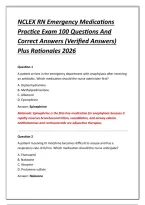
NCLEX RN Emergency Medications
Practice Exam 100 Questions And
Correct Answers (Verified Answers)
Plus Rationales 2026
Question 1
A patient arrives in the emergency department with anaphylaxis after receiving
an antibiotic. Which medication should the nurse administer first?
A. Diphenhydramine
B. Methylprednisolone
C. Albuterol
D. Epinephrine
Answer: Epinephrine
Rationale: Epinephrine is the first-line medication for anaphylaxis because it
rapidly reverses bronchoconstriction, vasodilation, and airway edema.
Antihistamines and corticosteroids are adjunctive therapies.
Question 2
A patient receiving IV morphine becomes difficult to arouse and has a
respiratory rate of 6/min. Which medication should the nurse anticipate?
A. Flumazenil
B. Naloxone
C. Atropine
D. Protamine sulfate
Answer: Naloxone
,Rationale: Naloxone is an opioid antagonist used to reverse opioid-induced
respiratory depression. Respiratory status is the priority.
Question 3
A patient develops severe hypotension during septic shock despite adequate IV
fluid resuscitation. Which medication is commonly used as the first-line
vasopressor?
A. Dopamine
B. Norepinephrine
C. Furosemide
D. Nitroglycerin
Answer: Norepinephrine
Rationale: Norepinephrine is generally the first-line vasopressor for persistent
hypotension in septic shock after adequate fluid resuscitation.
Question 4
A patient with symptomatic bradycardia has a heart rate of 38/min,
hypotension, and dizziness. Which medication should the nurse prepare to
administer?
A. Atropine
B. Adenosine
C. Amiodarone
D. Lidocaine
Answer: Atropine
Rationale: Atropine is the initial medication for symptomatic bradycardia
when there is hemodynamic compromise.
Question 5
,A patient develops a narrow-complex supraventricular tachycardia with a heart
rate of 190/min. Vagal maneuvers are unsuccessful. Which medication is
anticipated?
A. Adenosine
B. Atropine
C. Epinephrine
D. Magnesium sulfate
Answer: Adenosine
Rationale: Adenosine rapidly terminates many forms of paroxysmal
supraventricular tachycardia by temporarily slowing conduction through the
AV node.
Question 6
Which medication is commonly administered for torsades de pointes?
A. Calcium chloride
B. Magnesium sulfate
C. Adenosine
D. Atropine
Answer: Magnesium sulfate
Rationale: IV magnesium sulfate is the recommended medication for torsades
de pointes, even when the serum magnesium level is normal.
Question 7
A patient with severe hyperkalemia develops ECG changes. Which medication
helps stabilize the cardiac membrane?
A. Regular insulin
B. Sodium bicarbonate
C. Calcium gluconate
D. Furosemide
, Answer: Calcium gluconate
Rationale: IV calcium stabilizes the myocardial membrane and reduces the
risk of life-threatening dysrhythmias. It does not remove potassium from the
body.
Question 8
A patient with hyperkalemia is prescribed regular insulin with dextrose. What is
the purpose of this treatment?
A. Remove potassium through the kidneys
B. Shift potassium from the blood into cells
C. Increase serum potassium
D. Prevent hypoglycemia caused by hyperkalemia
Answer: Shift potassium from the blood into cells
Rationale: Insulin promotes cellular uptake of potassium. Dextrose is
administered to prevent hypoglycemia.
Question 9
A patient presents with severe chest pain and suspected acute coronary
syndrome. Which medication is commonly administered to reduce platelet
aggregation?
A. Aspirin
B. Acetaminophen
C. Furosemide
D. Protamine sulfate
Answer: Aspirin
Rationale: Aspirin inhibits platelet aggregation and is an important early
medication in suspected acute coronary syndrome unless contraindicated.
Question 10

