
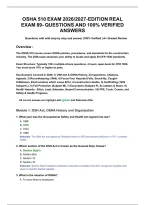
OSHA 510 EXAM 2026/2027-EDITION REAL
EXAM 89- QUESTIONS AND 100% VERIFIED
ANSWERS
Questions with with step by step and answer |100% Verified | A+ Graded Review
Overview :
The OSHA 510 course covers OSHA policies, procedures, and standards for the construction
industry. The 2026 exam assesses your ability to locate and apply 29 CFR 1926 standards.
Exam Structure: Typically 100+ multiple-choice questions, 4 hours, open-book for CFR 1926.
You must score 70% or higher to pass.
Key Domains Covered in 2026: 1) OSH Act & OSHA History, 2) Inspections, Citations,
Appeals, 3) Recordkeeping (1904), 4) Focus Four Hazards (Falls, Struck-By, Caught-
In/Between, Electrocution) which cause 60%+ of construction deaths, 5) Scaffolding (1926
Subpart L), 6) Fall Protection (Subpart M), 7) Excavation (Subpart P), 8) Ladders & Stairs, 9)
Health Hazards - Silica, Lead, Asbestos, Hazard Communication, 10) PPE, Tools, Cranes, and
Safety & Health Programs.
All correct answes are highlight with green and Rationale After
Module 1: OSH Act, OSHA History and Organization
1. What year was the Occupational Safety and Health Act signed into law?
A. 1968
B. 1970
C. 1972
D. 1980
Rationale: The OSH Act was signed by President Nixon in 1970 and became effective in 1971. It created
OSHA.
2. Which section of the OSH Act is known as the General Duty Clause?
A. Section 5(a)(1)
B. Section 8(a)
C. Section 10
D. Section 18
Rationale: Section 5(a)(1) requires employers to provide a workplace free from recognized hazards even
when no specific standard applies.
3. What is the mission of OSHA?
A. To issue fines to employers
, B. To assure safe and healthful working conditions for workers
C. To provide workers compensation
D. To manage construction sites
Rationale: OSHA's mission is prevention - to assure safe and healthful conditions by setting and enforcing
standards.
4. Which agency handles research and recommendations for OSHA standards?
A. NIOSH
B. ANSI
C. NFPA
D. CPSC
Rationale: NIOSH (National Institute for Occupational Safety and Health) is the research arm under CDC.
5. Under OSH Act, how many days does an employer have to contest a citation?
A. 7 working days
B. 15 working days
C. 30 calendar days
D. 60 days
Rationale: Employer has 15 working days from receipt to file a Notice of Contest with OSHA.
6. Which of the following is covered by OSHA?
A. Self-employed persons
B. Public employees in state without state plan
C. Federal agency employees
D. Coal miners
Rationale: OSHA covers federal employees. Self-employed, public employees in non-state-plan states,
and miners (covered by MSHA) are generally not covered.
7. What does a State Plan state must have?
A. Standards less effective than federal
B. Standards at least as effective as federal OSHA
C. No enforcement program
D. Coverage of only private sector
Rationale: State plans must be at least as effective as federal and cover public employees.
8. How long does OSHA have to file a complaint about discrimination under Section
11(c)?
A. 30 days from retaliation
B. 60 days
C. 6 months
D. 1 year
Rationale: Employee must file discrimination complaint within 30 days of adverse action.
9. What is the minimum number of employees needed for OSHA coverage?
A. 1 employee
B. 5 employees
, C. 10 employees
D. 11 employees
Rationale: OSHA covers employers with 1 or more employees, with some recordkeeping exemptions for
10 or fewer.
10. Which act gave OSHA the authority to set emergency temporary standards?
A. Section 6(c) of OSH Act
B. Section 6(a)
C. Section 8
D. Section 19
Rationale: Section 6(c) allows ETS when workers are in grave danger.
Module 2: OSHA Inspections, Citations and Penalties
11. What is the highest priority for OSHA inspections?
A. Programmed inspections
B. Imminent danger
C. Employee complaint
D. Fatality investigation
Rationale: Priority order: 1 Imminent danger, 2 Fatality/catastrophe, 3 Complaints/referrals, 4
Programmed.
12. An employer fatality must be reported to OSHA within how many hours?
A. 8 hours
B. 24 hours
C. 48 hours
D. 72 hours
Rationale: Fatality: 8 hours. In-patient hospitalization, amputation, loss of eye: 24 hours - 1904.39.
13. What is a Willful violation?
A. Unintentional violation
B. Violation committed with intentional disregard or plain indifference
C. Violation with no injury potential
D. First-time violation
Rationale: Willful means employer knew requirement and intentionally disregarded it.
14. What is the maximum penalty for a Serious violation in 2026 adjusted annually?
A. About $16,131 per violation
B. About $1,000 per violation
C. About $5,000 per violation
D. No penalty
Rationale: Serious violations ~ $16k+ in 2024-2026 inflation adjustments, willful/repeated can be ~
$161k+.
15. During an inspection, who has the right to accompany the OSHA inspector?
A. Only employer
EXAM 89- QUESTIONS AND 100% VERIFIED
ANSWERS
Questions with with step by step and answer |100% Verified | A+ Graded Review
Overview :
The OSHA 510 course covers OSHA policies, procedures, and standards for the construction
industry. The 2026 exam assesses your ability to locate and apply 29 CFR 1926 standards.
Exam Structure: Typically 100+ multiple-choice questions, 4 hours, open-book for CFR 1926.
You must score 70% or higher to pass.
Key Domains Covered in 2026: 1) OSH Act & OSHA History, 2) Inspections, Citations,
Appeals, 3) Recordkeeping (1904), 4) Focus Four Hazards (Falls, Struck-By, Caught-
In/Between, Electrocution) which cause 60%+ of construction deaths, 5) Scaffolding (1926
Subpart L), 6) Fall Protection (Subpart M), 7) Excavation (Subpart P), 8) Ladders & Stairs, 9)
Health Hazards - Silica, Lead, Asbestos, Hazard Communication, 10) PPE, Tools, Cranes, and
Safety & Health Programs.
All correct answes are highlight with green and Rationale After
Module 1: OSH Act, OSHA History and Organization
1. What year was the Occupational Safety and Health Act signed into law?
A. 1968
B. 1970
C. 1972
D. 1980
Rationale: The OSH Act was signed by President Nixon in 1970 and became effective in 1971. It created
OSHA.
2. Which section of the OSH Act is known as the General Duty Clause?
A. Section 5(a)(1)
B. Section 8(a)
C. Section 10
D. Section 18
Rationale: Section 5(a)(1) requires employers to provide a workplace free from recognized hazards even
when no specific standard applies.
3. What is the mission of OSHA?
A. To issue fines to employers
, B. To assure safe and healthful working conditions for workers
C. To provide workers compensation
D. To manage construction sites
Rationale: OSHA's mission is prevention - to assure safe and healthful conditions by setting and enforcing
standards.
4. Which agency handles research and recommendations for OSHA standards?
A. NIOSH
B. ANSI
C. NFPA
D. CPSC
Rationale: NIOSH (National Institute for Occupational Safety and Health) is the research arm under CDC.
5. Under OSH Act, how many days does an employer have to contest a citation?
A. 7 working days
B. 15 working days
C. 30 calendar days
D. 60 days
Rationale: Employer has 15 working days from receipt to file a Notice of Contest with OSHA.
6. Which of the following is covered by OSHA?
A. Self-employed persons
B. Public employees in state without state plan
C. Federal agency employees
D. Coal miners
Rationale: OSHA covers federal employees. Self-employed, public employees in non-state-plan states,
and miners (covered by MSHA) are generally not covered.
7. What does a State Plan state must have?
A. Standards less effective than federal
B. Standards at least as effective as federal OSHA
C. No enforcement program
D. Coverage of only private sector
Rationale: State plans must be at least as effective as federal and cover public employees.
8. How long does OSHA have to file a complaint about discrimination under Section
11(c)?
A. 30 days from retaliation
B. 60 days
C. 6 months
D. 1 year
Rationale: Employee must file discrimination complaint within 30 days of adverse action.
9. What is the minimum number of employees needed for OSHA coverage?
A. 1 employee
B. 5 employees
, C. 10 employees
D. 11 employees
Rationale: OSHA covers employers with 1 or more employees, with some recordkeeping exemptions for
10 or fewer.
10. Which act gave OSHA the authority to set emergency temporary standards?
A. Section 6(c) of OSH Act
B. Section 6(a)
C. Section 8
D. Section 19
Rationale: Section 6(c) allows ETS when workers are in grave danger.
Module 2: OSHA Inspections, Citations and Penalties
11. What is the highest priority for OSHA inspections?
A. Programmed inspections
B. Imminent danger
C. Employee complaint
D. Fatality investigation
Rationale: Priority order: 1 Imminent danger, 2 Fatality/catastrophe, 3 Complaints/referrals, 4
Programmed.
12. An employer fatality must be reported to OSHA within how many hours?
A. 8 hours
B. 24 hours
C. 48 hours
D. 72 hours
Rationale: Fatality: 8 hours. In-patient hospitalization, amputation, loss of eye: 24 hours - 1904.39.
13. What is a Willful violation?
A. Unintentional violation
B. Violation committed with intentional disregard or plain indifference
C. Violation with no injury potential
D. First-time violation
Rationale: Willful means employer knew requirement and intentionally disregarded it.
14. What is the maximum penalty for a Serious violation in 2026 adjusted annually?
A. About $16,131 per violation
B. About $1,000 per violation
C. About $5,000 per violation
D. No penalty
Rationale: Serious violations ~ $16k+ in 2024-2026 inflation adjustments, willful/repeated can be ~
$161k+.
15. During an inspection, who has the right to accompany the OSHA inspector?
A. Only employer

