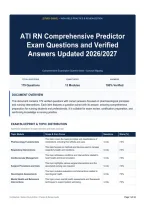
[STUDY GUIDE] • HIGH-YIELD PRACTICE & REVIEW EDITION
ATI RN Comprehensive Predictor
Exam Questions and Verified
Answers Updated 2026/2027
Comprehensive Examination Question Bank • Concept Mapping
TOTAL QUESTIONS EXAM TOPICS ANSWERS
179 Questions 13 Modules 100% Verified
DOCUMENT OVERVIEW
This document contains 179 verified questions with correct answers focused on pharmacological principles
and nursing interventions. Each item features a question paired with its answer, ensuring comprehensive
preparation for nursing students and professionals. It is suitable for exam review, certification preparation, and
reinforcing knowledge in nursing practice.
EXAM BLUEPRINT & TOPIC DISTRIBUTION
Systematic breakdown of subject domains and exam coverage.
Topic Module Scope & Core Focus Questions Share (%)
This topic covers the basic principles and classifications of
Pharmacology Fundamentals medications, including their effects and uses. 14 Qs 7.8%
This topic focuses on methods and devices used to manage
Respiratory Interventions respiratory health and conditions. 14 Qs 7.8%
This topic addresses conditions and interventions related to
Cardiovascular Management heart health and blood circulation. 14 Qs 7.8%
This topic highlights various surgical interventions and the
Surgical Procedures and Care associated nursing care required. 14 Qs 7.8%
This topic includes evaluations and interventions related to
Neurological Assessments neurological health. 14 Qs 7.8%
Mental Health and Behavioral This topic covers mental health assessments and therapeutic
Interventions techniques to support patient well-being. 14 Qs 7.8%
Confidential • Student Study Edition • Practice & Review Guide Page 1 of 34
,STUDENT STUDY & MASTERY EDITION PRACTICE & REVIEW GUIDE
Nutrition and Dietary This topic examines dietary assessments and interventions
Considerations relevant to patient care. 14 Qs 7.8%
Infection Control and This topic outlines practices and protocols for preventing
Precautions infection in healthcare settings. 14 Qs 7.8%
This topic focuses on strategies and pharmacological options
Pain Management for effective pain relief. 14 Qs 7.8%
This topic addresses measures and ethical considerations for
Patient Safety and Advocacy ensuring patient safety and rights. 14 Qs 7.8%
This topic discusses the management of fluids and
Fluid and Electrolyte Balance electrolytes in various health conditions. 13 Qs 7.3%
This topic focuses on the management and treatment of burns
Burn and Wound Care and other skin injuries. 13 Qs 7.3%
This topic addresses principles and practices related to
End-of-Life Care hospice and palliative care. 13 Qs 7.3%
Total Exam Coverage 13 Integrated Topic Modules 179 Qs 100.0%
TOPIC 1: PHARMACOLOGY FUNDAMENTALS
14 Questions • 7.8% of Exam • This topic covers the basic principles and classifications of medications, including their effects and
uses.
QUESTION 1
Narcotic Analgesic
Answer: A class of medications used to relieve pain by acting on the central nervous system.
QUESTION 2
Skin Flushing
Answer: A common side effect of certain medications, characterized by redness and warmth of the skin.
QUESTION 3
Safety measures for morphine administration
Answer: Actions taken to ensure patient safety, including monitoring respiratory rate and medication
interactions.
Confidential • Student Study Edition • Practice & Review Guide Page 2 of 34
,STUDENT STUDY & MASTERY EDITION PRACTICE & REVIEW GUIDE
QUESTION 4
Naloxone
Answer: An opioid antagonist used to reverse the effects of opioid overdose, including respiratory
depression.
QUESTION 5
Linezolid
Answer: An antibiotic used to treat certain bacterial infections, particularly those resistant to other
antibiotics.
QUESTION 6
Diuretic
Answer: A medication that promotes the removal of excess fluid from the body, often used in conditions like
hypertension.
QUESTION 7
Vancomycin
Answer: An antibiotic used to treat serious bacterial infections, particularly those caused by resistant strains
like MRSA.
QUESTION 8
Enoxaparin sodium
Answer: An anticoagulant medication used to prevent and treat deep vein thrombosis and pulmonary
embolism.
QUESTION 9
Straight Catheterization
Answer: A procedure to insert a catheter into the bladder to drain urine when a patient is unable to void.
Confidential • Student Study Edition • Practice & Review Guide Page 3 of 34
, STUDENT STUDY & MASTERY EDITION PRACTICE & REVIEW GUIDE
QUESTION 10
Morphine Sulfate
Answer: An opioid medication used to relieve severe pain and can also help reduce anxiety and respiratory
distress in heart failure.
QUESTION 11
Interdisciplinary Team
Answer: A group of healthcare professionals from various specialties who collaborate to provide
comprehensive care to patients.
QUESTION 12
Isoniazid
Answer: An antibiotic used to prevent and treat tuberculosis, which requires monitoring for liver function.
QUESTION 13
Processed Carbohydrates
Answer: Refined carbohydrates that are often low in fiber and high in sugar, which should be limited in a
diabetic diet.
QUESTION 14
Cataract Surgery Aftercare
Answer: Post-operative instructions and care required after cataract extraction to ensure proper healing and
compliance.
TOPIC 2: RESPIRATORY INTERVENTIONS
14 Questions • 7.8% of Exam • This topic focuses on methods and devices used to manage respiratory health and conditions.
Confidential • Student Study Edition • Practice & Review Guide Page 4 of 34