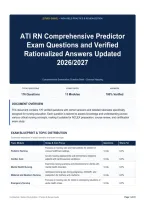
[STUDY GUIDE] • HIGH-YIELD PRACTICE & REVIEW EDITION
ATI RN Comprehensive Predictor
Exam Questions and Verified
Rationalized Answers Updated
2026/2027
Comprehensive Examination Question Bank • Concept Mapping
TOTAL QUESTIONS EXAM TOPICS ANSWERS
176 Questions 13 Modules 100% Verified
DOCUMENT OVERVIEW
This document contains 176 verified questions with correct answers and detailed rationales specifically
designed for nursing education. Each question is tailored to assess knowledge and understanding across
various critical nursing concepts, making it suitable for NCLEX preparation, course review, and certification
exam study.
EXAM BLUEPRINT & TOPIC DISTRIBUTION
Systematic breakdown of subject domains and exam coverage.
Topic Module Scope & Core Focus Questions Share (%)
Focuses on nursing care and interventions for children in
Pediatric Nursing various healthcare settings. 14 Qs 8.0%
Covers nursing assessments and interventions related to
Cardiac Care patients with cardiovascular conditions. 14 Qs 8.0%
Examines nursing practices and interventions for clients with
Mental Health Nursing mental health disorders. 14 Qs 8.0%
Addresses nursing care during pregnancy, childbirth, and
Maternal and Newborn Nursing postpartum for mothers and newborns. 14 Qs 8.0%
Focuses on nursing care for clients in emergency situations or
Emergency Nursing acute health crises. 14 Qs 8.0%
Confidential • Student Study Edition • Practice & Review Guide Page 1 of 91
,STUDENT STUDY & MASTERY EDITION PRACTICE & REVIEW GUIDE
Covers safe practices and protocols for administering
Medication Administration medications in nursing. 14 Qs 8.0%
Examines the role of nutrition and dietary management in
Nutrition and Diet Therapy nursing care. 14 Qs 8.0%
Focuses on strategies to prevent and manage infections in
Infection Control healthcare settings. 13 Qs 7.4%
Covers nursing responsibilities in ensuring patient safety and
Patient Safety and Advocacy advocating for patients' needs. 13 Qs 7.4%
Addresses nursing interventions and assessments for
Postoperative Care patients recovering from surgery. 13 Qs 7.4%
Focuses on nursing care strategies for patients with chronic
Chronic Disease Management conditions. 13 Qs 7.4%
Covers nursing assessment methods and interpretation of
Assessment Techniques findings. 13 Qs 7.4%
Legal and Ethical Examines the legal and ethical responsibilities of nurses in
Considerations practice. 13 Qs 7.4%
Total Exam Coverage 13 Integrated Topic Modules 176 Qs 100.0%
TOPIC 1: PEDIATRIC NURSING
14 Questions • 8.0% of Exam • Focuses on nursing care and interventions for children in various healthcare settings.
QUESTION 1
A nurse in a pediatric unit is preparing to insert an IV catheter for 7-yearold. Which of
the following actions should the nurse take?
A. (Unable to read)
B. Tell the child they will feel discomfort during the catheter insertion.
C. Use a mummy restraint to hold the child during the catheter insertion.
D. Require the parents to leave the room during the procedure.
Answer: B. Tell the child they will feel discomfort during the catheter insertion.
Rationale: When inserting an IV catheter in a child, it's essential to set realistic expectations and prepare the child for the
potential discomfort they may experience during the procedure. By informing the child that they will feel discomfort, the
nurse is being honest and transparent, which can help reduce anxiety and fear, ultimately making the experience less
distressing for the child.
Confidential • Student Study Edition • Practice & Review Guide Page 2 of 91
,STUDENT STUDY & MASTERY EDITION PRACTICE & REVIEW GUIDE
QUESTION 2
A nurse is caring for a client who has arteriovenous fistula Which of the following
findings should the nurse report?
A. Thrill upon palpation.
B. Absence of a bruit.
C. Distended blood vessels
D. Swishing sound upon auscultation.
Answer: B. Absence of a bruit.
Rationale: A bruit is an abnormal sound heard through a stethoscope, typically due to turbulent blood flow, which would be
expected in the presence of an arteriovenous fistula. Therefore, the absence of a bruit indicates that the fistula is not
functioning as expected, which is a critically important finding that the nurse would report to the healthcare provider.
QUESTION 3
A nurse is planning care for a client who has a prescription for a boweltraining program
following a spinal cord injury. Which of the following actions should the nurse include
in the plan of care?
A. Encourage a maximum fluid intake of 1,500 ml per day.
B. Increase the amount of refined grains in the client's diet.
C. Provide the client with a cold drink prior to defecation.
D. Administer a rectal suppository 30 minutes prior to scheduled defecation times.
Answer: D. Administer a rectal suppository 30 minutes prior to scheduled defecation times.
Rationale: The correct answer is D. Administer a rectal suppository 30 minutes prior to scheduled defecation times because
suppositories can help stimulate bowel movements and increase the client's ability to control their bowel movements, which
is a crucial component of a bowel-training program following a spinal cord injury. By administering the suppository 30
minutes before scheduled defecation times, the nurse can help ensure that the client is able to successfully complete bowel
movements during the scheduled time, promoting regularity and independence.
Confidential • Student Study Edition • Practice & Review Guide Page 3 of 91
, STUDENT STUDY & MASTERY EDITION PRACTICE & REVIEW GUIDE
QUESTION 4
A charge nurse is teaching a newly licensed nurse about clients designating a health
care proxy in situations that require a durable power of attorney for heal care (DPSHC).
Which of the following information should the charge nurse include?
A. "The proxy should make health care decisions for the client regardless of the client's ability to do so."
B. "The proxy can make financial decisions if the need arises."
C. "The proxy can make treatment decisions if the client is under anesthesia."
D. "The proxy should manage legal issues for the client."
Answer: C. "The proxy can make treatment decisions if the client is under anesthesia.".
Rationale: The correct answer is C because a proxy's authority is limited to making decisions when the client is unable to
do so themselves, not including situations like anesthesia where the client is unconscious but still capable of making
decisions.
QUESTION 5
A charge nurse is teaching a group of newly licensed nurses about the correct use of
restraints. Which of the following should the nurse include in the teaching?
A. Placing a belt restraint on a school-age child who has seizures.
B. Securing wrist restraints to the bed rails for an adolescent.
C. Applying elbow immobilizers of an infant receiving cleft lip injury
D. Keeping the side rails of a toddler's crib elevated.
Answer: C. Applying elbow immobilizers of an infant receiving cleft lip injury.
Rationale: The correct answer is C. Applying elbow immobilizers of an infant receiving cleft lip injury because an infant with
a cleft lip injury may have difficulty stabilizing their jaw and mouth, and elbow immobilizers can help maintain proper
alignment and positioning to facilitate healing and reduce discomfort. This use of restraints is a safe and appropriate
measure to support the infant's medical treatment, unlike the other options which are not appropriate or safe applications of
restraints.
Confidential • Student Study Edition • Practice & Review Guide Page 4 of 91