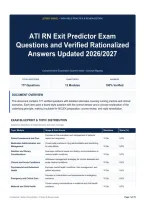
[STUDY GUIDE] • HIGH-YIELD PRACTICE & REVIEW EDITION
ATI RN Exit Predictor Exam
Questions and Verified Rationalized
Answers Updated 2026/2027
Comprehensive Examination Question Bank • Concept Mapping
TOTAL QUESTIONS EXAM TOPICS ANSWERS
177 Questions 12 Modules 100% Verified
DOCUMENT OVERVIEW
This document contains 177 verified questions with detailed rationales covering nursing practice and clinical
scenarios. Each item pairs a board-style question with the correct answer and a concise explanation of the
underlying principle, making it suitable for NCLEX preparation, course review, and rapid remediation.
EXAM BLUEPRINT & TOPIC DISTRIBUTION
Systematic breakdown of subject domains and exam coverage.
Topic Module Scope & Core Focus Questions Share (%)
Focuses on the evaluation and management of patients'
Patient Assessment and Care needs and responses. 15 Qs 8.5%
Medication Administration and Covers safe practices in drug administration and monitoring
Management for side effects. 15 Qs 8.5%
Nutrition and Dietary Examines nutritional needs and dietary recommendations in
Considerations various health conditions. 15 Qs 8.5%
Addresses management strategies for chronic diseases and
Chronic and Acute Conditions acute medical conditions. 15 Qs 8.5%
Psychosocial and Behavioral Explores mental health conditions, their management, and
Health patient education. 15 Qs 8.5%
Focuses on interventions and assessments in emergency
Emergency and Critical Care scenarios. 15 Qs 8.5%
Covers nursing considerations in maternal and child health
Maternal and Child Health scenarios. 15 Qs 8.5%
Confidential • Student Study Edition • Practice & Review Guide Page 1 of 70
,STUDENT STUDY & MASTERY EDITION PRACTICE & REVIEW GUIDE
Focuses on practices to prevent and manage infections in
Infection Control and Prevention healthcare settings. 15 Qs 8.5%
Legal and Ethical Examines ethical principles and legal standards in nursing
Considerations practice. 15 Qs 8.5%
Patient Education and Health Focuses on teaching patients about health maintenance and
Promotion disease prevention. 14 Qs 7.9%
Fluid and Electrolyte Addresses the assessment and management of fluid balance
Management and electrolyte levels. 14 Qs 7.9%
Covers nursing interventions and assessments for patients
Postoperative Care recovering from surgery. 14 Qs 7.9%
Total Exam Coverage 12 Integrated Topic Modules 177 Qs 100.0%
TOPIC 1: PATIENT ASSESSMENT AND CARE
15 Questions • 8.5% of Exam • Focuses on the evaluation and management of patients' needs and responses.
QUESTION 1
RN on a MS. Which of the following clients needs will the nurse assign to an AP?
Answer: Reapplying a condom catheter for a client who has urinary incontinence.
Rationale: The nurse will assign the task of reapplying a condom catheter for a client with urinary incontinence to an
assistive personnel (AP) because it requires assistance with a daily living activity that is not within the scope of the
registered nurse's
(RN) medical-surgical (MS) practice. As a result, the APis trained and authorized to perform this task, allowing the RN to
focus on other high-priority tasks that require their expertise and licensure.
QUESTION 2
RN is making assignments. Which of the following assignments should the LPN
question?
Answer: D. Replacing the cartridge and tubing on a PCA pump.
Rationale: The LPN should question "D. Replacing the cartridge and tubing on a PCA pump" because this task requires
medication calculation and assessment of the patient's response to medication, which are beyond the scope of practice for
LPNs.
Confidential • Student Study Edition • Practice & Review Guide Page 2 of 70
,STUDENT STUDY & MASTERY EDITION PRACTICE & REVIEW GUIDE
QUESTION 3
A client is waiting transfer back to the unit from the PACU following thoracic surgery.
To which staff member should the nurse assign the client?
Answer: B. RN.
Rationale: The nurse should assign the client to the Registered Nurse (RN) because the RN has the necessary skills and
training to care for clients with complex medical needs, including those who have undergone thoracic surgery. Additionally,
the RN is responsible for managing the client's transition from the Post-Anesthesia Care Unit (PACU) back to the unit,
ensuring a smooth and safe transfer.
QUESTION 4
A client is receiving total parenteral nutrition (TPN). To determine the client's tolerance
of this treatment, the nurse should assess for which of the Following?
Answer: 4.Urine output of at least 30cc per hour.
Rationale: Urine output of at least 30cc per hour is a critical indicator of a client's tolerance of TPN because it ensures that
the client's kidneys are effectively removing excess fluids and solutes from the bloodstream, thereby preventing fluid
overload and electrolyte imbalances. This parameter is particularly important in TPN therapy, where clients are receiving a
concentrated mixture of nutrients and fluids directly into the bloodstream, increasing the risk of fluid overload and electrolyte
disturbances if not properly monitored.
QUESTION 5
The nurse is caring for a young adult admitted to the hospital with a severe head injury.
The nurse should position the patient.
Answer: 1. With his neck in a midline position and the head of the bed elevated 30°.
Rationale: The correct positioning of the patient helps to reduce intracranial pressure, which is elevated in patients with
severe head
injuries. Elevating the head of the bed 30° and positioning the patient's neck in a midline position helps to reduce venous
congestion and promote cerebral perfusion, which is essential for reducing the risk of further neurological damage.
Confidential • Student Study Edition • Practice & Review Guide Page 3 of 70
, STUDENT STUDY & MASTERY EDITION PRACTICE & REVIEW GUIDE
QUESTION 6
The nurse is caring for clients in the skilled nursing facility. Which of the following
clients require the nurse's IMMEDIATE attention?
Answer: 1. A client admitted for a cerebral vascular accident (CVA) whose prescription for warfarin
(Coumadin) expired two days ago.
Rationale: The client requiring immediate attention is the one whose warfarin prescription expired two days ago, as timely
administration of this anticoagulant is crucial to prevent serious complications, such as stroke or heart attack, which can
have devastating consequences if not addressed promptly. The nurse's immediate attention is necessary to ensure the
client receives the medication and to prevent potential harm or deterioration of the client's condition.
QUESTION 7
A client is scheduled for a left lower lobectomy. The physician has ordered diazepam
(Valium) 2 mg IM for
anxiety. The nurse would determine that the medication is appropriate if the client
displays which of the following symptoms?
Answer: 3. Restlessness and increased heart rate.
Rationale: Diazepam (Valium) is a benzodiazepine anxiolytic, which is typically used to treat anxiety, restlessness, and
agitation.
Therefore, if the client displays symptoms of restlessness and increased heart rate, indicating anxiety, the nurse would
determine that the medication is appropriate because it is designed to treat these specific symptoms.
QUESTION 8
If a client develops cor pulmonale (right-sided heart failure), the nurse would expect to
observe
Answer: 3. Peripheral edema and anorexia.
Rationale: The presence of peripheral edema and anorexia is a result of the decreased cardiac output in cor pulmonale,
leading to decreased blood flow to the extremities and increased fluid accumulation, causing swelling, and affecting nutrient
absorption, resulting in weight loss and decreased appetite. As cor pulmonale is a right-sided heart failure, the nurse would
expect to observe these signs as a manifestation of the underlying cardiac condition.
Confidential • Student Study Edition • Practice & Review Guide Page 4 of 70