[STUDY GUIDE] • HIGH-YIELD PRACTICE & REVIEW EDITION
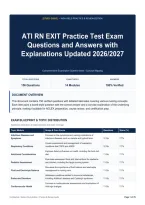
ATI RN EXIT Practice Test Exam
Questions and Answers with
Explanations Updated 2026/2027
Comprehensive Examination Question Bank • Concept Mapping
TOTAL QUESTIONS EXAM TOPICS ANSWERS
156 Questions 14 Modules 100% Verified
DOCUMENT OVERVIEW
This document contains 156 verified questions with detailed rationales covering various nursing concepts.
Each item pairs a board-style question with the correct answer and a concise explanation of the underlying
principle, making it suitable for NCLEX preparation, course review, and certification prep.
EXAM BLUEPRINT & TOPIC DISTRIBUTION
Systematic breakdown of subject domains and exam coverage.
Topic Module Scope & Core Focus Questions Share (%)
Infectious Diseases and Focuses on the symptoms and nursing implications of
Symptoms infectious diseases such as malaria and typhoid fever. 12 Qs 7.7%
Covers assessment and management of respiratory
Respiratory Conditions conditions like COPD and ARDS. 12 Qs 7.7%
Explores dietary influences on health, including the Acid Ash
Nutritional Considerations diet. 11 Qs 7.1%
Examines assessment tools and interventions for newborns
Pediatric Assessment and children, including the Apgar scoring system. 11 Qs 7.1%
Discusses the importance of fluid balance and electrolyte
Fluid and Electrolyte Balance management in nursing care. 11 Qs 7.1%
Addresses conditions related to hormonal imbalances,
Endocrine Disorders including Addison's disease and Cushing's syndrome. 11 Qs 7.1%
Focuses on cardiovascular assessments and implications of
Cardiovascular Health vital sign changes. 11 Qs 7.1%
Confidential • Student Study Edition • Practice & Review Guide Page 1 of 76
,STUDENT STUDY & MASTERY EDITION PRACTICE & REVIEW GUIDE
Medication Administration Covers safe medication practices and dosage calculations. 11 Qs 7.1%
Explores symptoms and nursing considerations in cancer
Oncology Nursing care. 11 Qs 7.1%
Discusses the use of various assessment techniques in
Patient Assessment Techniques nursing practice. 11 Qs 7.1%
Prepares for acute care scenarios and nursing interventions in
Emergency Nursing emergencies. 11 Qs 7.1%
Patient Education and Focuses on effective communication strategies and patient
Communication education in nursing practice. 11 Qs 7.1%
Covers fundamental nursing interventions and their
Basic Nursing Skills significance in patient care. 11 Qs 7.1%
Explores common eye conditions and their implications for
Vision and Eye Health nursing assessment. 11 Qs 7.1%
Total Exam Coverage 14 Integrated Topic Modules 156 Qs 100.0%
TOPIC 1: INFECTIOUS DISEASES AND SYMPTOMS
12 Questions • 7.7% of Exam • Focuses on the symptoms and nursing implications of infectious diseases such as malaria and typhoid
fever.
QUESTION 1
Describe how the symptoms of Malaria can impact patient care and nursing
assessments.
1. The symptoms of Malaria, such as stepladder-like fever with chills, require careful monitoring and prompt intervention to
manage fever and prevent complications.
2. The symptoms of Malaria are only relevant for diagnosis, not for ongoing patient care.
3. Malaria symptoms are generally mild and do not require special nursing assessments.
4. Patients with Malaria typically show no significant symptoms, making assessments unnecessary.
Answer: The symptoms of Malaria, such as stepladder-like fever with chills, require careful monitoring and
prompt intervention to manage fever and prevent complications.
Explanation:
This option is correct because Malaria symptoms, such as fever and chills, require careful monitoring and
prompt intervention to manage fever and prevent complications, which is a crucial aspect of patient care and
nursing assessments.
Confidential • Student Study Edition • Practice & Review Guide Page 2 of 76
,STUDENT STUDY & MASTERY EDITION PRACTICE & REVIEW GUIDE
QUESTION 2
Describe the significance of rose spots in the diagnosis of typhoid fever.
1. Rose spots are unrelated to typhoid fever.
2. Rose spots are indicative of typhoid fever and help in its diagnosis.
3. Rose spots indicate a viral infection.
4. Rose spots are a sign of dehydration.
Answer: Rose spots are indicative of typhoid fever and help in its diagnosis.
Explanation:
Rose spots are a characteristic feature of typhoid fever, and their presence is a significant diagnostic clue,
helping to confirm the diagnosis of the disease.
QUESTION 3
A patient presents with a persistent cough and shortness of breath. After assessment,
the healthcare provider determines the patient has COPD. How would this diagnosis
differ from a patient diagnosed with pneumonia in terms of treatment approach?
1. COPD treatment involves antibiotics, while pneumonia does not.
2. Pneumonia treatment is primarily focused on lifestyle changes, while COPD requires acute care.
3. Both conditions require immediate hospitalization and surgery.
4. The treatment for COPD focuses on long-term management, while pneumonia treatment is aimed at resolving the acute
infection.
Answer: The treatment for COPD focuses on long-term management, while pneumonia treatment is aimed at
resolving the acute infection.
Explanation:
The correct answer is that the treatment for COPD focuses on long-term management, while pneumonia
treatment is aimed at resolving the acute infection, as COPD is a chronic condition requiring ongoing
management, whereas pneumonia is an acute infection that requires prompt treatment to resolve the
infection.
Confidential • Student Study Edition • Practice & Review Guide Page 3 of 76
, STUDENT STUDY & MASTERY EDITION PRACTICE & REVIEW GUIDE
QUESTION 4
If a patient scores a 6 on the Glasgow Coma Scale, what immediate nursing action
should be taken?
1. Provide reassurance to the patient.
2. Initiate emergency medical intervention.
3. Monitor vital signs every hour.
4. Administer pain relief medication.
Answer: Initiate emergency medical intervention.
Explanation:
A Glasgow Coma Scale score of 6 indicates a severe head injury, requiring immediate medical attention and
intervention to prevent further deterioration and potential life-threatening complications.
QUESTION 5
A newborn presents with coughing, choking, cyanosis, and continuous drooling. As a
nursing student, what should be your immediate action based on these signs?
1. Administer oral fluids to the newborn.
2. Assess the airway and prepare for potential emergency intervention.
3. Perform a physical examination without immediate intervention.
4. Document the symptoms and wait for the physician's orders.
Answer: Assess the airway and prepare for potential emergency intervention.
Explanation:
This is the most likely correct answer because the symptoms of coughing, choking, cyanosis, and
continuous drooling suggest a potential airway obstruction or respiratory emergency, requiring immediate
assessment and preparation for potential emergency intervention to ensure the newborn's airway is patent
and breathing is stable.
QUESTION 6
Common symptoms of malaria include:
1. fever,
2. aemia,
3. chills,
4. flu-like illness and coma,
5. all of the above
Confidential • Student Study Edition • Practice & Review Guide Page 4 of 76