[STUDY GUIDE] • HIGH-YIELD PRACTICE & REVIEW EDITION
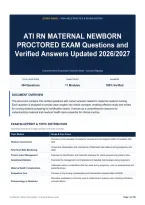
ATI RN MATERNAL NEWBORN
PROCTORED EXAM Questions and
Verified Answers Updated 2026/2027
Comprehensive Examination Question Bank • Concept Mapping
TOTAL QUESTIONS EXAM TOPICS ANSWERS
304 Questions 11 Modules 100% Verified
DOCUMENT OVERVIEW
This document contains 304 verified questions with correct answers related to maternal newborn nursing.
Each question is designed to provide clear insights into critical concepts, enabling effective study and review
for nursing students preparing for certification exams. It serves as a comprehensive resource for
understanding maternal and newborn health topics essential for clinical practice.
EXAM BLUEPRINT & TOPIC DISTRIBUTION
Systematic breakdown of subject domains and exam coverage.
Topic Module Scope & Core Focus
Focuses on the evaluation of newborns' physical and neurological health immediately after
Newborn Assessment birth.
Covers the interpretation and implications of fetal heart rate patterns during pregnancy and
Fetal Heart Rate Monitoring labor.
Preterm Labor Management Explores the identification and treatment strategies for clients experiencing preterm labor.
Gestational Diabetes Examines the management and implications of diabetes that develops during pregnancy.
Addresses various complications that can arise during pregnancy, such as preeclampsia and
Maternal Health Complications placental previa.
Postpartum Care Focuses on the nursing considerations and interventions required after childbirth.
Discusses medications commonly used in maternal and newborn care, including indications
Pharmacology in Obstetrics and side effects.
Confidential • Student Study Edition • Practice & Review Guide Page 1 of 106
,STUDENT STUDY & MASTERY EDITION PRACTICE & REVIEW GUIDE
Involves care practices for newborns, including feeding, safety, and developmental
Neonatal Care milestones.
Labor and Delivery Procedures Covers the stages of labor and the nursing roles during the delivery process.
Breastfeeding and Nutrition Focuses on the importance of breastfeeding and nutritional guidance for new mothers.
Infection Control in Maternal Care Examines strategies to prevent and manage infections during pregnancy and postpartum.
Total Exam Coverage 11 Integrated Topic Modules • 304 Examination Questions
HIGH-YIELD: QUESTIONS & VERIFIED ANSWERS
Complete Examination Questions • 304 Questions • Sequential Exam Layout
QUESTION 1
A nurse is caring for a client who is at 32 wks gestation and is experiencing preterm
labor. What meds should the nurse plan to administer?
a. misoprostol
b. betamethasone
c. poractant alfa
d. methylergonovine
Answer: B. betamethasone.
QUESTION 2
A nurse at a prenatal clinic is caring for a client who suspects she may be pregnant and
asks the nurse how the provider will confirm her pregnancy. The nurse should inform
the client that what lab test will be used to confirm her pregnancy?
a. urine test for presence of HCG
b. urine test for the presence of HCS
c. blood test for presence of estrogen
d. blood test for the amount of circulating progesterone
Answer: A. urine test for presence of HCG.
Confidential • Student Study Edition • Practice & Review Guide Page 2 of 106
,STUDENT STUDY & MASTERY EDITION PRACTICE & REVIEW GUIDE
QUESTION 3
A nurse is caring for a client who believes she may be pregnant. What finding should
the nurse identify as a positive sign of pregnancy?
a. palpable fetal movement
b. amenorrhea
c. chadwick's sign
d. positive pregnancy test
Answer: A. palpable fetal movement.
QUESTION 4
A nurse is caring for a client who has oligohydraminios. What fetal anomalies should
the nurse expect?
a. renal agenesis
b. atrial septal defect
c. spina bifida
d. hydrocephalus
Answer: A. renal agenesis.
QUESTION 5
A nurse is assessing a client who is at 37 wks gestation and has a suspected pelvic
fracture due to blunt abd
trauma. What findings should the nurse expect?
a. uterine contractions
b. bradycardia
c. seizures
d. bradypnea
Answer: A. uterine contractions
The nurse should expect the client to be experiencing uterine contractions due to abdominal trauma.
Confidential • Student Study Edition • Practice & Review Guide Page 3 of 106
, STUDENT STUDY & MASTERY EDITION PRACTICE & REVIEW GUIDE
QUESTION 6
A nurse is assessing a client who is at 12 wks gestation and has hydatidiform mole.
What findings should the nurse expect?
a. hypothermia
b. dark brown vaginal discharge
c. fetal heart tones
d. decreased urinary output
Answer: B. dark brown vaginal discharge
A hydatidiform mole, or a molar pregnancy, is a benign proliferative growth of the chorionic villi, which gives
rise to multiple cysts. The products of conception transform into a large number of edematous, fluid-filled
vesicles. As cells slough off the uterine wall, vaginal discharge is usually dark brown and can contain
grapelike clusters.
QUESTION 7
A nurse is assessing a client who is at 35 weeks of gestation and has mild gestational
HTN. What finding should the nurse identify as the priority?
a. 480 mL urine output in 24 hrs
b. 1+ protein in the urine
c. +2 edema of the feet
d. BP 144/92
Answer: A. 480 mL urine output in 24 hrs
When using the urgent vs. nonurgent approach to client care, the nurse should determine that the priority
finding is 480 mL of urine output in 24 hr because the minimum acceptable urine output in an adult client is
30 mL/hr. This can indicate progression of preeclampsia to preeclampsia with severe features, which requires
immediate intervention. Therefore, this is the priority finding.
Confidential • Student Study Edition • Practice & Review Guide Page 4 of 106