[STUDY GUIDE] • HIGH-YIELD PRACTICE & REVIEW EDITION
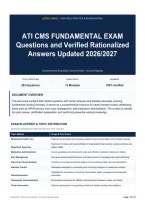
ATI CMS FUNDAMENTAL EXAM
Questions and Verified Rationalized
Answers Updated 2026/2027
Comprehensive Examination Question Bank • Concept Mapping
TOTAL QUESTIONS EXAM TOPICS ANSWERS
283 Questions 12 Modules 100% Verified
DOCUMENT OVERVIEW
This document contains 283 verified questions with correct answers and detailed rationales covering
fundamental nursing concepts. It serves as a comprehensive resource for newly licensed nurses, addressing
areas such as HIPAA privacy rules, pain management, and medication administration. The content is suitable
for exam review, certification preparation, and reinforcing essential nursing knowledge.
EXAM BLUEPRINT & TOPIC DISTRIBUTION
Systematic breakdown of subject domains and exam coverage.
Topic Module Scope & Core Focus
Restorative Health Care Explores the principles and practices related to recovering health and functional capacity.
Examines the roles and responsibilities of organizations that oversee nursing practices and
Regulatory Agencies patient safety.
Medication Administration Covers guidelines and protocols for safe and effective medication delivery to clients.
Pain Management Discusses assessment techniques and interventions for managing client pain effectively.
Client Care Documentation Focuses on the legal and ethical aspects of documenting client care and interactions.
Infection Control Addresses strategies for preventing and controlling infections in healthcare settings.
Highlights the importance of teaching clients about health management and disease
Patient Education prevention.
Therapeutic Communication Emphasizes techniques for effective communication between nurses and clients.
Crisis Intervention Explores approaches for supporting clients and families during crisis situations.
Confidential • Student Study Edition • Practice & Review Guide Page 1 of 112
,STUDENT STUDY & MASTERY EDITION PRACTICE & REVIEW GUIDE
Health Promotion Focuses on strategies for enhancing client wellness and preventing illness.
Cultural Competence Examines the significance of understanding diverse cultural backgrounds in nursing care.
End-of-Life Care Discusses nursing considerations and interventions for clients facing terminal illnesses.
Total Exam Coverage 12 Integrated Topic Modules • 283 Examination Questions
HIGH-YIELD: QUESTIONS & VERIFIED ANSWERS
Complete Examination Questions • 283 Questions • Sequential Exam Layout
QUESTION 1
Ch. 1) A nurse is discussing restorative health care with a newly licensed nurse. Which
of the following examples should the nurse include in the teaching? (Select all that
apply.)
A. Home health care
B. Rehabilitation facilities
C. Diagnostic centers
D. Skilled nursing facilities
E. Oncology centers
Answer: A, B, D.
Rationale: A. Restorative health care involves immediate follow up care for restoring health and prolonged self-care home
healthcare is a type of restorative healthcare
B. Rehabilitation facilities are a type of restorative health care
D. Skilled nursing facilities are a type of restorative healthcare.
QUESTION 2
Ch. 1) A nurse is explaining the various types of health clients might have to a group
care coverage of nurses. Which of the following health care financing mechanisms
should the nurse include as federally funded? (Select all that apply.)
A. Preferred provider organization (PPO)
B. Medicare
C. Long-term care insurance
D. Exclusive provider organization (EPO)
E. Medicaid
Answer: B, E.
Confidential • Student Study Edition • Practice & Review Guide Page 2 of 112
,STUDENT STUDY & MASTERY EDITION PRACTICE & REVIEW GUIDE
Rationale: Medicare and Medicaid are federally funded.
PPOs, Long-term care insurance and EPOs are privately funded.
QUESTION 3
Ch. 1) A nurse manager is developing strategies to care for the increasing number of
clients who have obesity. Which of the following actions should the nurse include as a
primary health care strategy?
A. Collaborating with providers to perform obesity screenings during routine office visits
B. Ensuring the availability of specialized beds in rehabilitation centers for clients who have obesity
C. Providing specialized intraoperative training in surgical treatments for obesity
D. Educating acute care nurses about postoperative complications related to obesity
Answer: A.
Rationale: Identify obesity screenings at office visit as an example of primary healthcare. primary healthcare emphasizes
health promotion and disease control, is often delivered during office visit, and includes screenings.
QUESTION 4
Ch. 1) A nurse is discussing the purpose of regulatory agencies during a staff meeting.
Which of the following tasks should the nurse identify as the responsibility of state
licensing boards?
A. Monitoring evidence-based practice for clients who have a specific diagnosis
B. Ensuring that health care providers comply with regulations
C. Setting quality standards for accreditation of health care facilities
D. Determining whether medications are safe for administration to clients
Answer: B.
Rationale: Identify that state licensing boards are responsible for ensuring that healthcare providers and agencies comply
with state regulations.
QUESTION 5
Ch. 1) A nurse is explaining the various levels of health care services to a group of
newly licensed
nurses. Which of the following examples of care or care settings should the nurse
classify as tertiary care? (Select all that apply)
Confidential • Student Study Edition • Practice & Review Guide Page 3 of 112
, STUDENT STUDY & MASTERY EDITION PRACTICE & REVIEW GUIDE
A. Intensive care unit
B. Oncology treatment center
C. Burn center
D. Cardiac rehabilitation
E. Home health care
Answer: A, B, C.
Rationale: Tertiary healthcare involves the provision of specialized and highly technical care (icu, oncology treatment
center, and burn centers)
QUESTION 6
Ch. 2) A nurse is caring for a group of clients on a medical-surgical unit. For which of
the following client care needs should the nurse initiate a referral for a social worker?
(Select all that apply.)
A. A client who has terminal cancer requests hospice care in the home.
B. A client asks about community resources available for older adults.
C. A client states, "I would like to have my child baptized before surgery."
D. A client requests an electric wheelchair for use after discharge.
E. A client states, "I do not understand how to use a nebulizer."
Answer: A, B, D.
Rationale: A. initiate a referral for a social worker to provide information and assistance in coordinating hospice care for a
patient
B. Initiate a referral for a social worker to provide information and assistance in coordinating care for community resources
available for clients
D. Initiate a referral for a social worker to assist the client in obtaining medical equipment for use after discharge.
Confidential • Student Study Edition • Practice & Review Guide Page 4 of 112