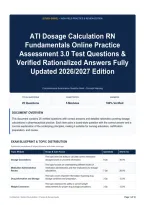
[STUDY GUIDE] • HIGH-YIELD PRACTICE & REVIEW EDITION
ATI Dosage Calculation RN
Fundamentals Online Practice
Assessment 3.0 Test Questions &
Verified Rationalized Answers Fully
Updated 2026/2027 Edition
Comprehensive Examination Question Bank • Concept Mapping
TOTAL QUESTIONS EXAM TOPICS ANSWERS
25 Questions 5 Modules 100% Verified
DOCUMENT OVERVIEW
This document contains 25 verified questions with correct answers and detailed rationales covering dosage
calculations in pharmaceutical practice. Each item pairs a board-style question with the correct answer and a
concise explanation of the underlying principles, making it suitable for nursing education, certification
preparation, and review.
EXAM BLUEPRINT & TOPIC DISTRIBUTION
Systematic breakdown of subject domains and exam coverage.
Topic Module Scope & Core Focus Questions Share (%)
This topic tests the ability to calculate correct medication
Dosage Calculations dosages based on provided information. 9 Qs 36.0%
This topic focuses on understanding different routes of
Medication Administration medication administration and their implications for dosage
Routes calculations. 7 Qs 28.0%
This topic covers important information regarding drug
Drug Information and Storage storage conditions and preparation. 3 Qs 12.0%
This topic assesses the ability to convert weight
Weight Conversion measurements for proper drug dosage calculations. 3 Qs 12.0%
Confidential • Student Study Edition • Practice & Review Guide Page 1 of 10
, STUDENT STUDY & MASTERY EDITION PRACTICE & REVIEW GUIDE
This topic evaluates the ability to review and clarify
Prescription Review medication prescriptions for accuracy. 3 Qs 12.0%
Total Exam Coverage 5 Integrated Topic Modules 25 Qs 100.0%
TOPIC 1: DOSAGE CALCULATIONS
9 Questions • 36.0% of Exam • This topic tests the ability to calculate correct medication dosages based on provided information.
QUESTION 1
A nurse is preparing to administer eszopiclone 2,000 mcg PO to a client. How many
should the nurse administer?
Answer: 2 Mg.
Rationale: The key is to recognize that mcg (micrograms) is a smaller unit of measurement than mg (milligrams), with 1 mg
being equal to 1,000 mcg. Therefore, to convert 2,000 mcg to mg, the nurse would divide by 1,000, resulting in 2 mg, which
is the correct dose to administer.
QUESTION 2
A nurse is preparing to administer codeine 20 mL oral solution to a client. How many
tsp should the nurse administer?
Answer: 4 Tsp.
Rationale: The key to solving this problem is to recognize that the dosage is given in milliliters (mL), but the desired unit of
measurement is teaspoons (tsp), and 1 teaspoon is equivalent to 5 milliliters. Therefore, to find the correct dosage in
teaspoons, the nurse must divide the given dosage in milliliters (20 mL) by the conversion factor (5 mL/tsp), resulting in 4
teaspoons.
QUESTION 3
A nurse is preparing to administer furosemide 20 mg IM. Available is furosemide
injection 10 mg/mL. How many mL should the nurse admsinister?
Answer: 2 ML.
Rationale: The nurse needs to administer 20 mg of furosemide, and since the available injection contains 10 mg per mL,
the nurse must administer 2 mL to deliver the required 20 mg dose. This is calculated by dividing the desired dose (20
mg) by the concentration of the injection (10 mg/mL), resulting in the correct volume of 2 mL.
Confidential • Student Study Edition • Practice & Review Guide Page 2 of 10