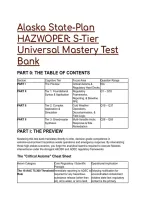
Alaska State-Plan
HAZWOPER: S-Tier
Universal Mastery Test
Bank
PART 0: THE TABLE OF CONTENTS
Section Cognitive Tier Focus Area Question Range
PART I The Preview Critical Axioms & N/A
Regulatory Hard Decks
PART II Tier 1: Foundational Regulatory Q1 – Q18
Syntax & Application Frameworks,
Reporting, & Baseline
PPE
PART II Tier 2: Complex Cold Weather Q19 – Q37
Application & Operations,
Simulation Decontamination, &
Field Logic
PART II Tier 3: Grandmaster Multi-Variable Arctic Q38 – Q55
Synthesis Response & Site
Remediation
PART I: THE PREVIEW
Mastering this test bank translates directly to elite, decision-grade competence in
extreme-environment hazardous waste operations and emergency response. By internalizing
these high-stakes scenarios, you forge the analytical stamina required to execute flawless
interventions under the stringent AKOSH and ADEC regulatory frameworks.
The "Critical Axioms" Cheat Sheet
Axiom Category Core Regulatory / Scientific Operational Implication
Principle
The 18 AAC 75.300 Threshold Immediate reporting to ADEC is Delaying notification for
Rule required for any hazardous uncoordinated containment
substance release (other than violates state law; regulatory
oil), oil to water, or oil to land contact is the primary
,Axiom Category Core Regulatory / Scientific Operational Implication
Principle
exceeding 55 gallons. operational trigger.
The 8 AAC 61.1110 PADS Alaska mandates Physical PPE provision does not replace
Mandate Agent Data Sheets (PADS) for the statutory requirement for
physical hazards (cold stress, physical hazard education and
noise), distinct from chemical documented training.
SDS.
The ACGIH Cold Stress At -45°F (-43°C) and below, all Operational shifts must be
Axiom non-emergency outdoor work dynamically adjusted based on
must cease regardless of wind combined wind-chill matrices,
speed. not isolated ambient
temperature readings.
The 18 AAC 75.434 Blowout Response Planning Standards Contingency plans must prove
RPS for blowouts require front-loaded logistical
containment of 16,500 barrels capability; equipment stockpiled
within 72 hours, plus 5,500 too far away invalidates the
barrels/day thereafter. plan.
The Subzero Decon Protocol In ambient temperatures below Transition to dry
freezing, wet decontamination decontamination (e.g.,
risks hypothermia and PPE FAST-ACT) and heated CRZ
mechanical failure. shelters is a physiological and
tactical necessity.
PART II: THE ELITE TEST BANK
Q1: During routine pipeline maintenance in the North Slope, a valve failure results in the release
of 60 gallons of crude oil directly onto the frozen tundra outside of secondary containment.
Based on the principles of 18 AAC 75.300, which action is the FIRST reporting requirement? A)
Notify the ADEC within 48 hours and log the spill in the monthly incident record. B) Wait until the
spill is contained, then submit a written final cleanup report to ADEC within 15 days. C)
Immediately notify the ADEC Response Team by telephone as soon as the person has
knowledge of the discharge. D) Report the incident to AKOSH under the Physical Agent Data
Sheet protocol immediately.
● Answer: C (Immediately notify the ADEC Response Team by telephone as soon as the
person has knowledge of the discharge.)
● Distractor Analysis:
○ A is incorrect: The 48-hour window applies to oil spills to land between 10 and 55
gallons, or spills over 55 gallons that are entirely captured within an impermeable
secondary containment structure.
○ B is incorrect: While a final cleanup report is required within 15 days of cleanup
completion, immediate verbal notification is the primary statutory trigger.
○ D is incorrect: AKOSH PADS apply to physical agents like cold stress, not chemical
spill reporting.
The Mentor's Analysis: Immediate reporting is the absolute hard deck for any oil spill to land
exceeding 55 gallons outside containment. By immediately engaging ADEC, you bypass the
common novice error of delaying notification while attempting uncoordinated containment.
Professional Intuition: If it breaches containment and exceeds a 55-gallon drum's worth,
, ADEC's phone rings immediately.
Q2: An operator discovers a leaking 5-gallon container of a highly toxic, non-oil hazardous
substance inside a facility's staging area. The substance has pooled on the concrete floor but
has not reached the soil or water. Under 18 AAC 75.300, which conclusion is the MOST
APPROPRIATE? A) The spill does not require immediate reporting because it is under the
10-gallon threshold. B) The spill must be reported within 48 hours because it is on an
impermeable surface. C) The spill must be reported immediately because it is a hazardous
substance other than oil. D) The spill is only reportable if it threatens a local population or
marine waters.
● Answer: C (The spill must be reported immediately because it is a hazardous substance
other than oil.)
● Distractor Analysis:
○ A is incorrect: Volume thresholds (10 or 55 gallons) apply strictly to oil releases, not
other hazardous substances.
○ B is incorrect: Secondary containment allowances for 48-hour reporting apply
specifically to oil, not hazardous chemicals.
○ D is incorrect: Threat to marine waters elevates the severity, but immediate
reporting is triggered by the substance classification alone.
The Mentor's Analysis: The regulatory framework treats non-oil hazardous substances with zero
tolerance regarding volume thresholds. Utilizing immediate notification for hazardous chemicals
bypasses the common trap of misapplying oil-specific volume rules to toxic chemicals.
Professional Intuition: For non-oil hazardous substances, the threshold for immediate
reporting is the presence of the spill itself, regardless of volume.
Q3: A facility accumulates a steady drip of a hazardous substance over several months,
resulting in a large pooled volume. Under 18 AAC 75.990, this gradual increase in quantity or
concentration over time is defined as which of the following? A) A major discharge B) An
instantaneous release C) Accumulation D) Background concentration
● Answer: C (Accumulation)
● Distractor Analysis:
○ A is incorrect: A major discharge refers to massive, acute releases, such as over
10,000 gallons on inland waters.
○ B is incorrect: Instantaneous implies a sudden, acute event, which is the opposite of
a steady drip.
○ D is incorrect: Background concentration refers to naturally occurring levels of a
substance in the environment.
The Mentor's Analysis: Statutory definitions govern liability and response triggers. Recognizing
accumulation bypasses the legal trap of ignoring slow leaks simply because they lack the optics
of a catastrophic spill. Professional Intuition: A slow drip is just a major spill operating in
slow motion; it meets the absolute legal definition of accumulation.
Q4: An employer in Alaska assigns a new technician to a winter remediation site. Before
exposing the worker to extreme cold, the employer must provide a specific state-mandated
document outlining the hazards of cold stress. Based on AKOSH regulations (8 AAC 61.1110),
which document is REQUIRED? A) A federal OSHA Form 20 Safety Data Sheet B) A Chemical
Hazard Communication Standard (HAZCOM) sheet C) A Physical Agent Data Sheet (PADS) D)
A Site-Specific Decontamination Plan
● Answer: C (A Physical Agent Data Sheet (PADS))
● Distractor Analysis:
○ A is incorrect: OSHA Form 20 is a legacy MSDS format for chemicals, not physical
HAZWOPER: S-Tier
Universal Mastery Test
Bank
PART 0: THE TABLE OF CONTENTS
Section Cognitive Tier Focus Area Question Range
PART I The Preview Critical Axioms & N/A
Regulatory Hard Decks
PART II Tier 1: Foundational Regulatory Q1 – Q18
Syntax & Application Frameworks,
Reporting, & Baseline
PPE
PART II Tier 2: Complex Cold Weather Q19 – Q37
Application & Operations,
Simulation Decontamination, &
Field Logic
PART II Tier 3: Grandmaster Multi-Variable Arctic Q38 – Q55
Synthesis Response & Site
Remediation
PART I: THE PREVIEW
Mastering this test bank translates directly to elite, decision-grade competence in
extreme-environment hazardous waste operations and emergency response. By internalizing
these high-stakes scenarios, you forge the analytical stamina required to execute flawless
interventions under the stringent AKOSH and ADEC regulatory frameworks.
The "Critical Axioms" Cheat Sheet
Axiom Category Core Regulatory / Scientific Operational Implication
Principle
The 18 AAC 75.300 Threshold Immediate reporting to ADEC is Delaying notification for
Rule required for any hazardous uncoordinated containment
substance release (other than violates state law; regulatory
oil), oil to water, or oil to land contact is the primary
,Axiom Category Core Regulatory / Scientific Operational Implication
Principle
exceeding 55 gallons. operational trigger.
The 8 AAC 61.1110 PADS Alaska mandates Physical PPE provision does not replace
Mandate Agent Data Sheets (PADS) for the statutory requirement for
physical hazards (cold stress, physical hazard education and
noise), distinct from chemical documented training.
SDS.
The ACGIH Cold Stress At -45°F (-43°C) and below, all Operational shifts must be
Axiom non-emergency outdoor work dynamically adjusted based on
must cease regardless of wind combined wind-chill matrices,
speed. not isolated ambient
temperature readings.
The 18 AAC 75.434 Blowout Response Planning Standards Contingency plans must prove
RPS for blowouts require front-loaded logistical
containment of 16,500 barrels capability; equipment stockpiled
within 72 hours, plus 5,500 too far away invalidates the
barrels/day thereafter. plan.
The Subzero Decon Protocol In ambient temperatures below Transition to dry
freezing, wet decontamination decontamination (e.g.,
risks hypothermia and PPE FAST-ACT) and heated CRZ
mechanical failure. shelters is a physiological and
tactical necessity.
PART II: THE ELITE TEST BANK
Q1: During routine pipeline maintenance in the North Slope, a valve failure results in the release
of 60 gallons of crude oil directly onto the frozen tundra outside of secondary containment.
Based on the principles of 18 AAC 75.300, which action is the FIRST reporting requirement? A)
Notify the ADEC within 48 hours and log the spill in the monthly incident record. B) Wait until the
spill is contained, then submit a written final cleanup report to ADEC within 15 days. C)
Immediately notify the ADEC Response Team by telephone as soon as the person has
knowledge of the discharge. D) Report the incident to AKOSH under the Physical Agent Data
Sheet protocol immediately.
● Answer: C (Immediately notify the ADEC Response Team by telephone as soon as the
person has knowledge of the discharge.)
● Distractor Analysis:
○ A is incorrect: The 48-hour window applies to oil spills to land between 10 and 55
gallons, or spills over 55 gallons that are entirely captured within an impermeable
secondary containment structure.
○ B is incorrect: While a final cleanup report is required within 15 days of cleanup
completion, immediate verbal notification is the primary statutory trigger.
○ D is incorrect: AKOSH PADS apply to physical agents like cold stress, not chemical
spill reporting.
The Mentor's Analysis: Immediate reporting is the absolute hard deck for any oil spill to land
exceeding 55 gallons outside containment. By immediately engaging ADEC, you bypass the
common novice error of delaying notification while attempting uncoordinated containment.
Professional Intuition: If it breaches containment and exceeds a 55-gallon drum's worth,
, ADEC's phone rings immediately.
Q2: An operator discovers a leaking 5-gallon container of a highly toxic, non-oil hazardous
substance inside a facility's staging area. The substance has pooled on the concrete floor but
has not reached the soil or water. Under 18 AAC 75.300, which conclusion is the MOST
APPROPRIATE? A) The spill does not require immediate reporting because it is under the
10-gallon threshold. B) The spill must be reported within 48 hours because it is on an
impermeable surface. C) The spill must be reported immediately because it is a hazardous
substance other than oil. D) The spill is only reportable if it threatens a local population or
marine waters.
● Answer: C (The spill must be reported immediately because it is a hazardous substance
other than oil.)
● Distractor Analysis:
○ A is incorrect: Volume thresholds (10 or 55 gallons) apply strictly to oil releases, not
other hazardous substances.
○ B is incorrect: Secondary containment allowances for 48-hour reporting apply
specifically to oil, not hazardous chemicals.
○ D is incorrect: Threat to marine waters elevates the severity, but immediate
reporting is triggered by the substance classification alone.
The Mentor's Analysis: The regulatory framework treats non-oil hazardous substances with zero
tolerance regarding volume thresholds. Utilizing immediate notification for hazardous chemicals
bypasses the common trap of misapplying oil-specific volume rules to toxic chemicals.
Professional Intuition: For non-oil hazardous substances, the threshold for immediate
reporting is the presence of the spill itself, regardless of volume.
Q3: A facility accumulates a steady drip of a hazardous substance over several months,
resulting in a large pooled volume. Under 18 AAC 75.990, this gradual increase in quantity or
concentration over time is defined as which of the following? A) A major discharge B) An
instantaneous release C) Accumulation D) Background concentration
● Answer: C (Accumulation)
● Distractor Analysis:
○ A is incorrect: A major discharge refers to massive, acute releases, such as over
10,000 gallons on inland waters.
○ B is incorrect: Instantaneous implies a sudden, acute event, which is the opposite of
a steady drip.
○ D is incorrect: Background concentration refers to naturally occurring levels of a
substance in the environment.
The Mentor's Analysis: Statutory definitions govern liability and response triggers. Recognizing
accumulation bypasses the legal trap of ignoring slow leaks simply because they lack the optics
of a catastrophic spill. Professional Intuition: A slow drip is just a major spill operating in
slow motion; it meets the absolute legal definition of accumulation.
Q4: An employer in Alaska assigns a new technician to a winter remediation site. Before
exposing the worker to extreme cold, the employer must provide a specific state-mandated
document outlining the hazards of cold stress. Based on AKOSH regulations (8 AAC 61.1110),
which document is REQUIRED? A) A federal OSHA Form 20 Safety Data Sheet B) A Chemical
Hazard Communication Standard (HAZCOM) sheet C) A Physical Agent Data Sheet (PADS) D)
A Site-Specific Decontamination Plan
● Answer: C (A Physical Agent Data Sheet (PADS))
● Distractor Analysis:
○ A is incorrect: OSHA Form 20 is a legacy MSDS format for chemicals, not physical