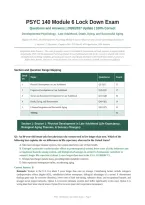
PSYC 140 Module 6 Lock Down Exam
Questions and Answers | 2026/2027 Update | 100% Correct
Developmental Psychology - Late Adulthood, Death, Dying, and Successful Aging
Aligned with PSYC 140 Developmental Psychology Module 6 Course Objectives and Current Gerontological Research
5 Sections | 75 Questions | Cognitive Mix: 35% Recall, 45% Application, 20% Analysis
Independent Study Resource - This exam preparation resource is intended for educational and study purposes to support students
preparing for PSYC 140 Developmental Psychology Module 6 (Late Adulthood and End of Life). Content is aligned with current
developmental psychology standards, gerontological research, and lifespan development theories (Erikson, Baltes, Carstensen,
Kübler-Ross, Bowlby, and others). Verify all content with current course materials, textbook, and instructor guidance.
Section and Question Range Mapping
Secti
Topic Questions Count
on
1 Physical Development in Late Adulthood Q1-Q15 15
2 Cognitive Development in Late Adulthood Q16-Q32 17
3 Social and Emotional Development in Late Adulthood Q33-Q48 16
4 Death, Dying, and Bereavement Q49-Q62 14
5 Lifespan Integration and Successful Aging Q63-Q75 13
TOTAL 75
Section 1: Section 1: Physical Development in Late Adulthood (Life Expectancy,
Biological Aging Theories, & Sensory Changes)
Q1: An 80-year-old female asks her physician why women tend to live longer than men. Which of the
following best explains the sex differences in life expectancy observed in the United States?
A. Men have stronger immune systems, but women take better care of their health.
B. Estrogen's protective cardiovascular effects in premenopausal women, lower rates of risky behaviors and
occupational hazards among women, and biological advantages in second X chromosome contribute to
women's longer life expectancy (about 5 years longer than men in the U.S.). [CORRECT]
C. Women have larger muscle mass, providing better metabolic reserves.
D. Men experience menopause earlier, accelerating aging.
Correct Answer: B
Rationale: Women in the U.S. live about 5 years longer than men on average. Contributing factors include estrogen's
cardioprotective effects (higher HDL, vasodilation) before menopause, biological advantages of a second X chromosome
(backup gene copy for recessive disorders), lower rates of fatal risk-taking, substance abuse, and occupational hazards, and
stronger social support networks. Option A is incorrect (immune systems don't differ significantly in this way). Option C is
wrong (men have more muscle mass). Option D is incorrect (men don't experience menopause).
PSYC 140 Module 6 Lock Down Exam | Page 1
,PSYC 140 MODULE 6 LOCK DOWN EXAM - 75 QUESTION TEST BANK
Q2: A researcher is studying cellular senescence and notes that telomeres shorten with each cell division until
the Hayflick limit is reached. Which biological theory of aging does this most directly support?
A. Wear-and-tear theory.
B. Cellular clock theory (Hayflick's programmed cellular aging). [CORRECT]
C. Hormonal stress theory.
D. Free radical theory.
Correct Answer: B
Rationale: Cellular clock theory, proposed by Leonard Hayflick, states that cells have a finite number of divisions (Hayflick
limit, ~50 divisions) due to telomere shortening. Telomeres are protective caps at chromosome ends that shorten with each cell
division; when critically short, cells enter senescence or apoptosis. This is a programmed (genetically influenced) theory of
aging. Wear-and-tear theory (Option A) emphasizes accumulated damage. Hormonal stress theory (Option C) focuses on
neuroendocrine changes. Free radical theory (Option D) emphasizes oxidative damage.
Q3: A gerontologist explains that lifelong exposure to environmental toxins, radiation, and metabolic
byproducts progressively damages cells and tissues, ultimately leading to aging. Which theory of aging is
being described?
A. Cellular clock theory.
B. Wear-and-tear theory (also called accumulation theory). [CORRECT]
C. Programmed theory of aging.
D. Activity theory.
Correct Answer: B
Rationale: Wear-and-tear theory (also called accumulation theory) proposes that aging results from accumulated damage to
cells and tissues from environmental toxins, radiation, free radicals, and metabolic byproducts over the lifespan. Unlike
programmed theories (Options A and C), it emphasizes stochastic (random) damage accumulation. Activity theory (Option D)
is a psychosocial theory of successful aging, not a biological theory.
Q4: A 72-year-old male complains of difficulty reading small print and focusing on close objects. Eye
examination reveals loss of lens elasticity. Which age-related sensory change is he experiencing?
A. Presbycusis.
B. Presbyopia. [CORRECT]
C. Macular degeneration.
D. Glaucoma.
Correct Answer: B
Rationale: Presbyopia (literally 'old eye') is the age-related loss of near vision due to hardening and loss of elasticity of the
lens, beginning around age 40 and progressively worsening. Reading glasses or bifocals correct this refractive change.
Presbycusis (Option A) is age-related hearing loss. Macular degeneration (Option C) involves deterioration of the macula
(central vision). Glaucoma (Option D) involves elevated intraocular pressure damaging the optic nerve (peripheral vision loss).
PSYC 140 Module 6 Lock Down Exam | Page 2
, PSYC 140 MODULE 6 LOCK DOWN EXAM - 75 QUESTION TEST BANK
Q5: An 80-year-old female reports progressive loss of central vision while peripheral vision remains intact.
Eye examination reveals drusen deposits in the macula. Which condition does she have?
A. Glaucoma.
B. Cataracts.
C. Macular degeneration. [CORRECT]
D. Presbyopia.
Correct Answer: C
Rationale: Macular degeneration (age-related macular degeneration, AMD) is characterized by deterioration of the macula
(central retina), causing loss of central vision while peripheral vision remains intact. Drusen (yellow deposits under the retina)
are a hallmark sign. It is the leading cause of blindness in older adults. Glaucoma (Option A) causes peripheral vision loss.
Cataracts (Option B) cause overall cloudy vision. Presbyopia (Option D) is age-related farsightedness.
Q6: A 75-year-old male presents with gradually increasing intraocular pressure and loss of peripheral vision.
He has not had an eye exam in 10 years. Which condition is most likely, and why is early detection important?
A. Macular degeneration; causes sudden central vision loss.
B. Glaucoma; often asymptomatic until significant irreversible optic nerve damage has occurred, so screening
is critical. [CORRECT]
C. Cataracts; cause acute eye pain.
D. Presbyopia; reverses with reading glasses.
Correct Answer: B
Rationale: Glaucoma involves elevated intraocular pressure damaging the optic nerve, leading to progressive peripheral vision
loss ('tunnel vision'). It is often asymptomatic until significant, irreversible damage has occurred, making routine screening
critical (especially for older adults, African Americans, and those with family history). Treatment (eye drops, laser, surgery)
can prevent further vision loss but cannot reverse existing damage. Macular degeneration (Option A) affects central vision.
Cataracts (Option C) cause gradual cloudy vision. Presbyopia (Option D) is age-related farsightedness.
Q7: A 78-year-old male complains of difficulty hearing high-frequency sounds (e.g., consonants like s, f, th),
making speech sound mumbled. Audiometry reveals bilateral high-frequency sensorineural hearing loss.
Which condition does he have, and what is the typical underlying cause?
A. Conductive hearing loss; damage to the eardrum.
B. Presbycusis; degeneration of hair cells in the cochlea (especially at the base, which processes high
frequencies). [CORRECT]
C. Otitis media; middle ear infection.
D. Tinnitus; excessive earwax.
Correct Answer: B
Rationale: Presbycusis is age-related sensorineural hearing loss, primarily affecting high frequencies first (because hair cells
at the base of the cochlea, which process high frequencies, degenerate first). It makes speech perception difficult (consonants
are high-frequency), especially in noisy environments (the 'cocktail party problem'). Hearing aids amplify sounds but cannot
restore normal frequency discrimination. Conductive hearing loss (Option A) involves outer/middle ear. Otitis media (Option
C) is middle ear infection. Tinnitus (Option D) is ringing in the ears.
PSYC 140 Module 6 Lock Down Exam | Page 3