
STUVIA ★ A+ VER IFIED
A+ VERIFIED NURSING ASSESSMENTS
T H E U N I V E R S I T Y O F T E X A S AT A R L I N G T O N
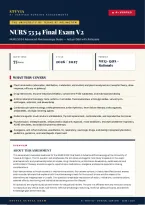
NURS 5334 Final Exam V2
NURS 5334 Advanced Pharmacology Guide — Actual Q&A with Rationale
QUE STI ONS CYCLE F O R M AT
75 Items MCQ · Q&A +
Rationale
WHAT THIS COVERS
Pharmacokinetics (absorption, distribution, metabolism, elimination) and pharmacodynamics (receptor theory, dose-
response, efficacy vs potency)
Drug interactions, enzyme induction/inhibition, cytochrome P450 substrates, and individualized dosing
Antimicrobial pharmacology: beta-lactams, macrolides, fluoroquinolones, aminoglycosides, vancomycin,
antifungals, antivirals, and stewardship
Cardiovascular pharmacology: antihypertensives, antiarrhythmics, heart failure therapy, anticoagulants,
antiplatelets, and lipid-lowering agents
Endocrine agents: insulin and oral antidiabetics, thyroid replacement, corticosteroids, and reproductive hormones
Psychotropics: antidepressants, antipsychotics (typical & atypical), mood stabilizers, anxiolytics/sedative-hypnotics,
ADHD stimulants, and addiction pharmacotherapy
Analgesics, anti-inflammatories, anesthetics, GI, respiratory, neurologic drugs, and dosing in pregnancy/lactation,
pediatrics, geriatrics, and renal/hepatic impairment
OVERVIEW
ABOUT THIS ASSESSMENT
This assessment evaluates readiness for the NURS 5334 Final Exam in Advanced Pharmacology at the University of
Texas at Arlington. The V2 question set emphasizes the principles and agents most likely to appear on the exam:
pharmacokinetic and pharmacodynamic principles, drug interactions, antimicrobial stewardship, cardiovascular and
antithrombotic therapy, endocrine agents, psychotropic medications, analgesia, and special-population dosing
considerations.
Each item provides a clinical scenario or mechanism question, four answer options, a clearly identified correct answer,
and a concise rationale that explains both the pharmacologic basis for the correct choice and the reasons the
alternatives are inappropriate or unsafe. The questions emphasize mechanism of action, indications, contraindications,
adverse effects, monitoring, and individualized dosing across the lifespan.
All questions are original study content written for educational review. They are not affiliated with any institution and do
not reproduce any official exam. Use them to refine pharmacologic reasoning, reinforce safety principles, and identify
knowledge gaps before test day.
STUVIA ACTUAL EXAM A+ VERI F I ED · O RI GI N AL CO N T EN T ·
,STUVIA ACTUAL EXAM
NURS 5334 Final Exam V2 Page 1
MULTIPLE CHOICE QUESTIONS — Q&A WITH RATIONALE
75 original items · Topics: pharmacokinetics/pharmacodynamics, drug interactions & CYP450, antimicrobial pharmacology &
stewardship, cardiovascular & antithrombotic agents, endocrine agents (insulin, oral antidiabetics, thyroid, corticosteroids),
psychotropics (antidepressants, antipsychotics, mood stabilizers, anxiolytics, ADHD), analgesia & anti-inflammatory, anesthetics,
GI/respiratory/neuro, and dosing in pregnancy/lactation, pediatrics, geriatrics, and renal/hepatic impairment.
Q1.
A drug with high first-pass metabolism is switched from oral to sublingual administration. The primary
pharmacokinetic rationale is to:
A. Bypass portal circulation and avoid first-pass metabolism
B. Increase hepatic metabolism of the drug
C. Reduce absorption rate
D. Increase protein binding
CORRECT ANSWER: A | Bypass portal circulation and avoid first-pass metabolism
RATIONALE
First-pass metabolism refers to drug metabolism by the liver before reaching systemic circulation following oral
administration. Sublingual, buccal, and certain rectal routes bypass the portal circulation, increasing bioavailability of
drugs with high first-pass effect (e.g., nitroglycerin, morphine, propranol). Other routes like IV also bypass first-pass
metabolism.
Q2.
A patient on warfarin is started on amiodarone. The nurse anticipates:
A. No interaction
B. Reduced amiodarone level
C. Decreased warfarin effect due to enzyme induction
D. Increased warfarin effect (CYP2C9 inhibition) and need for INR monitoring with dose reduction
CORRECT ANSWER: D | Increased warfarin effect (CYP2C9 inhibition) and need for INR monitoring
with dose reduction
RATIONALE
Amiodarone is a potent CYP2C9 inhibitor. Warfarin (S-enantiomer) is metabolized by CYP2C9; inhibition increases
INR and bleeding risk. Dose reduction of warfarin by 25–50% is typical, with close INR monitoring for weeks
(amiodarone has long half-life and the interaction persists after stopping). Other CYP2C9 inhibitors: fluconazole,
metronidazole, sulfamethoxazole, statins.
A+ VERIFIED · Original Content · NURS 5334 Final Exam V2
, STUVIA ACTUAL EXAM
NURS 5334 Final Exam V2 Page 2
Q3.
A patient with creatinine clearance 25 mL/min is started on vancomycin. The dosing adjustment is based
on:
A. Body surface area only
B. Body mass index only
C. Liver function tests
D. Renal function and target trough (typically 10–20 mcg/mL; 15–20 for serious MRSA infections)
CORRECT ANSWER: D | Renal function and target trough (typically 10–20 mcg/mL; 15–20 for serious
MRSA infections)
RATIONALE
Vancomycin is renally cleared and requires individualized dosing based on renal function and target trough levels. For
serious MRSA infections (pneumonia, bacteremia, endocarditis), target trough 15–20 mcg/mL. For mild-moderate
infections, target 10–15. AUC/MIC-based dosing is increasingly used. Nephrotoxicity risk increases with concurrent
nephrotoxins and high troughs.
Q4.
A patient with atrial fibrillation is prescribed dabigatran. The specific reversal agent is:
A. Protamine sulfate
B. Andexanet alfa
C. Idarucizumab
D. Vitamin K
CORRECT ANSWER: C | Idarucizumab
RATIONALE
Idarucizumab is a monoclonal antibody fragment that specifically reverses dabigatran (direct thrombin inhibitor).
Andexanet alfa reverses factor Xa inhibitors (apixaban, rivaroxaban, edoxaban). Protamine reverses heparin (and
partially enoxaparin). Vitamin K reverses warfarin (slow). Prothrombin complex concentrate (PCC) provides more rapid
reversal of warfarin.
Q5.
A patient with anaphylaxis receives IM epinephrine. The receptor primarily responsible for bronchodilation
is:
A. Alpha-1 (vascular smooth muscle constriction)
B. Beta-1 (cardiac)
C. Beta-2 (bronchial smooth muscle relaxation)
D. Muscarinic-3
CORRECT ANSWER: C | Beta-2 (bronchial smooth muscle relaxation)
RATIONALE
Epinephrine is a non-selective alpha and beta adrenergic agonist. Beta-2 stimulation causes bronchodilation, and
alpha-1 stimulation causes vasoconstriction reducing mucosal edema. Beta-1 increases heart rate and contractility.
For anaphylaxis, IM epinephrine (0.3–0.5 mg of 1:1000) in the anterolateral thigh is the first-line treatment; repeat
every 5–15 minutes as needed.
A+ VERIFIED · Original Content · NURS 5334 Final Exam V2
A+ VERIFIED NURSING ASSESSMENTS
T H E U N I V E R S I T Y O F T E X A S AT A R L I N G T O N
NURS 5334 Final Exam V2
NURS 5334 Advanced Pharmacology Guide — Actual Q&A with Rationale
QUE STI ONS CYCLE F O R M AT
75 Items MCQ · Q&A +
Rationale
WHAT THIS COVERS
Pharmacokinetics (absorption, distribution, metabolism, elimination) and pharmacodynamics (receptor theory, dose-
response, efficacy vs potency)
Drug interactions, enzyme induction/inhibition, cytochrome P450 substrates, and individualized dosing
Antimicrobial pharmacology: beta-lactams, macrolides, fluoroquinolones, aminoglycosides, vancomycin,
antifungals, antivirals, and stewardship
Cardiovascular pharmacology: antihypertensives, antiarrhythmics, heart failure therapy, anticoagulants,
antiplatelets, and lipid-lowering agents
Endocrine agents: insulin and oral antidiabetics, thyroid replacement, corticosteroids, and reproductive hormones
Psychotropics: antidepressants, antipsychotics (typical & atypical), mood stabilizers, anxiolytics/sedative-hypnotics,
ADHD stimulants, and addiction pharmacotherapy
Analgesics, anti-inflammatories, anesthetics, GI, respiratory, neurologic drugs, and dosing in pregnancy/lactation,
pediatrics, geriatrics, and renal/hepatic impairment
OVERVIEW
ABOUT THIS ASSESSMENT
This assessment evaluates readiness for the NURS 5334 Final Exam in Advanced Pharmacology at the University of
Texas at Arlington. The V2 question set emphasizes the principles and agents most likely to appear on the exam:
pharmacokinetic and pharmacodynamic principles, drug interactions, antimicrobial stewardship, cardiovascular and
antithrombotic therapy, endocrine agents, psychotropic medications, analgesia, and special-population dosing
considerations.
Each item provides a clinical scenario or mechanism question, four answer options, a clearly identified correct answer,
and a concise rationale that explains both the pharmacologic basis for the correct choice and the reasons the
alternatives are inappropriate or unsafe. The questions emphasize mechanism of action, indications, contraindications,
adverse effects, monitoring, and individualized dosing across the lifespan.
All questions are original study content written for educational review. They are not affiliated with any institution and do
not reproduce any official exam. Use them to refine pharmacologic reasoning, reinforce safety principles, and identify
knowledge gaps before test day.
STUVIA ACTUAL EXAM A+ VERI F I ED · O RI GI N AL CO N T EN T ·
,STUVIA ACTUAL EXAM
NURS 5334 Final Exam V2 Page 1
MULTIPLE CHOICE QUESTIONS — Q&A WITH RATIONALE
75 original items · Topics: pharmacokinetics/pharmacodynamics, drug interactions & CYP450, antimicrobial pharmacology &
stewardship, cardiovascular & antithrombotic agents, endocrine agents (insulin, oral antidiabetics, thyroid, corticosteroids),
psychotropics (antidepressants, antipsychotics, mood stabilizers, anxiolytics, ADHD), analgesia & anti-inflammatory, anesthetics,
GI/respiratory/neuro, and dosing in pregnancy/lactation, pediatrics, geriatrics, and renal/hepatic impairment.
Q1.
A drug with high first-pass metabolism is switched from oral to sublingual administration. The primary
pharmacokinetic rationale is to:
A. Bypass portal circulation and avoid first-pass metabolism
B. Increase hepatic metabolism of the drug
C. Reduce absorption rate
D. Increase protein binding
CORRECT ANSWER: A | Bypass portal circulation and avoid first-pass metabolism
RATIONALE
First-pass metabolism refers to drug metabolism by the liver before reaching systemic circulation following oral
administration. Sublingual, buccal, and certain rectal routes bypass the portal circulation, increasing bioavailability of
drugs with high first-pass effect (e.g., nitroglycerin, morphine, propranol). Other routes like IV also bypass first-pass
metabolism.
Q2.
A patient on warfarin is started on amiodarone. The nurse anticipates:
A. No interaction
B. Reduced amiodarone level
C. Decreased warfarin effect due to enzyme induction
D. Increased warfarin effect (CYP2C9 inhibition) and need for INR monitoring with dose reduction
CORRECT ANSWER: D | Increased warfarin effect (CYP2C9 inhibition) and need for INR monitoring
with dose reduction
RATIONALE
Amiodarone is a potent CYP2C9 inhibitor. Warfarin (S-enantiomer) is metabolized by CYP2C9; inhibition increases
INR and bleeding risk. Dose reduction of warfarin by 25–50% is typical, with close INR monitoring for weeks
(amiodarone has long half-life and the interaction persists after stopping). Other CYP2C9 inhibitors: fluconazole,
metronidazole, sulfamethoxazole, statins.
A+ VERIFIED · Original Content · NURS 5334 Final Exam V2
, STUVIA ACTUAL EXAM
NURS 5334 Final Exam V2 Page 2
Q3.
A patient with creatinine clearance 25 mL/min is started on vancomycin. The dosing adjustment is based
on:
A. Body surface area only
B. Body mass index only
C. Liver function tests
D. Renal function and target trough (typically 10–20 mcg/mL; 15–20 for serious MRSA infections)
CORRECT ANSWER: D | Renal function and target trough (typically 10–20 mcg/mL; 15–20 for serious
MRSA infections)
RATIONALE
Vancomycin is renally cleared and requires individualized dosing based on renal function and target trough levels. For
serious MRSA infections (pneumonia, bacteremia, endocarditis), target trough 15–20 mcg/mL. For mild-moderate
infections, target 10–15. AUC/MIC-based dosing is increasingly used. Nephrotoxicity risk increases with concurrent
nephrotoxins and high troughs.
Q4.
A patient with atrial fibrillation is prescribed dabigatran. The specific reversal agent is:
A. Protamine sulfate
B. Andexanet alfa
C. Idarucizumab
D. Vitamin K
CORRECT ANSWER: C | Idarucizumab
RATIONALE
Idarucizumab is a monoclonal antibody fragment that specifically reverses dabigatran (direct thrombin inhibitor).
Andexanet alfa reverses factor Xa inhibitors (apixaban, rivaroxaban, edoxaban). Protamine reverses heparin (and
partially enoxaparin). Vitamin K reverses warfarin (slow). Prothrombin complex concentrate (PCC) provides more rapid
reversal of warfarin.
Q5.
A patient with anaphylaxis receives IM epinephrine. The receptor primarily responsible for bronchodilation
is:
A. Alpha-1 (vascular smooth muscle constriction)
B. Beta-1 (cardiac)
C. Beta-2 (bronchial smooth muscle relaxation)
D. Muscarinic-3
CORRECT ANSWER: C | Beta-2 (bronchial smooth muscle relaxation)
RATIONALE
Epinephrine is a non-selective alpha and beta adrenergic agonist. Beta-2 stimulation causes bronchodilation, and
alpha-1 stimulation causes vasoconstriction reducing mucosal edema. Beta-1 increases heart rate and contractility.
For anaphylaxis, IM epinephrine (0.3–0.5 mg of 1:1000) in the anterolateral thigh is the first-line treatment; repeat
every 5–15 minutes as needed.
A+ VERIFIED · Original Content · NURS 5334 Final Exam V2

