
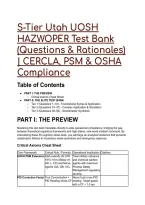
S-Tier Utah UOSH
HAZWOPER Test Bank
(Questions & Rationales)
| CERCLA, PSM & OSHA
Compliance
Table of Contents
● PART I: THE PREVIEW
○ Critical Axioms Cheat Sheet
● PART II: THE ELITE TEST BANK
○ Tier 1 (Questions 1–18) - Foundational Syntax & Application
○ Tier 2 (Questions 19–37) - Complex Application & Simulation
○ Tier 3 (Questions 38–55) - Grandmaster Synthesis
PART I: THE PREVIEW
Mastering this test bank translates directly to elite operational competency, bridging the gap
between theoretical regulatory frameworks and high-stakes, real-world incident command. By
internalizing these 55 cognitive stress tests, you will forge an analytical resilience that prevents
catastrophic failures in hazardous waste operations and emergency response.
Critical Axioms Cheat Sheet
Core Framework Critical Rule / Formula Operational Implication Citations
UOSH PSM Extension Utah extends 29 CFR Treat military ordnance
1910.119 to Blister (H, and chemical warfare
HD, L, CX) and Nerve agents with maximum
Agents (GA, GB, VX). Process Safety
Management regulatory
severity.
PID Correction Factor True Concentration = Never trust a raw PID
PID Reading \times CF reading. Target gases
with a CF < 1.0 are
,Core Framework Critical Rule / Formula Operational Implication Citations
more toxic than the raw
reading suggests.
LEL Sensor Catalytic bead sensors In oxygen-deficient
Limitation require >10% O_2 to atmospheres, LEL
function. sensors will fatally
under-report
combustible gas
concentrations.
ASTM F739 Breakthrough time is Breakthrough time
Permeation defined by a 0.1 does not equal safe
µg/cm²/min threshold, wearing time; it is a
NOT physical molecular diffusion rate
penetration. in a laboratory.
CERCLA Liability Liability is strict, joint, Indemnification
and several. contracts do not shield
a primary contractor
from EPA enforcement;
you are liable for
subcontractors.
PART II: THE ELITE TEST BANK
Tier 1 (Questions 1–18) - Foundational Syntax &
Application
Q1: An employee suffers a significant, disabling injury during a trenching operation at a Utah
hazardous waste site. Based on Utah Administrative Code R614-1-5, what is the MOST
APPROPRIATE reporting timeline? A) Notify federal OSHA within 24 hours. B) Log the injury on
the OSHA 300 form within 7 days with no immediate call required. C) Notify UOSH within 8
hours of the occurrence. D) Notify the EPA within 48 hours under CERCLA guidelines.
● Answer: C (Notify UOSH within 8 hours of the occurrence.)
● Distractor Analysis:
○ A is incorrect: Utah operates an approved State Plan (UOSH); federal OSHA is not
the primary contact, and 24 hours fails the strict state timeline.
○ B is incorrect: While logging is required, severe/disabling injuries mandate
immediate UOSH notification.
○ D is incorrect: The EPA handles environmental releases, not occupational injury
reporting.
The Mentor's Analysis: Utah enforces stricter reporting requirements than standard federal
baselines. When facing serious occupational injuries or fatalities, the immediate priority is
notifying UOSH within the strict 8-hour window. By utilizing this state-specific mandate, you
bypass the common trap of defaulting to broader federal reporting timelines. Professional
Intuition: Always defer to the most stringent State Plan reporting window (8 hours for
UOSH) to avoid jurisdictional citations .
Q2: A contractor discovers historical military munitions at a Brownfield site. Based on Utah
, UOSH regulations extending Process Safety Management (PSM), which compound is
UNEQUIVOCALLY covered under 29 CFR 1910.119 regardless of standard threshold
quantities? A) Anhydrous ammonia B) Chlorine gas C) Sarin (GB) D) Phosgene
● Answer: C (Sarin (GB))
● Distractor Analysis:
○ A is incorrect: Ammonia is covered federally if it exceeds threshold quantities, but
Utah specifically targets nerve agents regardless of thresholds here.
○ B is incorrect: Chlorine is standard PSM, but does not highlight the unique UOSH
extension.
○ D is incorrect: Phosgene is a choking agent, not explicitly listed in the unique Utah
extension for blister/nerve agents.
The Mentor's Analysis: Utah uniquely extends 29 CFR 1910.119 to include specific chemical
warfare agents. When facing unknown military ordnance, the immediate priority is recognizing
that nerve agents like Sarin (GB) and blister agents fall strictly under UOSH PSM regulations.
By utilizing this state-specific knowledge, you bypass the common trap of misclassifying warfare
agents under general hazard communication. Professional Intuition: UOSH PSM extends to
blister (Mustard, Lewisite) and nerve agents (Sarin, VX); treat them with maximum
regulatory severity .
Q3: A technician uses a Photoionization Detector (PID) calibrated to isobutylene (CF = 1.0) to
measure butyl acetate (CF = 2.4). The PID reads 10 ppm. What is the ACCURATE true
concentration? A) 4.16 ppm B) 10 ppm C) 24 ppm D) 240 ppm
● Answer: C (24 ppm)
● Distractor Analysis:
○ A is incorrect: This is the result of dividing the reading by the CF, a common novice
mathematical error.
○ B is incorrect: This assumes the instrument reads directly without requiring a
correction factor.
○ D is incorrect: This is a decimal placement error.
The Mentor's Analysis: PIDs are broadband sensors calibrated to a standard gas. When facing
a known target gas, the immediate priority is multiplying the instrument reading by the specific
Correction Factor (CF). By utilizing the formula True Concentration = Reading \times CF, you
bypass the common trap of accepting raw PID readings as absolute truths. Professional
Intuition: Never trust a raw PID reading unless measuring the exact calibration gas;
always apply the CF.
Q4: A worker is tasked with drum handling operations. Upon inspection, crystalline material is
noted on the exterior of a drum. According to 29 CFR 1910.120(j), what is the FIRST action
required? A) Overpack the drum using a polyethylene salvage container. B) Sample the
crystalline material to determine its chemical makeup. C) Handle the contents as a
shock-sensitive waste until identified. D) Decontaminate the exterior using a pressure washer.
● Answer: C (Handle the contents as a shock-sensitive waste until identified.)
● Distractor Analysis:
○ A is incorrect: Moving the drum for overpacking risks detonation if the material is
shock-sensitive.
○ B is incorrect: Sampling requires physical interaction, which is highly dangerous
without proper explosive ordnance protocols.
○ D is incorrect: High-pressure washing could trigger a shock-sensitive detonation.
The Mentor's Analysis: Crystallization on containers indicates potential peroxide formation or
explosive degradation. When facing crystalline deposits, the immediate priority is treating the
HAZWOPER Test Bank
(Questions & Rationales)
| CERCLA, PSM & OSHA
Compliance
Table of Contents
● PART I: THE PREVIEW
○ Critical Axioms Cheat Sheet
● PART II: THE ELITE TEST BANK
○ Tier 1 (Questions 1–18) - Foundational Syntax & Application
○ Tier 2 (Questions 19–37) - Complex Application & Simulation
○ Tier 3 (Questions 38–55) - Grandmaster Synthesis
PART I: THE PREVIEW
Mastering this test bank translates directly to elite operational competency, bridging the gap
between theoretical regulatory frameworks and high-stakes, real-world incident command. By
internalizing these 55 cognitive stress tests, you will forge an analytical resilience that prevents
catastrophic failures in hazardous waste operations and emergency response.
Critical Axioms Cheat Sheet
Core Framework Critical Rule / Formula Operational Implication Citations
UOSH PSM Extension Utah extends 29 CFR Treat military ordnance
1910.119 to Blister (H, and chemical warfare
HD, L, CX) and Nerve agents with maximum
Agents (GA, GB, VX). Process Safety
Management regulatory
severity.
PID Correction Factor True Concentration = Never trust a raw PID
PID Reading \times CF reading. Target gases
with a CF < 1.0 are
,Core Framework Critical Rule / Formula Operational Implication Citations
more toxic than the raw
reading suggests.
LEL Sensor Catalytic bead sensors In oxygen-deficient
Limitation require >10% O_2 to atmospheres, LEL
function. sensors will fatally
under-report
combustible gas
concentrations.
ASTM F739 Breakthrough time is Breakthrough time
Permeation defined by a 0.1 does not equal safe
µg/cm²/min threshold, wearing time; it is a
NOT physical molecular diffusion rate
penetration. in a laboratory.
CERCLA Liability Liability is strict, joint, Indemnification
and several. contracts do not shield
a primary contractor
from EPA enforcement;
you are liable for
subcontractors.
PART II: THE ELITE TEST BANK
Tier 1 (Questions 1–18) - Foundational Syntax &
Application
Q1: An employee suffers a significant, disabling injury during a trenching operation at a Utah
hazardous waste site. Based on Utah Administrative Code R614-1-5, what is the MOST
APPROPRIATE reporting timeline? A) Notify federal OSHA within 24 hours. B) Log the injury on
the OSHA 300 form within 7 days with no immediate call required. C) Notify UOSH within 8
hours of the occurrence. D) Notify the EPA within 48 hours under CERCLA guidelines.
● Answer: C (Notify UOSH within 8 hours of the occurrence.)
● Distractor Analysis:
○ A is incorrect: Utah operates an approved State Plan (UOSH); federal OSHA is not
the primary contact, and 24 hours fails the strict state timeline.
○ B is incorrect: While logging is required, severe/disabling injuries mandate
immediate UOSH notification.
○ D is incorrect: The EPA handles environmental releases, not occupational injury
reporting.
The Mentor's Analysis: Utah enforces stricter reporting requirements than standard federal
baselines. When facing serious occupational injuries or fatalities, the immediate priority is
notifying UOSH within the strict 8-hour window. By utilizing this state-specific mandate, you
bypass the common trap of defaulting to broader federal reporting timelines. Professional
Intuition: Always defer to the most stringent State Plan reporting window (8 hours for
UOSH) to avoid jurisdictional citations .
Q2: A contractor discovers historical military munitions at a Brownfield site. Based on Utah
, UOSH regulations extending Process Safety Management (PSM), which compound is
UNEQUIVOCALLY covered under 29 CFR 1910.119 regardless of standard threshold
quantities? A) Anhydrous ammonia B) Chlorine gas C) Sarin (GB) D) Phosgene
● Answer: C (Sarin (GB))
● Distractor Analysis:
○ A is incorrect: Ammonia is covered federally if it exceeds threshold quantities, but
Utah specifically targets nerve agents regardless of thresholds here.
○ B is incorrect: Chlorine is standard PSM, but does not highlight the unique UOSH
extension.
○ D is incorrect: Phosgene is a choking agent, not explicitly listed in the unique Utah
extension for blister/nerve agents.
The Mentor's Analysis: Utah uniquely extends 29 CFR 1910.119 to include specific chemical
warfare agents. When facing unknown military ordnance, the immediate priority is recognizing
that nerve agents like Sarin (GB) and blister agents fall strictly under UOSH PSM regulations.
By utilizing this state-specific knowledge, you bypass the common trap of misclassifying warfare
agents under general hazard communication. Professional Intuition: UOSH PSM extends to
blister (Mustard, Lewisite) and nerve agents (Sarin, VX); treat them with maximum
regulatory severity .
Q3: A technician uses a Photoionization Detector (PID) calibrated to isobutylene (CF = 1.0) to
measure butyl acetate (CF = 2.4). The PID reads 10 ppm. What is the ACCURATE true
concentration? A) 4.16 ppm B) 10 ppm C) 24 ppm D) 240 ppm
● Answer: C (24 ppm)
● Distractor Analysis:
○ A is incorrect: This is the result of dividing the reading by the CF, a common novice
mathematical error.
○ B is incorrect: This assumes the instrument reads directly without requiring a
correction factor.
○ D is incorrect: This is a decimal placement error.
The Mentor's Analysis: PIDs are broadband sensors calibrated to a standard gas. When facing
a known target gas, the immediate priority is multiplying the instrument reading by the specific
Correction Factor (CF). By utilizing the formula True Concentration = Reading \times CF, you
bypass the common trap of accepting raw PID readings as absolute truths. Professional
Intuition: Never trust a raw PID reading unless measuring the exact calibration gas;
always apply the CF.
Q4: A worker is tasked with drum handling operations. Upon inspection, crystalline material is
noted on the exterior of a drum. According to 29 CFR 1910.120(j), what is the FIRST action
required? A) Overpack the drum using a polyethylene salvage container. B) Sample the
crystalline material to determine its chemical makeup. C) Handle the contents as a
shock-sensitive waste until identified. D) Decontaminate the exterior using a pressure washer.
● Answer: C (Handle the contents as a shock-sensitive waste until identified.)
● Distractor Analysis:
○ A is incorrect: Moving the drum for overpacking risks detonation if the material is
shock-sensitive.
○ B is incorrect: Sampling requires physical interaction, which is highly dangerous
without proper explosive ordnance protocols.
○ D is incorrect: High-pressure washing could trigger a shock-sensitive detonation.
The Mentor's Analysis: Crystallization on containers indicates potential peroxide formation or
explosive degradation. When facing crystalline deposits, the immediate priority is treating the

