
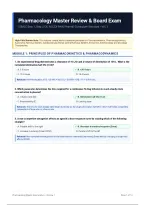
Pharmacology Master Review & Board Exam
USMLE Step 1, Step 2 CK, NCLEX-RN & PharmD Curriculum Standard • Vol. 1
High-Yield Review Note: This volume covers key foundational principles in Pharmacokinetics, Pharmacodynamics,
Autonomic Nervous System, Cardiovascular, Renal, Central Nervous System, Endocrine, Antimicrobial, and Oncology
Therapeutics.
MODULE 1: PRINCIPLES OF PHARMACOKINETICS & PHARMACODYNAMICS
1. An experimental drug demonstrates a clearance of 10 L/hr and a volume of distribution of 100 L. What is the
calculated elimination half-life (t1/2)?
• A. 3.5 hours ✓ B. 6.93 hours
• C. 10.0 hours • D. 14.4 hours
Rationale: Half-life equation: t1/2 = (0.693 × Vd) / CL = (0.693 × 100) / 10 = 6.93 hours.
2. Which parameter determines the time required for a continuous IV drug infusion to reach steady-state
concentration in plasma?
• A. Infusion rate (k0) ✓ B. Elimination half-life (t1/2)
• C. Bioavailability (F) • D. Loading dose
Rationale: The time to reach steady state depends strictly on the drug's elimination half-life (~4 to 5 half-lives), completely
independent of dose size or infusion rate.
3. A non-competitive antagonist affects an agonist's dose-response curve by causing which of the following
changes?
• A. Parallel shift to the right ✓ B. Decrease in maximal response (Emax)
• C. Increase in potency (lower EC50) • D. Parallel shift to the left
Rationale: Non-competitive antagonists bind allosterically or irreversibly, decreasing Emax without changing the agonist's
affinity (EC50).
Pharmacology Master Examination • Volume 1 Page 1 of 10
, MODULE 2: AUTONOMIC NERVOUS SYSTEM PHARMACOLOGY
4. A patient presenting with cholinergic crisis after exposure to organophosphate nerve agents should
immediately receive which combination of drugs?
• A. Physostigmine + Edrophonium ✓ B. Atropine + Pralidoxime
• C. Neostigmine + Glycopyrrolate • D. Pilocarpine + Methacholine
Rationale: Atropine blocks excess muscarinic stimulation, while Pralidoxime reactivates acetylcholinesterase at nicotinic
sites to reverse muscle paralysis.
5. Pretreatment with which receptor antagonist blocks epinephrine-induced hyperglycemia and vasodilation?
• A. Alpha-1 antagonist ✓ B. Beta-2 antagonist
• C. Muscarinic M3 antagonist • D. Nicotinic Nn antagonist
Rationale: Epinephrine stimulates glycogenolysis in liver/skeletal muscle and vasodilation in skeletal muscle vascular
beds via Beta-2 receptors.
6. Which selective alpha-2 adrenergic agonist is utilized in ICU settings for sedation without inducing
significant respiratory depression?
• A. Clonidine ✓ B. Dexmedetomidine
• C. Phenylephrine • D. Midodrine
Rationale: Dexmedetomidine is a highly selective central alpha-2 agonist providing sedation and analgesia with minimal
respiratory depression.
7. A 60-year-old male with benign prostatic hyperplasia (BPH) and hypertension is prescribed Tamsulosin.
What explains its low risk of orthostatic hypotension?
✓ A. Selective Alpha-1A receptor blockade • B. Non-selective Alpha-1 and Beta-1 blockade
• C. Direct smooth muscle relaxation via nitric oxide • D. Central inhibition of sympathetic outflow
Rationale: Tamsulosin selectively targets Alpha-1A receptors located primarily in the prostate bladder neck, sparing Alpha-
1B receptors in vascular smooth muscle.
Pharmacology Master Examination • Volume 1 Page 2 of 10

