Page 1 of 49
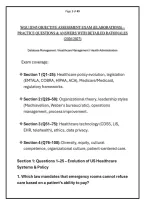
WGU D545 OBJECTIVE ASSESSMENT EXAM (ELABORATIONS) –
PRACTICE QUESTIONS & ANSWERS WITH DETAILED RATIONALES
(2026/2027)
Database Management / Healthcare Management / Health Administration
Exam coverage:
❖ Section 1 (Q1–25): Healthcare policy evolution, legislation
(EMTALA, COBRA, HIPAA, ACA), Medicare/Medicaid,
regulatory frameworks.
❖ Section 2 (Q26–50): Organizational theory, leadership styles
(Machiavellian, Weber's bureaucratic), operations
management, process improvement.
❖ Section 3 (Q51–75): Healthcare technology (CDSS, LIS,
EHR, telehealth), ethics, data privacy.
❖ Section 4 (Q76–100): Diversity, equity, cultural
competence, organizational culture, patient-centered care.
Section 1: Questions 1–25 – Evolution of US Healthcare
Systems & Policy
1. Which law mandates that emergency rooms cannot refuse
care based on a patient's ability to pay?
, Page 2 of 49
A. Health Insurance Portability and Accountability Act (HIPAA)
B. Consolidated Omnibus Budget Reconciliation Act (COBRA)
C. Emergency Medical Treatment and Active Labor Act
(EMTALA) ✓
D. Affordable Care Act (ACA)
RATIONALE: EMTALA is the CORRECT answer because it
mandates that emergency rooms cannot refuse care based on a
patient's ability to pay. This federal law requires hospitals with
emergency departments to provide stabilizing treatment to any
patient regardless of insurance status .
2. What was the relationship between changing
demographics in the US and the Medicare Prescription Drug,
Improvement, and Modernization Act (MMA) of 2003?
A. Younger populations increased demand for prescription
coverage
B. An aging population led to increased prescription
coverage under the MMA ✓
C. MMA restricted prescription coverage to only elderly people
in nursing homes
D. MMA eliminated access to drugs for disabled individuals
RATIONALE: The CORRECT answer is B because the MMA
introduced Medicare Part D in response to rising prescription
, Page 3 of 49
drug needs of an aging population, expanding access and
affordability of medications for seniors .
3. Which law provides for continuation of health insurance
coverage after job loss?
A. Health Insurance Portability and Accountability Act (HIPAA)
B. Employee Retirement Income Security Act (ERISA)
C. Consolidated Omnibus Budget Reconciliation Act
(COBRA) ✓
D. Affordable Care Act (ACA)
RATIONALE: COBRA is the CORRECT answer because it
mandates that employees and their families can continue group
health coverage at their own expense when employment ends
or hours are reduced, ensuring continuity of care .
4. How does the Affordable Care Act (ACA) affect individuals
with preexisting conditions?
A. It allows insurers to charge higher premiums based on health
status
B. It requires insurers to cover individuals regardless of
preexisting conditions ✓
, Page 4 of 49
C. It excludes coverage for preexisting conditions for the first
year
D. It only covers preexisting conditions for children under 19
RATIONALE: The CORRECT answer is B because the ACA
prohibits insurance companies from denying coverage or
charging higher premiums based on preexisting conditions,
ensuring access to health insurance regardless of health
status .
5. What is the primary goal of the Clinical Laboratory
Improvement Amendments (CLIA)?
A. Regulating pharmaceutical manufacturing
B. Standardizing testing procedures across organizations ✓
C. Reducing hospital readmission rates
D. Expanding telemedicine services
RATIONALE: CLIA is the CORRECT answer because it ensures
consistent quality and accuracy in lab testing by standardizing
testing procedures across organizations .
6. Which Act emphasizes patient input in the FDA's drug
approval process?