
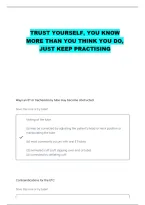
Ways an ET or tracheostomy tube may become obstructed:
Give this one a try later!
kinking of the tube
(a) may be corrected by adjusting the patient's head or neck position or
manipulating the tube
(b) most commonly occurs with oral ET tubes
(2) herniated cuff (cuff slipping over end of tube)
(a) corrected by deflating cuff
Contraindications for the ETC
Give this one a try later!
, a. Patient with an intact gag reflex
b. Patient with known or suspected esophageal disease
c. Patient known to have ingested a caustic substance
d. Suspected upper airway obstruction because of laryngeal foreign body
or pathology
e. Patient less than 4 feet tall
Mac blade?
Give this one a try later!
The curved blade (McIntosh) should be inserted between the epiglottis
and the base of the tongue (valeculla) and with a forward and upward
motion the epiglottis is raised to expose the glottis and vocal cords.
Cuff pressures should exceed not what pressures?
Give this one a try later!
exceed not 25 mm Hg (35 cm H2O)
if cuff pressure exceeds this value, ischemic damage to the trachea is
possible.
Whats the inner portion of a fenestrated tube for?
Give this one a try later!
Give this one a try later!
kinking of the tube
(a) may be corrected by adjusting the patient's head or neck position or
manipulating the tube
(b) most commonly occurs with oral ET tubes
(2) herniated cuff (cuff slipping over end of tube)
(a) corrected by deflating cuff
Contraindications for the ETC
Give this one a try later!
, a. Patient with an intact gag reflex
b. Patient with known or suspected esophageal disease
c. Patient known to have ingested a caustic substance
d. Suspected upper airway obstruction because of laryngeal foreign body
or pathology
e. Patient less than 4 feet tall
Mac blade?
Give this one a try later!
The curved blade (McIntosh) should be inserted between the epiglottis
and the base of the tongue (valeculla) and with a forward and upward
motion the epiglottis is raised to expose the glottis and vocal cords.
Cuff pressures should exceed not what pressures?
Give this one a try later!
exceed not 25 mm Hg (35 cm H2O)
if cuff pressure exceeds this value, ischemic damage to the trachea is
possible.
Whats the inner portion of a fenestrated tube for?
Give this one a try later!

