
NUR 2502 - Exam 1 - Multidimensional Care III / MDC 3 Rasmussen University | Edition
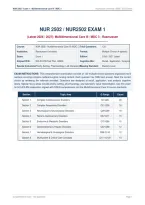
NUR 2502 / NUR2502 EXAM 1
(Latest ): Multidimensional Care III / MDC 3 - Rasmussen
Course: NUR 2502 - Multidimensional Care III (MDC 3) Total Questions: 120
Institution: Rasmussen University Format: Multiple Choice (4 options)
Exam: Exam 1 Edition: Latest
Aligned With: NCLEX-RN Test Plan, QSEN Cognitive Mix: Recall / Application / Analysis
Special Inclusions:Priority-Setting, Pharmacology, Lab Interpretation
Passing Standard: Mastery Level
EXAM INSTRUCTIONS: This comprehensive examination consists of 120 multiple-choice questions organized into 8
sections covering complex medical-surgical nursing content. Each question has ONE best answer. Mark the correct
choice by reviewing the rationale provided. Questions are designed at recall, application, and analysis cognitive
levels. Special focus areas include priority-setting, pharmacology, and laboratory value interpretation. Use this exam
for NCLEX-RN preparation aligned with QSEN competencies and the Multidimensional Care III course standards.
Section Topic Area Q Range Count
Section 1 Complex Cardiovascular Disorders Q1-Q20 20
Section 2 Complex Respiratory Disorders Q21-Q38 18
Section 3 Neurological & Neurosurgical Disorders Q39-Q56 18
Section 4 Renal & Genitourinary Disorders Q57-Q71 15
Section 5 Endocrine & Metabolic Disorders Q72-Q86 15
Section 6 Gastrointestinal & Hepatic Disorders Q87-Q98 12
Section 7 Hematological & Oncological Disorders Q99-Q110 12
Section 8 Multisystem & Critical Care Concepts Q111-Q120 10
Comprehensive Exam - 120 Questions Page 1
,NUR 2502 - Exam 1 - Multidimensional Care III / MDC 3 Rasmussen University | Edition
SECTION 1: COMPLEX CARDIOVASCULAR DISORDERS
Question Range: Q1 to Q20 (20 questions)
Focus: Acute coronary syndromes, myocardial infarction, heart failure, cardiogenic shock, dysrhythmias, valvular disorders, cardiac
surgery, pacemakers, ICDs, hemodynamic monitoring, anticoagulant therapy.
Q1. A 58-year-old male is admitted with substernal chest pain radiating to the left arm, diaphoresis,
and nausea. The 12-lead ECG reveals ST-segment elevation in leads II, III, and aVF. Which
pathophysiological process is occurring in this client?
A. Anterior wall ischemia due to left anterior descending artery occlusion
B. Inferior wall infarction due to right coronary artery occlusion [CORRECT]
C. Lateral wall ischemia from circumflex artery compromise
D. Subendocardial injury without full-thickness necrosis
Correct Answer: B
Rationale: ST elevation in leads II, III, and aVF indicates an inferior wall myocardial infarction, which is
most commonly caused by occlusion of the right coronary artery (RCA). The anterior wall is supplied by the
LAD (leads V1-V4), the lateral wall by the circumflex (leads I, aVL, V5-V6). This aligns with NUR 2502 ECG
interpretation content and the NCLEX-RN physiological integrity domain.
Cognitive: Analysis | Focus: Priority-Setting
Q2. The nurse is caring for four clients on the cardiac telemetry unit. Which client should the nurse
assess FIRST?
A. A client with atrial fibrillation with a heart rate of 102 bpm and a controlled ventricular response
B. A client 2 hours post-PCI with a femoral sheath in place reporting back discomfort
[CORRECT]
C. A client with a demand pacemaker showing a paced rhythm at 70 bpm with occasional paced
beats
D. A client with a sinus rhythm and premature ventricular contractions occurring 4 times per minute
Correct Answer: B
Rationale: The post-PCI client with a femoral sheath reporting back discomfort may be experiencing
retroperitoneal bleeding, a life-threatening complication of femoral arterial access. This requires immediate
assessment. The other clients are stable: controlled AFib, functioning pacemaker, and occasional PVCs
(less than 6/min) are expected findings. This question tests prioritization using the ABC and
acute-vs-chronic frameworks emphasized in NUR 2502.
Cognitive: Analysis | Focus: Priority-Setting
Q3. A client with acute decompensated heart failure receives a prescription for IV furosemide 40
mg push. Which laboratory value requires monitoring within 6-12 hours of administration?
A. Sodium and chloride
B. Potassium and magnesium [CORRECT]
C. Calcium and phosphate
D. Hemoglobin and hematocrit
Correct Answer: B
Comprehensive Exam - 120 Questions Page 2
,NUR 2502 - Exam 1 - Multidimensional Care III / MDC 3 Rasmussen University | Edition
Rationale: IV furosemide is a loop diuretic that causes excretion of potassium and magnesium, putting the
client at risk for hypokalemia and hypomagnesemia, which can precipitate lethal dysrhythmias in a cardiac
client already prone to arrhythmias. Monitoring these electrolytes is essential within 6-12 hours of
administration. Sodium and chloride are less acutely affected. This reflects NCLEX-RN pharmacology
standards and QSEN safety competencies.
Cognitive: Application | Focus: Lab Interpretation
Q4. A client is receiving IV heparin infusion for a deep vein thrombosis. The current aPTT is 98
seconds (control 30 seconds). The heparin protocol indicates therapeutic range is 1.5-2.5 times
control. Which action should the nurse take?
A. Increase the heparin rate per protocol
B. Maintain the current infusion rate
C. Decrease the heparin rate per protocol [CORRECT]
D. Stop the infusion and administer protamine sulfate
Correct Answer: C
Rationale: The therapeutic aPTT range is 45-75 seconds (1.5-2.5 × 30). A value of 98 seconds exceeds the
upper limit, indicating the client is supratherapeutic and at risk for bleeding. The correct action is to
decrease the rate per protocol (not stop entirely unless critical bleeding). Stopping and giving protamine is
reserved for significant hemorrhage. This reflects NCLEX-RN medication safety standards.
Cognitive: Analysis | Focus: Lab Interpretation
Q5. A client returns from coronary artery bypass graft (CABG) surgery. The nurse notes 250 mL of
dark red chest tube drainage in the first hour. What is the PRIORITY nursing action?
A. Document the finding as expected postoperatively
B. Notify the surgeon immediately [CORRECT]
C. Increase the IV fluid rate to maintain patency
D. Milk the chest tube to maintain patency
Correct Answer: B
Rationale: Chest tube drainage exceeding 200 mL/hour in the first hour after CABG is a critical finding that
suggests active hemorrhage and requires immediate surgeon notification. Normal drainage is less than 200
mL/hour initially, declining over time. Milking chest tubes is contraindicated without a physician order. This is
a postoperative complication requiring urgent surgical evaluation per QSEN safety standards.
Cognitive: Analysis | Focus: Priority-Setting
Q6. Which assessment finding in a client with a newly inserted permanent pacemaker (3 hours
post-procedure) requires immediate intervention by the nurse?
A. Mild tenderness and bruising at the insertion site
B. Heart rate of 72 bpm with a paced rhythm on the monitor
C. Hiccups that began 30 minutes ago and are persistent [CORRECT]
D. Slight swelling of the left arm where the device was placed
Correct Answer: C
Rationale: Persistent hiccups after pacemaker insertion suggest diaphragmatic stimulation from a
misplaced or displaced lead, which requires immediate evaluation and possible repositioning. Mild
tenderness and bruising are expected. A paced rhythm at 72 bpm indicates proper function. Arm swelling
Comprehensive Exam - 120 Questions Page 3
, NUR 2502 - Exam 1 - Multidimensional Care III / MDC 3 Rasmussen University | Edition
may indicate hematoma but is less urgent than lead displacement. This aligns with NUR 2502 cardiac
device management content.
Cognitive: Analysis | Focus: Priority-Setting
Q7. A client is receiving warfarin 5 mg daily for atrial fibrillation. The client's INR is 3.8 (target
2.0-3.0). Which herbal supplement reported in the medication history most likely contributed to
this elevation?
A. St. John's Wort
B. Garlic capsules
C. Ginkgo biloba [CORRECT]
D. Coenzyme Q10
Correct Answer: C
Rationale: Ginkgo biloba has antiplatelet properties and can potentiate the anticoagulant effect of warfarin,
increasing INR and bleeding risk. St. John's Wort decreases warfarin effectiveness (lowers INR). Garlic has
mild antiplatelet effects but is less impactful than ginkgo. CoQ10 may decrease warfarin effectiveness. This
reflects the NUR 2502 curriculum on drug-supplement interactions and NCLEX-RN pharmacological
principles.
Cognitive: Application | Focus: Pharmacology
Q8. A client with cardiogenic shock following an acute MI has a pulmonary artery catheter in place.
Which hemodynamic parameter best confirms the diagnosis of cardiogenic shock?
A. Decreased cardiac output, decreased systemic vascular resistance, decreased pulmonary
capillary wedge pressure
B. Increased cardiac output, increased SVR, decreased PCWP
C. Decreased cardiac output, increased SVR, increased PCWP [CORRECT]
D. Increased cardiac output, decreased SVR, increased PCWP
Correct Answer: C
Rationale: Cardiogenic shock is characterized by a failing pump, which produces decreased cardiac output
(CO < 4 L/min, CI < 2.2 L/min/m²). Compensatory vasoconstriction increases SVR, and backward failure
into the pulmonary circulation raises PCWP (>18 mmHg). This classic triad differentiates cardiogenic shock
from distributive shock (high CO, low SVR) and hypovolemic shock (low CO, high SVR, low PCWP).
Cognitive: Analysis
Q9. A client with heart failure has a BNP level of 1,250 pg/mL. The nurse understands that this
value:
A. Confirms a diagnosis of acute myocardial infarction
B. Indicates mild heart failure that requires outpatient management
C. Suggests severe heart failure exacerbation requiring hospitalization [CORRECT]
D. Is a normal finding in elderly clients
Correct Answer: C
Rationale: BNP greater than 400 pg/mL strongly supports heart failure, and values above 900-1,000 pg/mL
suggest severe exacerbation requiring hospitalization and aggressive diuresis. BNP reflects ventricular
stretch and volume overload, not myocardial infarction. Normal BNP is less than 100 pg/mL. This aligns with
NUR 2502 laboratory interpretation content and the NCLEX-RN reduction of risk domain.
Comprehensive Exam - 120 Questions Page 4
NUR 2502 / NUR2502 EXAM 1
(Latest ): Multidimensional Care III / MDC 3 - Rasmussen
Course: NUR 2502 - Multidimensional Care III (MDC 3) Total Questions: 120
Institution: Rasmussen University Format: Multiple Choice (4 options)
Exam: Exam 1 Edition: Latest
Aligned With: NCLEX-RN Test Plan, QSEN Cognitive Mix: Recall / Application / Analysis
Special Inclusions:Priority-Setting, Pharmacology, Lab Interpretation
Passing Standard: Mastery Level
EXAM INSTRUCTIONS: This comprehensive examination consists of 120 multiple-choice questions organized into 8
sections covering complex medical-surgical nursing content. Each question has ONE best answer. Mark the correct
choice by reviewing the rationale provided. Questions are designed at recall, application, and analysis cognitive
levels. Special focus areas include priority-setting, pharmacology, and laboratory value interpretation. Use this exam
for NCLEX-RN preparation aligned with QSEN competencies and the Multidimensional Care III course standards.
Section Topic Area Q Range Count
Section 1 Complex Cardiovascular Disorders Q1-Q20 20
Section 2 Complex Respiratory Disorders Q21-Q38 18
Section 3 Neurological & Neurosurgical Disorders Q39-Q56 18
Section 4 Renal & Genitourinary Disorders Q57-Q71 15
Section 5 Endocrine & Metabolic Disorders Q72-Q86 15
Section 6 Gastrointestinal & Hepatic Disorders Q87-Q98 12
Section 7 Hematological & Oncological Disorders Q99-Q110 12
Section 8 Multisystem & Critical Care Concepts Q111-Q120 10
Comprehensive Exam - 120 Questions Page 1
,NUR 2502 - Exam 1 - Multidimensional Care III / MDC 3 Rasmussen University | Edition
SECTION 1: COMPLEX CARDIOVASCULAR DISORDERS
Question Range: Q1 to Q20 (20 questions)
Focus: Acute coronary syndromes, myocardial infarction, heart failure, cardiogenic shock, dysrhythmias, valvular disorders, cardiac
surgery, pacemakers, ICDs, hemodynamic monitoring, anticoagulant therapy.
Q1. A 58-year-old male is admitted with substernal chest pain radiating to the left arm, diaphoresis,
and nausea. The 12-lead ECG reveals ST-segment elevation in leads II, III, and aVF. Which
pathophysiological process is occurring in this client?
A. Anterior wall ischemia due to left anterior descending artery occlusion
B. Inferior wall infarction due to right coronary artery occlusion [CORRECT]
C. Lateral wall ischemia from circumflex artery compromise
D. Subendocardial injury without full-thickness necrosis
Correct Answer: B
Rationale: ST elevation in leads II, III, and aVF indicates an inferior wall myocardial infarction, which is
most commonly caused by occlusion of the right coronary artery (RCA). The anterior wall is supplied by the
LAD (leads V1-V4), the lateral wall by the circumflex (leads I, aVL, V5-V6). This aligns with NUR 2502 ECG
interpretation content and the NCLEX-RN physiological integrity domain.
Cognitive: Analysis | Focus: Priority-Setting
Q2. The nurse is caring for four clients on the cardiac telemetry unit. Which client should the nurse
assess FIRST?
A. A client with atrial fibrillation with a heart rate of 102 bpm and a controlled ventricular response
B. A client 2 hours post-PCI with a femoral sheath in place reporting back discomfort
[CORRECT]
C. A client with a demand pacemaker showing a paced rhythm at 70 bpm with occasional paced
beats
D. A client with a sinus rhythm and premature ventricular contractions occurring 4 times per minute
Correct Answer: B
Rationale: The post-PCI client with a femoral sheath reporting back discomfort may be experiencing
retroperitoneal bleeding, a life-threatening complication of femoral arterial access. This requires immediate
assessment. The other clients are stable: controlled AFib, functioning pacemaker, and occasional PVCs
(less than 6/min) are expected findings. This question tests prioritization using the ABC and
acute-vs-chronic frameworks emphasized in NUR 2502.
Cognitive: Analysis | Focus: Priority-Setting
Q3. A client with acute decompensated heart failure receives a prescription for IV furosemide 40
mg push. Which laboratory value requires monitoring within 6-12 hours of administration?
A. Sodium and chloride
B. Potassium and magnesium [CORRECT]
C. Calcium and phosphate
D. Hemoglobin and hematocrit
Correct Answer: B
Comprehensive Exam - 120 Questions Page 2
,NUR 2502 - Exam 1 - Multidimensional Care III / MDC 3 Rasmussen University | Edition
Rationale: IV furosemide is a loop diuretic that causes excretion of potassium and magnesium, putting the
client at risk for hypokalemia and hypomagnesemia, which can precipitate lethal dysrhythmias in a cardiac
client already prone to arrhythmias. Monitoring these electrolytes is essential within 6-12 hours of
administration. Sodium and chloride are less acutely affected. This reflects NCLEX-RN pharmacology
standards and QSEN safety competencies.
Cognitive: Application | Focus: Lab Interpretation
Q4. A client is receiving IV heparin infusion for a deep vein thrombosis. The current aPTT is 98
seconds (control 30 seconds). The heparin protocol indicates therapeutic range is 1.5-2.5 times
control. Which action should the nurse take?
A. Increase the heparin rate per protocol
B. Maintain the current infusion rate
C. Decrease the heparin rate per protocol [CORRECT]
D. Stop the infusion and administer protamine sulfate
Correct Answer: C
Rationale: The therapeutic aPTT range is 45-75 seconds (1.5-2.5 × 30). A value of 98 seconds exceeds the
upper limit, indicating the client is supratherapeutic and at risk for bleeding. The correct action is to
decrease the rate per protocol (not stop entirely unless critical bleeding). Stopping and giving protamine is
reserved for significant hemorrhage. This reflects NCLEX-RN medication safety standards.
Cognitive: Analysis | Focus: Lab Interpretation
Q5. A client returns from coronary artery bypass graft (CABG) surgery. The nurse notes 250 mL of
dark red chest tube drainage in the first hour. What is the PRIORITY nursing action?
A. Document the finding as expected postoperatively
B. Notify the surgeon immediately [CORRECT]
C. Increase the IV fluid rate to maintain patency
D. Milk the chest tube to maintain patency
Correct Answer: B
Rationale: Chest tube drainage exceeding 200 mL/hour in the first hour after CABG is a critical finding that
suggests active hemorrhage and requires immediate surgeon notification. Normal drainage is less than 200
mL/hour initially, declining over time. Milking chest tubes is contraindicated without a physician order. This is
a postoperative complication requiring urgent surgical evaluation per QSEN safety standards.
Cognitive: Analysis | Focus: Priority-Setting
Q6. Which assessment finding in a client with a newly inserted permanent pacemaker (3 hours
post-procedure) requires immediate intervention by the nurse?
A. Mild tenderness and bruising at the insertion site
B. Heart rate of 72 bpm with a paced rhythm on the monitor
C. Hiccups that began 30 minutes ago and are persistent [CORRECT]
D. Slight swelling of the left arm where the device was placed
Correct Answer: C
Rationale: Persistent hiccups after pacemaker insertion suggest diaphragmatic stimulation from a
misplaced or displaced lead, which requires immediate evaluation and possible repositioning. Mild
tenderness and bruising are expected. A paced rhythm at 72 bpm indicates proper function. Arm swelling
Comprehensive Exam - 120 Questions Page 3
, NUR 2502 - Exam 1 - Multidimensional Care III / MDC 3 Rasmussen University | Edition
may indicate hematoma but is less urgent than lead displacement. This aligns with NUR 2502 cardiac
device management content.
Cognitive: Analysis | Focus: Priority-Setting
Q7. A client is receiving warfarin 5 mg daily for atrial fibrillation. The client's INR is 3.8 (target
2.0-3.0). Which herbal supplement reported in the medication history most likely contributed to
this elevation?
A. St. John's Wort
B. Garlic capsules
C. Ginkgo biloba [CORRECT]
D. Coenzyme Q10
Correct Answer: C
Rationale: Ginkgo biloba has antiplatelet properties and can potentiate the anticoagulant effect of warfarin,
increasing INR and bleeding risk. St. John's Wort decreases warfarin effectiveness (lowers INR). Garlic has
mild antiplatelet effects but is less impactful than ginkgo. CoQ10 may decrease warfarin effectiveness. This
reflects the NUR 2502 curriculum on drug-supplement interactions and NCLEX-RN pharmacological
principles.
Cognitive: Application | Focus: Pharmacology
Q8. A client with cardiogenic shock following an acute MI has a pulmonary artery catheter in place.
Which hemodynamic parameter best confirms the diagnosis of cardiogenic shock?
A. Decreased cardiac output, decreased systemic vascular resistance, decreased pulmonary
capillary wedge pressure
B. Increased cardiac output, increased SVR, decreased PCWP
C. Decreased cardiac output, increased SVR, increased PCWP [CORRECT]
D. Increased cardiac output, decreased SVR, increased PCWP
Correct Answer: C
Rationale: Cardiogenic shock is characterized by a failing pump, which produces decreased cardiac output
(CO < 4 L/min, CI < 2.2 L/min/m²). Compensatory vasoconstriction increases SVR, and backward failure
into the pulmonary circulation raises PCWP (>18 mmHg). This classic triad differentiates cardiogenic shock
from distributive shock (high CO, low SVR) and hypovolemic shock (low CO, high SVR, low PCWP).
Cognitive: Analysis
Q9. A client with heart failure has a BNP level of 1,250 pg/mL. The nurse understands that this
value:
A. Confirms a diagnosis of acute myocardial infarction
B. Indicates mild heart failure that requires outpatient management
C. Suggests severe heart failure exacerbation requiring hospitalization [CORRECT]
D. Is a normal finding in elderly clients
Correct Answer: C
Rationale: BNP greater than 400 pg/mL strongly supports heart failure, and values above 900-1,000 pg/mL
suggest severe exacerbation requiring hospitalization and aggressive diuresis. BNP reflects ventricular
stretch and volume overload, not myocardial infarction. Normal BNP is less than 100 pg/mL. This aligns with
NUR 2502 laboratory interpretation content and the NCLEX-RN reduction of risk domain.
Comprehensive Exam - 120 Questions Page 4

