

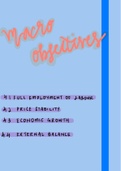
macro
objectives
4. I FULL EMPLOYMENT OF LABOUR
4. 2 PRICE STABILITY
4. 3 ECONOMIC GROWTH
4. 4 EXTERNAL BALANCE
, macroeconomic
objectives
4. l F U L L EMPLOYMENT OF LABOUR
I. employment
full 3. causes of unemployment
I
eco term full employment : is the lowest rate of ma l .
cyclical 1 general unemployment ( economic
downturn)
unemployment obtainable without accelerating inflation -
lack of demand for goods S services
A economic well-being
generates personal if firms governments S foreign buyers reduce
-
consumers
-
, ,
reduces household 's standard of livings individual's Hotan
unemployment
a
their demand for S services firms will
aggregate goods
.
self
.
esteem
Bo T A R G E T RATE respond by reducing production hence their demand for resources .
•
governments set targets this causes unemployment of labour resources .
for full employment is the lowest possible rate of unemployment
•
target -
unemployment due to lack of demand is referred as
rate
'
unemployment natural
'
lowest rate of attainable is known as
•
cyclical unemployment
.
of unemployment
frictional unemployment
.
Z '
•
full employment is defined as natural rate .
-
this term is used to explain people who are between
jobs
2- indicators of unemployment total no of
-
individuals in this category usually have already secured their
total no of
Labour workers in + next
TB THE LABOUR FORCE
=
force employment
workers
unemployed
jobs .
or
new entrants to the market ; school leavers
a
group of people available to work in
production of goods S services
labour
• -
.
CCOterm : the labour force consists of those over the age of 15 who are working in university graduates
paid employment for more than one hour per week or
actively seeking employment . -
individuals who are re -
entering the workforce after
PB TH E LABOUR FORCE PARTICIPATION RATE absence .
:
:÷÷÷:÷÷÷÷÷÷÷÷÷÷÷÷÷÷÷:÷ ÷:÷:÷ ÷ : ÷ ÷ ÷i:÷ :*
"÷ ÷ ÷ ÷ ÷ ÷ ÷ ÷ ÷:÷:÷÷÷:÷÷::÷÷:::
" "
•
Classification in the labour force -
examples
:
agricultural industries workers such as fruit pickers
and shears
working age population
.
government usually are not concerned with addressing this
type
individuals
-
i.
employed individuals 2. unemployed
of unemployment because it is temporary
(a) full time work
.
(a) actively seeking
(b) part time -
available to start work in reference week 4 . Structural unemployment
(b) usually happens when a firms restructure because
not actively seeking work -
reference week some labour work is not needed
-
not available to start work in
-
occurs when there is a mismatch between the skills of person
PB RELATIONSHIP BETWEEN THE PARTICIPATION A UNEMPLOYMENT RATES
for those skills in the location where individual
and the demand
is .
unemployment falls when the labour force participation rate rises
'
.
technical change improve labour productivity
when ECONOMIC activity starts to increase unemployment actually increases or to will create
-
the rate can
'
, ,
not decrease as fast as expected . as more people begin to actively seek work .
structural unemployment because only fewer workers are needed
This is because
jobseekers initially are unemployed -
to produce the same
output .
7W THE RATE OF UNEMPLOYMENT -
capital equipment
is
usually used to replace workers
in order to reduce production costs
eco erm the unemployed are those working less than one hour
per week
.
- :
known as structural
in paid employment actively seeking , work and ready to start .
-
unemployment created this
way is
'
formula for Total number of unemployment .
= unemployed
rate of -
× 100 example :
typist
unemployment
-
Labour force
objectives
4. I FULL EMPLOYMENT OF LABOUR
4. 2 PRICE STABILITY
4. 3 ECONOMIC GROWTH
4. 4 EXTERNAL BALANCE
, macroeconomic
objectives
4. l F U L L EMPLOYMENT OF LABOUR
I. employment
full 3. causes of unemployment
I
eco term full employment : is the lowest rate of ma l .
cyclical 1 general unemployment ( economic
downturn)
unemployment obtainable without accelerating inflation -
lack of demand for goods S services
A economic well-being
generates personal if firms governments S foreign buyers reduce
-
consumers
-
, ,
reduces household 's standard of livings individual's Hotan
unemployment
a
their demand for S services firms will
aggregate goods
.
self
.
esteem
Bo T A R G E T RATE respond by reducing production hence their demand for resources .
•
governments set targets this causes unemployment of labour resources .
for full employment is the lowest possible rate of unemployment
•
target -
unemployment due to lack of demand is referred as
rate
'
unemployment natural
'
lowest rate of attainable is known as
•
cyclical unemployment
.
of unemployment
frictional unemployment
.
Z '
•
full employment is defined as natural rate .
-
this term is used to explain people who are between
jobs
2- indicators of unemployment total no of
-
individuals in this category usually have already secured their
total no of
Labour workers in + next
TB THE LABOUR FORCE
=
force employment
workers
unemployed
jobs .
or
new entrants to the market ; school leavers
a
group of people available to work in
production of goods S services
labour
• -
.
CCOterm : the labour force consists of those over the age of 15 who are working in university graduates
paid employment for more than one hour per week or
actively seeking employment . -
individuals who are re -
entering the workforce after
PB TH E LABOUR FORCE PARTICIPATION RATE absence .
:
:÷÷÷:÷÷÷÷÷÷÷÷÷÷÷÷÷÷÷:÷ ÷:÷:÷ ÷ : ÷ ÷ ÷i:÷ :*
"÷ ÷ ÷ ÷ ÷ ÷ ÷ ÷ ÷:÷:÷÷÷:÷÷::÷÷:::
" "
•
Classification in the labour force -
examples
:
agricultural industries workers such as fruit pickers
and shears
working age population
.
government usually are not concerned with addressing this
type
individuals
-
i.
employed individuals 2. unemployed
of unemployment because it is temporary
(a) full time work
.
(a) actively seeking
(b) part time -
available to start work in reference week 4 . Structural unemployment
(b) usually happens when a firms restructure because
not actively seeking work -
reference week some labour work is not needed
-
not available to start work in
-
occurs when there is a mismatch between the skills of person
PB RELATIONSHIP BETWEEN THE PARTICIPATION A UNEMPLOYMENT RATES
for those skills in the location where individual
and the demand
is .
unemployment falls when the labour force participation rate rises
'
.
technical change improve labour productivity
when ECONOMIC activity starts to increase unemployment actually increases or to will create
-
the rate can
'
, ,
not decrease as fast as expected . as more people begin to actively seek work .
structural unemployment because only fewer workers are needed
This is because
jobseekers initially are unemployed -
to produce the same
output .
7W THE RATE OF UNEMPLOYMENT -
capital equipment
is
usually used to replace workers
in order to reduce production costs
eco erm the unemployed are those working less than one hour
per week
.
- :
known as structural
in paid employment actively seeking , work and ready to start .
-
unemployment created this
way is
'
formula for Total number of unemployment .
= unemployed
rate of -
× 100 example :
typist
unemployment
-
Labour force


