
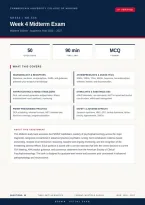
CHAMBERLAIN UNIVERSITY COLLEGE OF NURSING
A+ VERIFIED
NR546 / NR-546
Week 4 Midterm Exam
Midterm Edition · Academic Year 2026 – 2027
50 90 min MCQ
QUESTIONS TIME LIMIT F O R M AT
W H AT T H I S C O V E R S
NEUROBIOLOGY & RECEPTORS ANTIDEPRESSANTS & ANXIOLYTICS
Dopamine, serotonin, norepinephrine, GABA, and glutamate SSRIs, SNRIs, TCAs, MAOIs, buspirone, benzodiazepines:
pathways plus receptor pharmacology. selection, titration, and discontinuation.
ANTIPSYCHOTICS & MOOD STABILIZERS STIMULANTS & SUBSTANCE USE
First- and second-generation antipsychotics, lithium, ADHD stimulants, non-stimulants, MAT for opioid and alcohol
anticonvulsant mood stabilizers, monitoring. use disorders, withdrawal management.
PMHNP PRESCRIBING PRACTICE SAFETY & ADVERSE EFFECTS
DEA scheduling, informed consent, MET, baseline labs, Serotonin syndrome, NMS, EPS, tardive dyskinesia, lithium
black-box warnings, pregnancy/lactation. toxicity, hyponatremia, SIADH.
ABOUT THIS ASSESSMENT
This Midterm study bank assesses the PMHNP candidate's mastery of psychopharmacology across the major
diagnostic categories encountered in advanced practice psychiatric nursing. Items emphasize evidence-based
prescribing, receptor-level mechanism reasoning, baseline and ongoing monitoring, and the recognition of life-
threatening adverse effects. Each question is paired with a concise rationale that links the correct decision to current
FDA labeling, APA practice guidance, and consensus statements from the American Society of Clinical
Psychopharmacology. The bank is designed for graduate-level review and assumes prior coursework in advanced
pathophysiology and neuroscience.
QUESTIONS: 50 T I M E L I M I T: 9 0 M I N U T E S F O R M AT: M U LT I P L E C H O I C E YEAR: 2026 – 2027
S TUVI A A C T UA L E X AM
, NR546 / NR-546 NR546 / NR-546
NR546 Week 4 Midterm — Advanced Pharmacology:
Psychopharmacology for the PMHNP
Original Study Question Bank · Multiple Choice · With Rationales
Week 4 Midterm — Psychopharmacology for the PMHNP (Q1–Q50)
1. A 34-year-old female with major depressive disorder is started on fluoxetine 20 mg daily. Three
weeks later she reports new anxiety, diaphoresis, tremor, and confusion after also taking
over-the-counter dextromethorphan for a cough. Which adverse event should the PMHNP suspect
first?
A. Tyramine-induced hypertensive crisis
B. Neuroleptic malignant syndrome
C. Serotonin syndrome
D. Anticholinergic toxicity
Correct Answer: C
Rationale: Fluoxetine is an SSRI and dextromethorphan is a serotonergic agent; combined they can precipitate
serotonin syndrome characterized by neuromuscular hyperactivity, autonomic instability, and altered mental
status. NMS requires antipsychotic exposure, anticholinergic toxicity presents with dry skin and urinary
retention, and tyramine crisis is associated with MAOIs.
2. A patient on a monoamine oxidase inhibitor (phenelzine) presents to the clinic with a throbbing
headache, blood pressure 184/112, and diaphoresis 30 minutes after a restaurant meal. Which
dietary substance most likely triggered this event?
A. Aged cheddar cheese and cured meats
B. Whole-grain bread
C. Leafy green vegetables
D. Pasteurized cottage cheese
Correct Answer: A
Rationale: Aged cheeses and cured meats are rich in tyramine, which displaces norepinephrine from
adrenergic nerve terminals when MAO is inhibited, producing a hypertensive crisis. The patient requires
emergency blood pressure control with a direct vasodilator such as phentolamine.
3. A 28-year-old male with schizophrenia has been on haloperidol for 6 months. He presents with
mask-like facies, cogwheel rigidity, and a shuffling gait. Which intervention is most appropriate as
a first-line response?
A. Discontinue haloperidol immediately
B. Increase the haloperidol dose
C. Initiate a beta-blocker
D. Add an anticholinergic such as benztropine
Correct Answer: D
Rationale: The presentation is parkinsonism, an extrapyramidal symptom caused by D2 blockade in the
nigrostriatal pathway. Adding an anticholinergic like benztropine or diphenhydramine is first-line; if it persists,
A+ Verified Study Resource Page 1
A+ VERIFIED
NR546 / NR-546
Week 4 Midterm Exam
Midterm Edition · Academic Year 2026 – 2027
50 90 min MCQ
QUESTIONS TIME LIMIT F O R M AT
W H AT T H I S C O V E R S
NEUROBIOLOGY & RECEPTORS ANTIDEPRESSANTS & ANXIOLYTICS
Dopamine, serotonin, norepinephrine, GABA, and glutamate SSRIs, SNRIs, TCAs, MAOIs, buspirone, benzodiazepines:
pathways plus receptor pharmacology. selection, titration, and discontinuation.
ANTIPSYCHOTICS & MOOD STABILIZERS STIMULANTS & SUBSTANCE USE
First- and second-generation antipsychotics, lithium, ADHD stimulants, non-stimulants, MAT for opioid and alcohol
anticonvulsant mood stabilizers, monitoring. use disorders, withdrawal management.
PMHNP PRESCRIBING PRACTICE SAFETY & ADVERSE EFFECTS
DEA scheduling, informed consent, MET, baseline labs, Serotonin syndrome, NMS, EPS, tardive dyskinesia, lithium
black-box warnings, pregnancy/lactation. toxicity, hyponatremia, SIADH.
ABOUT THIS ASSESSMENT
This Midterm study bank assesses the PMHNP candidate's mastery of psychopharmacology across the major
diagnostic categories encountered in advanced practice psychiatric nursing. Items emphasize evidence-based
prescribing, receptor-level mechanism reasoning, baseline and ongoing monitoring, and the recognition of life-
threatening adverse effects. Each question is paired with a concise rationale that links the correct decision to current
FDA labeling, APA practice guidance, and consensus statements from the American Society of Clinical
Psychopharmacology. The bank is designed for graduate-level review and assumes prior coursework in advanced
pathophysiology and neuroscience.
QUESTIONS: 50 T I M E L I M I T: 9 0 M I N U T E S F O R M AT: M U LT I P L E C H O I C E YEAR: 2026 – 2027
S TUVI A A C T UA L E X AM
, NR546 / NR-546 NR546 / NR-546
NR546 Week 4 Midterm — Advanced Pharmacology:
Psychopharmacology for the PMHNP
Original Study Question Bank · Multiple Choice · With Rationales
Week 4 Midterm — Psychopharmacology for the PMHNP (Q1–Q50)
1. A 34-year-old female with major depressive disorder is started on fluoxetine 20 mg daily. Three
weeks later she reports new anxiety, diaphoresis, tremor, and confusion after also taking
over-the-counter dextromethorphan for a cough. Which adverse event should the PMHNP suspect
first?
A. Tyramine-induced hypertensive crisis
B. Neuroleptic malignant syndrome
C. Serotonin syndrome
D. Anticholinergic toxicity
Correct Answer: C
Rationale: Fluoxetine is an SSRI and dextromethorphan is a serotonergic agent; combined they can precipitate
serotonin syndrome characterized by neuromuscular hyperactivity, autonomic instability, and altered mental
status. NMS requires antipsychotic exposure, anticholinergic toxicity presents with dry skin and urinary
retention, and tyramine crisis is associated with MAOIs.
2. A patient on a monoamine oxidase inhibitor (phenelzine) presents to the clinic with a throbbing
headache, blood pressure 184/112, and diaphoresis 30 minutes after a restaurant meal. Which
dietary substance most likely triggered this event?
A. Aged cheddar cheese and cured meats
B. Whole-grain bread
C. Leafy green vegetables
D. Pasteurized cottage cheese
Correct Answer: A
Rationale: Aged cheeses and cured meats are rich in tyramine, which displaces norepinephrine from
adrenergic nerve terminals when MAO is inhibited, producing a hypertensive crisis. The patient requires
emergency blood pressure control with a direct vasodilator such as phentolamine.
3. A 28-year-old male with schizophrenia has been on haloperidol for 6 months. He presents with
mask-like facies, cogwheel rigidity, and a shuffling gait. Which intervention is most appropriate as
a first-line response?
A. Discontinue haloperidol immediately
B. Increase the haloperidol dose
C. Initiate a beta-blocker
D. Add an anticholinergic such as benztropine
Correct Answer: D
Rationale: The presentation is parkinsonism, an extrapyramidal symptom caused by D2 blockade in the
nigrostriatal pathway. Adding an anticholinergic like benztropine or diphenhydramine is first-line; if it persists,
A+ Verified Study Resource Page 1

