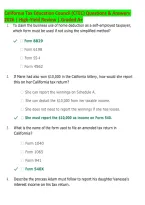
California Tax Education Council (CTEC) Questions & Answers
2026 | High-Yield Review | Graded A+
1. To claim the business use of home deduction as a self-employed taxpayer,
which form must be used if not using the simplified method?
Form 8829
Form 6198
Form SS-4
Form 4562
2. If Marie had also won $10,000 in the California lottery, how would she report
this on her California tax return?
She can report the winnings on Schedule A.
She can deduct the $10,000 from her taxable income.
She does not need to report the winnings if she has losses.
She must report the $10,000 as income on Form 540.
3. What is the name of the form used to file an amended tax return in
California?
Form 1040
Form 1065
Form 941
Form 540X
4. Describe the process Adam must follow to report his daughter Vanessa's
interest income on his tax return.
, Adam must include Vanessa's interest income on his Form 540 as
part of his total income.
Adam must file a separate tax return for Vanessa.
Adam can report Vanessa's income separately on Form 1040.
Adam does not need to report Vanessa's income since she is a minor.
5. If an investor holds both California municipal bonds and federal municipal
bonds, how would they report these on their California tax return?
Report both types as partially taxable.
Report both types as taxable income.
Report federal municipal bonds as non-taxable and California bonds
as taxable.
Only report California municipal bonds as non-taxable.
6. Which box on Form W-2 contains the information about California wages?
Box 12
Box 16
Box 1
Box 2
7. Which of the following options is explicitly mentioned as not being a
California fringe benefit?
Claiming their child's income.
Employee stock options.
Transportation subsidies provided by the employer.
Health insurance premiums paid by the employer.
,8. What is the maximum amount of California renter's credit that a single filer
can claim?
$200
$150
$120
$60
9. Describe the significance of adjusting federal adjusted gross income on 540
Schedule CA for California taxpayers.
California taxpayers do not need to adjust their federal income for
state taxes.
Adjusting federal adjusted gross income on 540 Schedule CA
ensures that California taxpayers accurately reflect their state tax
obligations.
Adjusting federal adjusted gross income is only necessary for high-
income earners.
Adjustments on 540 Schedule CA are irrelevant to state tax
calculations.
10. If Adam's total income exceeds the threshold for filing taxes in California,
how would this affect his reporting of Vanessa's interest income?
Adam must file a separate return for Vanessa if his income is high.
Adam can report Vanessa's income only if he itemizes deductions.
Adam can choose not to report Vanessa's income if his income is
high.
Adam must still report Vanessa's interest income on his tax return
regardless of his total income.
, 11. What is the purpose of Schedule E in California tax regulations?
To calculate capital gains from property sales.
To report income and expenses from rental real estate.
To report self-employment income.
To summarize total income from all sources.
12. Which statement accurately defines a California resident?
A person who is domiciled in California is a resident.
A nonresident for part of the year can choose to be treated as
resident for the entire year.
A person who works in California but lives out of state is a resident.
A person who lives in California for more than half the year is a
resident.
13. If Omar had not itemized his federal deductions, how would his state return
differ regarding the state refund?
He would need to file a different tax form.
He would have to pay additional taxes on the refund.
He would not need to report the state refund as income.
He would have to report the refund as a deduction.
14. What must food truck operators file with the CDTFA after registering?
Franchise tax returns
Income tax returns
Sales tax returns
2026 | High-Yield Review | Graded A+
1. To claim the business use of home deduction as a self-employed taxpayer,
which form must be used if not using the simplified method?
Form 8829
Form 6198
Form SS-4
Form 4562
2. If Marie had also won $10,000 in the California lottery, how would she report
this on her California tax return?
She can report the winnings on Schedule A.
She can deduct the $10,000 from her taxable income.
She does not need to report the winnings if she has losses.
She must report the $10,000 as income on Form 540.
3. What is the name of the form used to file an amended tax return in
California?
Form 1040
Form 1065
Form 941
Form 540X
4. Describe the process Adam must follow to report his daughter Vanessa's
interest income on his tax return.
, Adam must include Vanessa's interest income on his Form 540 as
part of his total income.
Adam must file a separate tax return for Vanessa.
Adam can report Vanessa's income separately on Form 1040.
Adam does not need to report Vanessa's income since she is a minor.
5. If an investor holds both California municipal bonds and federal municipal
bonds, how would they report these on their California tax return?
Report both types as partially taxable.
Report both types as taxable income.
Report federal municipal bonds as non-taxable and California bonds
as taxable.
Only report California municipal bonds as non-taxable.
6. Which box on Form W-2 contains the information about California wages?
Box 12
Box 16
Box 1
Box 2
7. Which of the following options is explicitly mentioned as not being a
California fringe benefit?
Claiming their child's income.
Employee stock options.
Transportation subsidies provided by the employer.
Health insurance premiums paid by the employer.
,8. What is the maximum amount of California renter's credit that a single filer
can claim?
$200
$150
$120
$60
9. Describe the significance of adjusting federal adjusted gross income on 540
Schedule CA for California taxpayers.
California taxpayers do not need to adjust their federal income for
state taxes.
Adjusting federal adjusted gross income on 540 Schedule CA
ensures that California taxpayers accurately reflect their state tax
obligations.
Adjusting federal adjusted gross income is only necessary for high-
income earners.
Adjustments on 540 Schedule CA are irrelevant to state tax
calculations.
10. If Adam's total income exceeds the threshold for filing taxes in California,
how would this affect his reporting of Vanessa's interest income?
Adam must file a separate return for Vanessa if his income is high.
Adam can report Vanessa's income only if he itemizes deductions.
Adam can choose not to report Vanessa's income if his income is
high.
Adam must still report Vanessa's interest income on his tax return
regardless of his total income.
, 11. What is the purpose of Schedule E in California tax regulations?
To calculate capital gains from property sales.
To report income and expenses from rental real estate.
To report self-employment income.
To summarize total income from all sources.
12. Which statement accurately defines a California resident?
A person who is domiciled in California is a resident.
A nonresident for part of the year can choose to be treated as
resident for the entire year.
A person who works in California but lives out of state is a resident.
A person who lives in California for more than half the year is a
resident.
13. If Omar had not itemized his federal deductions, how would his state return
differ regarding the state refund?
He would need to file a different tax form.
He would have to pay additional taxes on the refund.
He would not need to report the state refund as income.
He would have to report the refund as a deduction.
14. What must food truck operators file with the CDTFA after registering?
Franchise tax returns
Income tax returns
Sales tax returns