
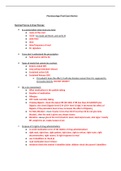
Pharmacology Final Exam Review
Pharmacology Final Exam Review Nursing Process & Drug Therapy Pharmacology Final Exam Review In a prescription what must you have: o nameofthemed o route- (no route call the Dr. and verify it) o date/time o dose o time/frequency of med o Dture If you don’t understand the prescription: o hold med & call the Dr. Types of meds that cannot be crushed: o Enteric coated (EC) o Long acting (extended release) o Sustainedaction(SA) o SustainedRelease(SR) If crushed it loses the effect, it will also dissolve sooner than it is supposed to increasing toxicity. DO NOT CRUSH!! Do a pre assessment: o Whatmedicationsisthepatienttaking o Baselineofmedication o Allergies o OTCmedscurrentlytaking o If taking Digoxin- check the Apical HR (60-100); if HR less than 60 CANNOT give Digoxin; also check Digoxin level & K+ (if K+ level is high, it decreases the effect of Digoxin; if the potassium level is low, increases the effect of Digoxin) o ForBetaBlockers-checkifpulseislessthan60(Iflessthan60donotgivebeta blocker), after the med is given you always Assess o Diuretics- always give in the A.M (check K+ level, electrolyte levels, vital signs *mostly BP, weight the pt, intake/output of pt) Purpose of 9 rights of drug administration: o to avoid medication error of OD (Safety of drug administration) o rightmed,righttime,rightpatient,rightdose,righttorefuse,rightroute,right documentation, right reason, & right response to med o use2identifierstocheckpt o read medication level 3 times! o newborn-checkthemother’sidentifier/olderchildren-checktheparent’sidentifiers o elderly-2identifiers;ifconfused(donotaskptforthename) o give med 30 min before or 30 min after the due time (right time) o TID:3times/day;BID:2times/day;QID:4times/day;DONOTuseQD(writetheword Daily) Pharmacokinetics: o What the body does to the drug o Four Principles of Pharmacokinetics: Absorption (Route) depends on the site: Parenteral goes 1st because- it bypasses 1st pass effect, so it has a bioavailability of 100%, IV has more effect than oral Oral: has the 1st pass effect, the bioavailability is 80% Sublingual: under the tongue because of increase in vascularity bypasses the 1st pass effect 100% bioavailability Buccal: between the cheeks & the upper/lower molar & rotate, with vascularity you also will bypass the 1st pass effect 100% bioavailability Distribution- also depends on the site (high/more vascularity = more distribution of the med) Plasma protein affects distribution of meds (Albumin) Albumin meds are highly protein bound so it attaches to the receptor & once attached they remain in the bloodstream & the rest of meds are free to go 2 meds together compete & can cause toxicity Metabolism AKA (Biotransformation)- the main organ is the Liver Is the process by which the body inactivates drugs If you have liver problems- higher chances of toxicity because medication cannot be broken down Elderly & Newborns are at higher risk due to immature liver Excretion- the main organ is the Kidney If patient has renal failure cannot excrete the drugs so higher chances of toxicity to occur; also newborns have immature kidneys so they as well are at higher risk of toxicity o Half-LifeofaDrug: Is the time required for 1 half of the medication to be removed from the body EX: 800mg, half-life is every 8 hrs. Within 24 hrs. how much of the drug will be left/remain? 1st half life is 400; 2nd is 200; 3rd is 100 so the half-life is 100 o Pharmacodynamics: Is what the drug does to the body Can have receptor on receptor binding It can have enzymes- it can break down or enhance the effect (agonist action- mimics receptor actions, so it binds to it) Antagonist actions- blocks the reaction Partial agonist- blocks & enhances at the same time (partial reaction) o Synergistic Effects: When TWO drugs are given- 1 of the drug enhances the effect of the other drug o AntagonistReaction: One medication blocks the other medication (Blocks the reaction) Categorize a Drug: Which drugs can be used for pregnant women: Category A- No risk for human fetus Category B- No risk for animal fetus; NO info in human fetus Category C- Risk in animal fetus; NO info in human fetus Category D- Possible fetal risk in Humans BUT in selected cases potential benefit vs risk may warrant use of these drugs in Pregnant woman (depends what is more beneficial to the patient) Category X- CANNOT give to pregnant women (fetal abnormalities) o Medication reconciliation: Every time a patient comes in to the hospital or transfer from a unit to another unit nurse reconcile all meds together to know which one’s patient will use or no longer use It is Safety mechanism o Standards of Care when administering meds: DO NOT recap needles, put them in a sharp container Type of medication that we are giving: never crush enteric coated or long acting Less than 5 ml must be given in a syringe For children must be given in calibrated syringe (#’s are on top of syringe) Nasal Gastrostomy Tube: Do Not give enteric coated meds; must call pharmacy to obtain liquid form Put the patient in Semi Fowlers Position/High Fowler Position Before you give G tube meds- You must check for Tube placement; flush before/after you give med with warm water, when medication is complete you flush with 30-60 ml of warm water; meds must go through gravity (so you hold tube and put the med); leave head bead elevated for 30 min to avoid aspiration o ParenteralMeds&Angles: Subcutaneous- (45-90) degree angle (depending on size of patient) if patient is obese 90; if patient is thin/child 45; average adult 90; Use a 25-gauge needle; for Heparin & Insulin 1/8 to 1 inch the needle DO NOT MASSAGE THE SITE, DO NOT ASPIRATE Intradermal- (5-15) degree angle, a bleb after injection is Normal; TB; 0.01-0.1ml of solution can be given; 25-27gauge needle must be used (remember the bigger the gauge # the smaller the needle is) Intramuscular- you go all the way down to the muscle (90 degrees); Use the Z track method, mostly for (IRON); Ventrogluteal site for adults; vastus lateralis for children (MUST ASPIRATE to make sure there is no blood); 22-27 needle size Insulin- Unit syringe; Regular & NPH can be mixed in same syringe; 1st draw Regular Insulin (clear), and 2nd draw the NPH (cloudy) insulin Long Acting Insulin cannot be mixed together IV Medication- IV locks must be flushed before/after each use either Heparin or Saline flush is used; (saline lock is usually for short term medications or peripheral line); To mix- you put medication into port & you will mix it gently; after mixing hang & label the IV with the name of the patient, what’s there, & the time given; Tubing must be labeled as well depending on type of medication (if giving antibiotic which is a secondary bag via IV must change every 24 hrs.; if using a primary bag up to 96 hrs. to change tubing port) Ear Drops- o Patient has to lie on the unaffected side (remain in this position for 2-3 minutes) o For children younger than 3 yrs.- Pull Pinna Down & Back o For adult or older child- Pull Pinna Up & Back Eye Drops- o Place medication in lower conjunctival sac & instruct pt to blink 1 or 2 times, then keep eyes closed for several minutes o To Prevent Systemic Absorption Gently Press on the Nasolacrimal Duct Inhaler & Rectal Suppositories- o Inhaler- have patient open his/her mouth, position inhaler 1- 2in away from mouth; have patient exhale, then press down once on inhaler, have patient breathe slowly/deeply for 5 seconds; if second inhalation is prescribed wait 1-2 min before administering it. o Rectal Suppositories- place patient on Left side or Sim’s position, lubricate suppository with a small amount of water soluble lubricant, have patient remain laying on his side for 15- 20 minutes to allow absorption of med. o Extrapyramidal Symptoms: Serious movement disorders Caused by 1st Generation Antipsychotic Drugs (FGA) Reversible/Early Extrapyramidal Symptoms: Acute Dystonia- painful muscle spasms (severe spasm of tongue, neck, face, or back) – can cause Oculogyric (eye popping) this is a crisis situation Parkinsonism- bradykinesia (slow), tremors Akathisia- distressing motor restlessness (unable to stand/sit still, pacing & agitated) Irreversible/Late Extrapyramidal Symptoms: Tardive Dyskinesia (NOT REVERSIBLE)- involuntary movements of tongue & face (lip smacking which can cause speech/eating disturbances) Neuroleptic Malignant Syndrome (may be FATAL if not treated fast)- high fever, muscle rigidity (leap pipe), myoglobinuria, autonomic instability o DepolarizingNeuromuscularBlockingDrugs: Used for skeletal muscle paralysis to facilitate controlled ventilation during surgical procedures Succinylcholine- the only available drug in NMBDs Most commonly used to facilitate endotracheal intubation Adverse Effect: Malignant Hyperthermia Signs/Symptoms: Muscle Rigidity, Increased temperature Administer: Dantrolene IV o MAOIs: Are 1st generation antidepressant drugs (They are rarely use as antidepressant, MOSTLY used for Parkinson’s disease Cause Hypertensive Crisis when taken with tyramine foods Patient on MAOIs: cannot consume aged cheese, smoked/pickled meats, red wine Ex of the meds: Isocarboxazid, Phenelzine, Tranylcypromine (nonselective of MAO type A Type B) SELEGILINE is (Selective MAO-B); in Oral form it is used for Parkinson’s Disease Rasagiline o AntiparkinsonDrugs: CARBIDOPA-LEVODOPA (dopamine replacement) Carbidopa alone is NOT used as therapy Carbidopa is Used in combination with LEVODOPA (to reduce the adverse effect of Levodopa, allows smaller dose of Levodopa to be used) Contraindicated: in patients with angle-closure glaucoma, history of melanoma, concurrent use of MAOIs Common Adverse Effect of Carbidopa/Levodopa: palpitations, hypotension, urinary retention & Dyskinesia (difficulty in performing voluntary movements) AMANTADINE (dopamine modulator) Is an antiviral drug, also treats mild-moderate Parkinson’s Disease ENTACAPONE (COMT inhibitor) Is taken with Levodopa & is effective from the 1st dose It can be used to reduce on-off effect They prolong the duration of action of Levodopa SELEGILINE & RASAGILINE is (Selective MAO-B); in Oral form it is used for Parkinson’s Disease o Antiepileptic Drugs: Traditional AED: Phenobarbital & Primidone (barbiturates)- Phenobarbital has the longest half-life of all AED’s Adverse Effect of barbiturates: paradoxical restlessness, lethargy, GI upset, osteomalacia) Phenytoin- (hyndatoins) Adverse Effect of Phenytoin: Nystagmus, Gingival Hyperplasia, ataxia, thrombocytopenia, agranulocytosis Phenytoin via IV: is given only with Normal Saline; must be given slowly no more than 50mg/min in adults; the patient must be monitored for Bradycardia & decrease BP *Therapeutic Level of Phenytoin 10-20 mcg Make sure patient has a good oral hygiene (to avoid gingival hyperplasia) Carbamazepine- (iminostilbenes) Adverse Effect: visual change, unusual eye movement, behavioral changes) Valproic Acid Adverse Effect: weight gain, hepatotoxicity) Diazepam- drug of choice for Status Epilepticus o Autonomic Nervous System (ANS): Is an Involuntary type of system (breathe on your own); divided into the SNS & PNS SNS:
Información del documento
- Subido en
- 16 de agosto de 2021
- Número de páginas
- 21
- Escrito en
- 2020/2021
- Tipo
- Examen
- Contiene
- Preguntas y respuestas

