
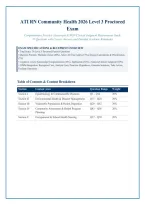
ATI RN Community Health 2026 Level 3 Proctored
Exam
Comprehensive Practice Assessment & NGN Clinical Judgment Measurement Guide
70 Questions with Correct Answers and Detailed Academic Rationales
EXAM SPECIFICATIONS & BLUEPRINT OVERVIEW
• Total Items: 70 Level 3 Proctored Practice Questions
• Question Formats: Multiple Choice (80%), Select All That Apply (15%), Dosage Calculations & Prioritization
(5%)
• Cognitive Levels: Knowledge/Comprehension (20%), Application (50%), Analysis/Clinical Judgment (30%)
• CJMM Integration: Recognize Cues, Analyze Cues, Prioritize Hypotheses, Generate Solutions, Take Action,
Evaluate Outcomes
Table of Contents & Content Breakdown
Section Content Area Question Range Weight
Section I Epidemiology & Communicable Diseases Q1 – Q14 20%
Section II Environmental Health & Disaster Management Q15 – Q28 20%
Section III Vulnerable Populations & Health Disparities Q29 – Q42 20%
Section IV Community Assessment & Health Program Q43 – Q56 20%
Planning
Section V Occupational & School Health Nursing Q57 – Q70 20%
,Section I: Epidemiology & Communicable Diseases
QUESTION 1
A public health nurse (PHN) is conducting an epidemiological investigation following an outbreak of
Salmonella enteritidis at a local community center picnic. To calculate the attack rate for individuals who
consumed the potato salad, which of the following formulas should the nurse utilize?
A. (Number of people who ate potato salad and became ill / Total number of people who attended the
picnic) × 100
B. (Number of people who ate potato salad and became ill / Total number of people who ate potato salad)
× 100
C. (Number of people who became ill / Total number of people who ate potato salad) × 100
D. (Number of people who ate potato salad / Total population of the community) × 100
Correct Answer: B
Tags: [Epidemiology & Communicable Diseases] | [Application] | CJMM: [Analyze Cues]
Rationale: The food-specific attack rate measures the proportion of people exposed to a specific risk factor
(eating potato salad) who developed the illness. Option B correctly places persons who ate the food and became
ill in the numerator, and the total population exposed to that specific food in the denominator. Option A uses the
overall attendee population rather than the specific food-exposed group. Option C includes all ill individuals,
even those who did not consume the specific item. Option D calculates exposure prevalence rather than an
attack rate.
QUESTION 2
An occupational health nurse is evaluating primary prevention strategies for a chemical manufacturing
facility. Which of the following activities represents a primary prevention intervention?
A. Screening workers annually for elevated blood lead levels.
B. Facilitating a return-to-work program for an employee recovering from an industrial chemical exposure
injury.
C. Conducting mandatory educational sessions on proper usage of Personal Protective Equipment (PPE)
prior to workplace exposure.
D. Performing routine pulmonary function testing for employees in the silica handling department.
Correct Answer: C
Tags: [Epidemiology & Communicable Diseases] | [Comprehension] | CJMM: [Generate Solutions]
Rationale: Primary prevention aims to prevent disease or injury before it occurs by eliminating risks or
increasing resistance (education on PPE before exposure). Options A and D represent secondary prevention
(early screening and detection of existing subclinical changes). Option B represents tertiary prevention
(rehabilitation and minimizing disability from an established injury).
, QUESTION 3
A public health nurse receives notification of a newly diagnosed case of active Pulmonary Tuberculosis
(TB) in a residential shelter. Which of the following actions should the nurse prioritize in the immediate
management plan? (Select All That Apply)
[X] A. Initiate contact tracing for individuals who spent prolonged time in close proximity with the client.
[ ] B. Administer the Bacille Calmette-Guérin (BCG) vaccine to all residents in the shelter.
[X] C. Instruct the client that airborne isolation precautions are required until three consecutive sputum
smears are negative for acid-fast bacilli.
[X] D. Report the confirmed TB case to the state or local health department within the mandated
timeframe.
[ ] E. Schedule a Tuberculin Skin Test (TST) immediately for the index client to confirm the active
diagnosis.
Correct Answer: A, C, D
Tags: [Epidemiology & Communicable Diseases] | [Analysis] | CJMM: [Take Action]
Rationale: Immediate public health actions for active TB include contact tracing (A), placing the client under
airborne isolation until non-infectious (3 negative AFB smears) (C), and mandatory reporting to public health
authorities (D). Option B is incorrect because BCG is not administered routinely in outbreak settings in the US.
Option E is incorrect because skin testing is not used to confirm active disease in a client already diagnosed;
sputum cultures and chest radiographs confirm active status.
QUESTION 4
A nurse in a rural clinic is educating a client who was recently bitten by an unknown feral dog. The dog
fled the scene and cannot be located for observation. Which of the following post-exposure prophylaxis
(PEP) regimens should the nurse prepare to administer?
A. Tetanus toxoid booster only; monitor for fever over 14 days.
B. Human Rabies Immune Globulin (HRIG) and the 4-dose rabies vaccine series.
C. Oral amoxicillin-clavulanate for 10 days and oral diphenhydramine.
D. A single dose of intramuscular rabies vaccine and strict wound care.
Correct Answer: B
Tags: [Epidemiology & Communicable Diseases] | [Application] | CJMM: [Take Action]
Rationale: When a client is exposed to a potentially rabid animal that cannot be impounded or tested, standard
rabies PEP protocol dictates immediate administration of Human Rabies Immune Globulin (HRIG) on day 0
alongside a 4-dose rabies vaccine series (days 0, 3, 7, and 14). Tetanus alone (Option A) or antibiotic therapy
alone (Option C) is insufficient against the fatal rabies virus. A single vaccine dose (Option D) does not provide
adequate active immunity.
Exam
Comprehensive Practice Assessment & NGN Clinical Judgment Measurement Guide
70 Questions with Correct Answers and Detailed Academic Rationales
EXAM SPECIFICATIONS & BLUEPRINT OVERVIEW
• Total Items: 70 Level 3 Proctored Practice Questions
• Question Formats: Multiple Choice (80%), Select All That Apply (15%), Dosage Calculations & Prioritization
(5%)
• Cognitive Levels: Knowledge/Comprehension (20%), Application (50%), Analysis/Clinical Judgment (30%)
• CJMM Integration: Recognize Cues, Analyze Cues, Prioritize Hypotheses, Generate Solutions, Take Action,
Evaluate Outcomes
Table of Contents & Content Breakdown
Section Content Area Question Range Weight
Section I Epidemiology & Communicable Diseases Q1 – Q14 20%
Section II Environmental Health & Disaster Management Q15 – Q28 20%
Section III Vulnerable Populations & Health Disparities Q29 – Q42 20%
Section IV Community Assessment & Health Program Q43 – Q56 20%
Planning
Section V Occupational & School Health Nursing Q57 – Q70 20%
,Section I: Epidemiology & Communicable Diseases
QUESTION 1
A public health nurse (PHN) is conducting an epidemiological investigation following an outbreak of
Salmonella enteritidis at a local community center picnic. To calculate the attack rate for individuals who
consumed the potato salad, which of the following formulas should the nurse utilize?
A. (Number of people who ate potato salad and became ill / Total number of people who attended the
picnic) × 100
B. (Number of people who ate potato salad and became ill / Total number of people who ate potato salad)
× 100
C. (Number of people who became ill / Total number of people who ate potato salad) × 100
D. (Number of people who ate potato salad / Total population of the community) × 100
Correct Answer: B
Tags: [Epidemiology & Communicable Diseases] | [Application] | CJMM: [Analyze Cues]
Rationale: The food-specific attack rate measures the proportion of people exposed to a specific risk factor
(eating potato salad) who developed the illness. Option B correctly places persons who ate the food and became
ill in the numerator, and the total population exposed to that specific food in the denominator. Option A uses the
overall attendee population rather than the specific food-exposed group. Option C includes all ill individuals,
even those who did not consume the specific item. Option D calculates exposure prevalence rather than an
attack rate.
QUESTION 2
An occupational health nurse is evaluating primary prevention strategies for a chemical manufacturing
facility. Which of the following activities represents a primary prevention intervention?
A. Screening workers annually for elevated blood lead levels.
B. Facilitating a return-to-work program for an employee recovering from an industrial chemical exposure
injury.
C. Conducting mandatory educational sessions on proper usage of Personal Protective Equipment (PPE)
prior to workplace exposure.
D. Performing routine pulmonary function testing for employees in the silica handling department.
Correct Answer: C
Tags: [Epidemiology & Communicable Diseases] | [Comprehension] | CJMM: [Generate Solutions]
Rationale: Primary prevention aims to prevent disease or injury before it occurs by eliminating risks or
increasing resistance (education on PPE before exposure). Options A and D represent secondary prevention
(early screening and detection of existing subclinical changes). Option B represents tertiary prevention
(rehabilitation and minimizing disability from an established injury).
, QUESTION 3
A public health nurse receives notification of a newly diagnosed case of active Pulmonary Tuberculosis
(TB) in a residential shelter. Which of the following actions should the nurse prioritize in the immediate
management plan? (Select All That Apply)
[X] A. Initiate contact tracing for individuals who spent prolonged time in close proximity with the client.
[ ] B. Administer the Bacille Calmette-Guérin (BCG) vaccine to all residents in the shelter.
[X] C. Instruct the client that airborne isolation precautions are required until three consecutive sputum
smears are negative for acid-fast bacilli.
[X] D. Report the confirmed TB case to the state or local health department within the mandated
timeframe.
[ ] E. Schedule a Tuberculin Skin Test (TST) immediately for the index client to confirm the active
diagnosis.
Correct Answer: A, C, D
Tags: [Epidemiology & Communicable Diseases] | [Analysis] | CJMM: [Take Action]
Rationale: Immediate public health actions for active TB include contact tracing (A), placing the client under
airborne isolation until non-infectious (3 negative AFB smears) (C), and mandatory reporting to public health
authorities (D). Option B is incorrect because BCG is not administered routinely in outbreak settings in the US.
Option E is incorrect because skin testing is not used to confirm active disease in a client already diagnosed;
sputum cultures and chest radiographs confirm active status.
QUESTION 4
A nurse in a rural clinic is educating a client who was recently bitten by an unknown feral dog. The dog
fled the scene and cannot be located for observation. Which of the following post-exposure prophylaxis
(PEP) regimens should the nurse prepare to administer?
A. Tetanus toxoid booster only; monitor for fever over 14 days.
B. Human Rabies Immune Globulin (HRIG) and the 4-dose rabies vaccine series.
C. Oral amoxicillin-clavulanate for 10 days and oral diphenhydramine.
D. A single dose of intramuscular rabies vaccine and strict wound care.
Correct Answer: B
Tags: [Epidemiology & Communicable Diseases] | [Application] | CJMM: [Take Action]
Rationale: When a client is exposed to a potentially rabid animal that cannot be impounded or tested, standard
rabies PEP protocol dictates immediate administration of Human Rabies Immune Globulin (HRIG) on day 0
alongside a 4-dose rabies vaccine series (days 0, 3, 7, and 14). Tetanus alone (Option A) or antibiotic therapy
alone (Option C) is insufficient against the fatal rabies virus. A single vaccine dose (Option D) does not provide
adequate active immunity.

