
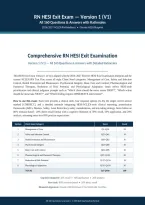
RN HESI Exit Exam — Version 1 (V1)
All 160 Questions & Answers with Rationales
2026/2027 NCLEX-RN Readiness • Elsevier HESI Blueprint
Comprehensive RN HESI Exit Examination
Version 1 (V1) — All 160 Questions & Answers with Detailed Rationales
This HESI Exit Exam Version 1 (V1) is aligned with the 2026–2027 Elsevier HESI Exit Examination blueprint and the
current NCLEX-RN Test Plan across all eight Client Need categories: Management of Care, Safety and Infection
Control, Health Promotion and Maintenance, Psychosocial Integrity, Basic Care and Comfort, Pharmacological and
Parenteral Therapies, Reduction of Risk Potential, and Physiological Adaptation. Items reflect HESI-style
prioritization and clinical judgment prompts such as "Which client should the nurse assess FIRST?", "Which action
should the nurse take NEXT?", and "Which finding requires IMMEDIATE intervention?".
How to use this exam: Each item presents a clinical stem, four response options (A–D), the single correct answer
marked [CORRECT], and a detailed rationale integrating HESI/NCLEX-style clinical reasoning, prioritization
frameworks (ABCs, Maslow, Safety, Least Restrictive), safety considerations, and test-taking strategy. Items follow an
80% scenario-based / 20% direct-recall format with a cognitive blueprint of 30% recall, 50% application, and 20%
analysis, mirroring entry-level RN practice expectations.
Section Client Need Category Items Count
1 Management of Care Q1–Q24 24
2 Safety and Infection Control Q25–Q42 18
3 Health Promotion and Maintenance Q43–Q62 20
4 Psychosocial Integrity Q63–Q80 18
5 Basic Care and Comfort Q81–Q96 16
6 Pharmacological and Parenteral Therapies Q97–Q116 20
7 Reduction of Risk Potential Q117–Q134 18
8 Physiological Adaptation Q135–Q160 26
TOTAL Q1–Q160 160
Cognitive blueprint: 30% recall • 50% application • 20% analysis
Item style: 80% scenario-based • 20% direct recall
Blueprint alignment: Elsevier HESI Exit Exam V1 & NCLEX-RN Test Plan
All 160 Questions & Answers • HESI Exit Examination Format
,RN HESI Exit Exam V1 | 160 Questions & Answers with Rationales 2026–2027 NCLEX-RN Readiness
Section 1: Management of Care
Advocacy, Delegation, Prioritization, Case Management, Continuity of Care, and Legal/Ethical Issues — Questions 1 through 24
Q1: The charge nurse on a medical unit is assigned four newly admitted clients. Which client should the nurse
assess FIRST?
A. A 68-year-old with COPD who has an oxygen saturation of 88% on 2 L/min nasal cannula. [CORRECT]
B. A 54-year-old with a femoral fracture who is receiving IV morphine for pain.
C. A 72-year-old admitted with confusion who has an indwelling urinary catheter.
D. A 45-year-old post-op client who has not voided since surgery 8 hours ago.
Correct Answer: A
Rationale: Apply the ABC framework: Airway, Breathing, then Circulation. The COPD client with SpO₂ 88% on
supplemental oxygen is the most unstable and requires immediate assessment. The morphine client and the post-op client
with urinary retention are important but stable. Confusion in the elderly client warrants evaluation but is not as acute as a
compromised airway/
Q2: A registered nurse (RN) is delegating tasks to a licensed practical nurse (LPN) and an unlicensed assistive
personnel (UAP). Which task is most appropriate to delegate to the UAP?
A. Ambulating a stable 3-day post-op client who has a steady gait to the bathroom. [CORRECT]
B. Administering oral acetaminophen to a client with a fever.
C. Performing a sterile dressing change on a post-op abdominal wound.
D. Teaching a client with newly diagnosed diabetes about insulin injection.
Correct Answer: A
Rationale: UAP scope includes ambulation, hygiene, feeding (no medications), and routine measurements of stable clients.
Medication administration, sterile procedures, and teaching require RN scope. The UAP can ambulate the stable post-op
client. LPN can give oral meds to stable clients but not the initial teaching. Match task complexity to delegatee
qualifications.
Q3: A client with a terminal illness asks the nurse, "Am I dying?" The client's family has requested that the
nurse not disclose the prognosis. Which action by the nurse is most appropriate?
A. Explore the client's understanding and feelings, then discuss the situation with the healthcare team and family
to align on truthful, compassionate disclosure. [CORRECT]
B. Tell the client to ask the family.
C. Lie to the client and say everything is fine.
D. Refuse to discuss the topic at all.
Correct Answer: A
Rationale: Ethical principles of autonomy, veracity (truth-telling), and beneficence guide the nurse's response. Clients have
the right to know their prognosis. The nurse should explore the client's understanding, then collaborate with the healthcare
team and family to support truthful, compassionate disclosure. Lying or evading damages trust and violates ethical
principles.
Q4: A nurse witnesses a colleague documenting a medication as given when it was not actually administered.
Which action should the nurse take FIRST?
A. Report the incident to the nurse manager or supervisor through the chain of command. [CORRECT]
B. Confront the colleague publicly in the nurses' station.
C. Ignore the situation to maintain a good working relationship.
D. Document the discrepancy in the client's medical record directly.
Correct Answer: A
Rationale: Falsifying medical records is a serious violation of professional and legal standards (fraud). The nurse must
report through the chain of command (nurse manager, supervisor) per facility policy. The Nurse Practice Act and ANA
Code of Ethics require reporting unethical conduct. Public confrontation is unprofessional; ignoring enables harm; altering
records without authority is inappropriate.
HESI Exit Exam Blueprint • Entry-Level RN Clinical Judgment Page 2
,RN HESI Exit Exam V1 | 160 Questions & Answers with Rationales 2026–2027 NCLEX-RN Readiness
Q5: A client scheduled for an elective cholecystectomy tells the nurse, "I don't want any more treatment and
want to leave against medical advice (AMA)." Which action should the nurse take FIRST?
A. Explore the client's reasons for wanting to leave and provide information about the risks and benefits of
treatment. [CORRECT]
B. Call security to restrain the client.
C. Have the client sign the AMA form immediately.
D. Notify the healthcare provider to discharge the client.
Correct Answer: A
Rationale: Autonomy requires that competent clients have the right to refuse treatment. First action: explore the client's
concerns and provide information about risks/benefits to ensure informed decision-making. If the client still wants to leave,
ensure AMA form is signed (witnessed), notify the provider, and document thoroughly. Restraint violates autonomy unless
the client lacks capacity and is at imminent risk.
Q6: A nurse is caring for a client who has an advance directive specifying no intubation or resuscitation (DNR).
The client goes into cardiac arrest and a new resident orders intubation. Which action by the nurse is most
appropriate?
A. Honor the advance directive and DNR order; do not intubate; notify the healthcare provider. [CORRECT]
B. Follow the new order and intubate immediately.
C. Ask the family what they want to do.
D. Continue CPR but no intubation.
Correct Answer: A
Rationale: Advance directives and DNR orders represent the client's autonomous wishes and must be honored. The nurse
should not intubate and should notify the resident and attending that a DNR is in place. Following the new order violates the
client's autonomy. Family cannot override a competent adult's advance directive. Partial CPR misinterprets the DNR.
Q7: A nurse manager is planning staffing for the upcoming shift. Which assignment is most appropriate for a
float RN from a medical-surgical unit assigned to a critical care unit?
A. Assign the float RN to care for the most stable critical care clients with a buddy system for orientation.
[CORRECT]
B. Assign the float RN to the most unstable client to maximize learning.
C. Send the float RN home because critical care is too specialized.
D. Assign the float RN to perform UAP duties only.
Correct Answer: A
Rationale: Float RNs should be assigned clients whose care needs match their competencies. The most stable critical care
clients are appropriate with a buddy system for orientation. Float RNs are qualified to provide nursing care; they are not
UAP. The most unstable clients require specialty-trained critical care nurses for safe care.
Q8: A nurse is preparing to administer a blood transfusion. The client refuses the transfusion due to religious
beliefs (Jehovah's Witness). Which action by the nurse is most appropriate?
A. Respect the client's refusal, document the refusal, notify the healthcare provider, and explore alternatives
with the healthcare team. [CORRECT]
B. Administer the blood transfusion because it is life-saving.
C. Obtain a court order to override the refusal.
D. Have the family sign a consent for the transfusion.
Correct Answer: A
Rationale: Competent adults have the right to refuse treatment for any reason, including religious beliefs (autonomy). The
nurse should respect the refusal, document thoroughly, notify the provider, and collaborate on alternatives (e.g., blood
conservation strategies, erythropoietin, volume expanders). Forced transfusion violates autonomy and constitutes battery.
Family cannot override a competent adult's decision.
HESI Exit Exam Blueprint • Entry-Level RN Clinical Judgment Page 3
, RN HESI Exit Exam V1 | 160 Questions & Answers with Rationales 2026–2027 NCLEX-RN Readiness
Q9: Which task can the RN safely delegate to a UAP for a client with a Stage 3 pressure injury?
A. Assist the client with repositioning every 2 hours per the turning schedule. [CORRECT]
B. Assess the wound for signs of infection.
C. Apply a hydrocolloid dressing to the wound.
D. Teach the family about pressure injury prevention.
Correct Answer: A
Rationale: UAP can perform routine client care tasks such as repositioning per established schedule (with stable clients).
Wound assessment, application of dressings, and teaching require RN scope of practice. The UAP should report any
changes (e.g., skin color, complaints of pain) to the RN for further assessment.
Q10: An RN is caring for four clients. Which client should the nurse assess FIRST?
A. A client with heart failure who has new-onset dyspnea and crackles throughout the lung fields. [CORRECT]
B. A client with diabetes who has a fasting glucose of 130 mg/dL.
C. A client 2 days post-op who has a temperature of 99.8°F (37.7°C).
D. A client with a urinary tract infection who is receiving IV antibiotics.
Correct Answer: A
Rationale: Apply ABC and acute-vs-chronic frameworks. The heart failure client with new dyspnea and crackles
(indicating pulmonary edema) is the most unstable and requires immediate assessment. The other clients are stable and
within expected findings. Pulmonary edema can rapidly progress to respiratory failure.
Q11: A client is scheduled for surgery in the morning. The surgeon explains the procedure and risks, then asks
the nurse to witness the client's signature on the consent form. The client appears hesitant. Which action by the
nurse is most appropriate?
A. Ask the client if they have any questions or concerns about the procedure, and notify the surgeon if they
appear to need more information. [CORRECT]
B. Witness the signature immediately.
C. Tell the client they must sign or the surgery cannot proceed.
D. Cancel the surgery.
Correct Answer: A
Rationale: The nurse's role as witness is to verify that the client signed voluntarily and appears competent. If the client
appears hesitant, the nurse should ask about concerns and notify the surgeon so informed consent can be ensured. The nurse
does not obtain consent (surgeon's responsibility) but advocates for the client's right to informed decision-making.
Q12: A nurse manager notes that a staff nurse has been arriving late, smelling of alcohol, and making
medication errors. Which action by the nurse manager is most appropriate?
A. Report the nurse to the Board of Nursing and remove from patient care immediately, per state law and
facility policy. [CORRECT]
B. Confront the nurse informally and ask them to stop.
C. Ignore the situation because the nurse is well-liked.
D. Reassign the nurse to less critical clients.
Correct Answer: A
Rationale: Impaired nurses pose a serious risk to client safety and must be removed from patient care immediately. The
nurse manager should follow facility policy and state law (mandatory reporting to Board of Nursing). Patient safety is the
priority. Informal confrontation is insufficient; reassignment without addressing the impairment is unsafe; ignoring enables
harm.
HESI Exit Exam Blueprint • Entry-Level RN Clinical Judgment Page 4
All 160 Questions & Answers with Rationales
2026/2027 NCLEX-RN Readiness • Elsevier HESI Blueprint
Comprehensive RN HESI Exit Examination
Version 1 (V1) — All 160 Questions & Answers with Detailed Rationales
This HESI Exit Exam Version 1 (V1) is aligned with the 2026–2027 Elsevier HESI Exit Examination blueprint and the
current NCLEX-RN Test Plan across all eight Client Need categories: Management of Care, Safety and Infection
Control, Health Promotion and Maintenance, Psychosocial Integrity, Basic Care and Comfort, Pharmacological and
Parenteral Therapies, Reduction of Risk Potential, and Physiological Adaptation. Items reflect HESI-style
prioritization and clinical judgment prompts such as "Which client should the nurse assess FIRST?", "Which action
should the nurse take NEXT?", and "Which finding requires IMMEDIATE intervention?".
How to use this exam: Each item presents a clinical stem, four response options (A–D), the single correct answer
marked [CORRECT], and a detailed rationale integrating HESI/NCLEX-style clinical reasoning, prioritization
frameworks (ABCs, Maslow, Safety, Least Restrictive), safety considerations, and test-taking strategy. Items follow an
80% scenario-based / 20% direct-recall format with a cognitive blueprint of 30% recall, 50% application, and 20%
analysis, mirroring entry-level RN practice expectations.
Section Client Need Category Items Count
1 Management of Care Q1–Q24 24
2 Safety and Infection Control Q25–Q42 18
3 Health Promotion and Maintenance Q43–Q62 20
4 Psychosocial Integrity Q63–Q80 18
5 Basic Care and Comfort Q81–Q96 16
6 Pharmacological and Parenteral Therapies Q97–Q116 20
7 Reduction of Risk Potential Q117–Q134 18
8 Physiological Adaptation Q135–Q160 26
TOTAL Q1–Q160 160
Cognitive blueprint: 30% recall • 50% application • 20% analysis
Item style: 80% scenario-based • 20% direct recall
Blueprint alignment: Elsevier HESI Exit Exam V1 & NCLEX-RN Test Plan
All 160 Questions & Answers • HESI Exit Examination Format
,RN HESI Exit Exam V1 | 160 Questions & Answers with Rationales 2026–2027 NCLEX-RN Readiness
Section 1: Management of Care
Advocacy, Delegation, Prioritization, Case Management, Continuity of Care, and Legal/Ethical Issues — Questions 1 through 24
Q1: The charge nurse on a medical unit is assigned four newly admitted clients. Which client should the nurse
assess FIRST?
A. A 68-year-old with COPD who has an oxygen saturation of 88% on 2 L/min nasal cannula. [CORRECT]
B. A 54-year-old with a femoral fracture who is receiving IV morphine for pain.
C. A 72-year-old admitted with confusion who has an indwelling urinary catheter.
D. A 45-year-old post-op client who has not voided since surgery 8 hours ago.
Correct Answer: A
Rationale: Apply the ABC framework: Airway, Breathing, then Circulation. The COPD client with SpO₂ 88% on
supplemental oxygen is the most unstable and requires immediate assessment. The morphine client and the post-op client
with urinary retention are important but stable. Confusion in the elderly client warrants evaluation but is not as acute as a
compromised airway/
Q2: A registered nurse (RN) is delegating tasks to a licensed practical nurse (LPN) and an unlicensed assistive
personnel (UAP). Which task is most appropriate to delegate to the UAP?
A. Ambulating a stable 3-day post-op client who has a steady gait to the bathroom. [CORRECT]
B. Administering oral acetaminophen to a client with a fever.
C. Performing a sterile dressing change on a post-op abdominal wound.
D. Teaching a client with newly diagnosed diabetes about insulin injection.
Correct Answer: A
Rationale: UAP scope includes ambulation, hygiene, feeding (no medications), and routine measurements of stable clients.
Medication administration, sterile procedures, and teaching require RN scope. The UAP can ambulate the stable post-op
client. LPN can give oral meds to stable clients but not the initial teaching. Match task complexity to delegatee
qualifications.
Q3: A client with a terminal illness asks the nurse, "Am I dying?" The client's family has requested that the
nurse not disclose the prognosis. Which action by the nurse is most appropriate?
A. Explore the client's understanding and feelings, then discuss the situation with the healthcare team and family
to align on truthful, compassionate disclosure. [CORRECT]
B. Tell the client to ask the family.
C. Lie to the client and say everything is fine.
D. Refuse to discuss the topic at all.
Correct Answer: A
Rationale: Ethical principles of autonomy, veracity (truth-telling), and beneficence guide the nurse's response. Clients have
the right to know their prognosis. The nurse should explore the client's understanding, then collaborate with the healthcare
team and family to support truthful, compassionate disclosure. Lying or evading damages trust and violates ethical
principles.
Q4: A nurse witnesses a colleague documenting a medication as given when it was not actually administered.
Which action should the nurse take FIRST?
A. Report the incident to the nurse manager or supervisor through the chain of command. [CORRECT]
B. Confront the colleague publicly in the nurses' station.
C. Ignore the situation to maintain a good working relationship.
D. Document the discrepancy in the client's medical record directly.
Correct Answer: A
Rationale: Falsifying medical records is a serious violation of professional and legal standards (fraud). The nurse must
report through the chain of command (nurse manager, supervisor) per facility policy. The Nurse Practice Act and ANA
Code of Ethics require reporting unethical conduct. Public confrontation is unprofessional; ignoring enables harm; altering
records without authority is inappropriate.
HESI Exit Exam Blueprint • Entry-Level RN Clinical Judgment Page 2
,RN HESI Exit Exam V1 | 160 Questions & Answers with Rationales 2026–2027 NCLEX-RN Readiness
Q5: A client scheduled for an elective cholecystectomy tells the nurse, "I don't want any more treatment and
want to leave against medical advice (AMA)." Which action should the nurse take FIRST?
A. Explore the client's reasons for wanting to leave and provide information about the risks and benefits of
treatment. [CORRECT]
B. Call security to restrain the client.
C. Have the client sign the AMA form immediately.
D. Notify the healthcare provider to discharge the client.
Correct Answer: A
Rationale: Autonomy requires that competent clients have the right to refuse treatment. First action: explore the client's
concerns and provide information about risks/benefits to ensure informed decision-making. If the client still wants to leave,
ensure AMA form is signed (witnessed), notify the provider, and document thoroughly. Restraint violates autonomy unless
the client lacks capacity and is at imminent risk.
Q6: A nurse is caring for a client who has an advance directive specifying no intubation or resuscitation (DNR).
The client goes into cardiac arrest and a new resident orders intubation. Which action by the nurse is most
appropriate?
A. Honor the advance directive and DNR order; do not intubate; notify the healthcare provider. [CORRECT]
B. Follow the new order and intubate immediately.
C. Ask the family what they want to do.
D. Continue CPR but no intubation.
Correct Answer: A
Rationale: Advance directives and DNR orders represent the client's autonomous wishes and must be honored. The nurse
should not intubate and should notify the resident and attending that a DNR is in place. Following the new order violates the
client's autonomy. Family cannot override a competent adult's advance directive. Partial CPR misinterprets the DNR.
Q7: A nurse manager is planning staffing for the upcoming shift. Which assignment is most appropriate for a
float RN from a medical-surgical unit assigned to a critical care unit?
A. Assign the float RN to care for the most stable critical care clients with a buddy system for orientation.
[CORRECT]
B. Assign the float RN to the most unstable client to maximize learning.
C. Send the float RN home because critical care is too specialized.
D. Assign the float RN to perform UAP duties only.
Correct Answer: A
Rationale: Float RNs should be assigned clients whose care needs match their competencies. The most stable critical care
clients are appropriate with a buddy system for orientation. Float RNs are qualified to provide nursing care; they are not
UAP. The most unstable clients require specialty-trained critical care nurses for safe care.
Q8: A nurse is preparing to administer a blood transfusion. The client refuses the transfusion due to religious
beliefs (Jehovah's Witness). Which action by the nurse is most appropriate?
A. Respect the client's refusal, document the refusal, notify the healthcare provider, and explore alternatives
with the healthcare team. [CORRECT]
B. Administer the blood transfusion because it is life-saving.
C. Obtain a court order to override the refusal.
D. Have the family sign a consent for the transfusion.
Correct Answer: A
Rationale: Competent adults have the right to refuse treatment for any reason, including religious beliefs (autonomy). The
nurse should respect the refusal, document thoroughly, notify the provider, and collaborate on alternatives (e.g., blood
conservation strategies, erythropoietin, volume expanders). Forced transfusion violates autonomy and constitutes battery.
Family cannot override a competent adult's decision.
HESI Exit Exam Blueprint • Entry-Level RN Clinical Judgment Page 3
, RN HESI Exit Exam V1 | 160 Questions & Answers with Rationales 2026–2027 NCLEX-RN Readiness
Q9: Which task can the RN safely delegate to a UAP for a client with a Stage 3 pressure injury?
A. Assist the client with repositioning every 2 hours per the turning schedule. [CORRECT]
B. Assess the wound for signs of infection.
C. Apply a hydrocolloid dressing to the wound.
D. Teach the family about pressure injury prevention.
Correct Answer: A
Rationale: UAP can perform routine client care tasks such as repositioning per established schedule (with stable clients).
Wound assessment, application of dressings, and teaching require RN scope of practice. The UAP should report any
changes (e.g., skin color, complaints of pain) to the RN for further assessment.
Q10: An RN is caring for four clients. Which client should the nurse assess FIRST?
A. A client with heart failure who has new-onset dyspnea and crackles throughout the lung fields. [CORRECT]
B. A client with diabetes who has a fasting glucose of 130 mg/dL.
C. A client 2 days post-op who has a temperature of 99.8°F (37.7°C).
D. A client with a urinary tract infection who is receiving IV antibiotics.
Correct Answer: A
Rationale: Apply ABC and acute-vs-chronic frameworks. The heart failure client with new dyspnea and crackles
(indicating pulmonary edema) is the most unstable and requires immediate assessment. The other clients are stable and
within expected findings. Pulmonary edema can rapidly progress to respiratory failure.
Q11: A client is scheduled for surgery in the morning. The surgeon explains the procedure and risks, then asks
the nurse to witness the client's signature on the consent form. The client appears hesitant. Which action by the
nurse is most appropriate?
A. Ask the client if they have any questions or concerns about the procedure, and notify the surgeon if they
appear to need more information. [CORRECT]
B. Witness the signature immediately.
C. Tell the client they must sign or the surgery cannot proceed.
D. Cancel the surgery.
Correct Answer: A
Rationale: The nurse's role as witness is to verify that the client signed voluntarily and appears competent. If the client
appears hesitant, the nurse should ask about concerns and notify the surgeon so informed consent can be ensured. The nurse
does not obtain consent (surgeon's responsibility) but advocates for the client's right to informed decision-making.
Q12: A nurse manager notes that a staff nurse has been arriving late, smelling of alcohol, and making
medication errors. Which action by the nurse manager is most appropriate?
A. Report the nurse to the Board of Nursing and remove from patient care immediately, per state law and
facility policy. [CORRECT]
B. Confront the nurse informally and ask them to stop.
C. Ignore the situation because the nurse is well-liked.
D. Reassign the nurse to less critical clients.
Correct Answer: A
Rationale: Impaired nurses pose a serious risk to client safety and must be removed from patient care immediately. The
nurse manager should follow facility policy and state law (mandatory reporting to Board of Nursing). Patient safety is the
priority. Informal confrontation is insufficient; reassignment without addressing the impairment is unsafe; ignoring enables
harm.
HESI Exit Exam Blueprint • Entry-Level RN Clinical Judgment Page 4

