
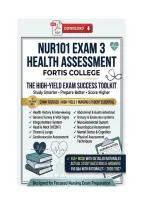
,NUR101 Health Assessment Exam 3 Study
Guide & 150 Practice Questions Fortis College
2026/2027
1. A 42-year-old woman presents to the clinic for the first time. The nurse begins the interview
with "Tell me about what brought you in today." The patient responds with a vague description
of fatigue and worry. The nurse should recognize that this type of question primarily
demonstrates which interview technique?
A. Direct questioning that limits patient response options
B. Open-ended questioning that encourages narrative response
C. Leading questioning that biases the patient's answers
D. Closed questioning that requires yes or no answers
Correct Answer: B. Open-ended questioning that encourages narrative response
Rationale: Open-ended questions such as "Tell me about..." allow patients to describe
symptoms in their own words and provide richer clinical data. Closed or direct questions
constrain the response to specific facts. Leading questions inappropriately introduce bias into
the patient's account.
,2. During a health history interview, a 67-year-old Vietnamese-speaking patient appears
confused when asked about medication use. The nurse's best action to ensure accurate data
collection is to do which of the following?
A. Use a trained medical interpreter to facilitate the interview
B. Ask a family member to translate medical terminology directly
C. Speak slowly and loudly so the patient can lip-read
D. Document that the patient was unable to provide a history
Correct Answer: A. Use a trained medical interpreter to facilitate the interview
Rationale: A trained medical interpreter ensures accurate, confidential, and culturally
appropriate communication during the health history. Family members may omit or alter
information, and shouting does not address a language barrier. Documenting inability to provide
a history is inappropriate when an interpreter is available.
3. A nurse is completing a health history for a 55-year-old man with suspected alcohol use
disorder. The patient denies problematic drinking. The nurse uses the CAGE questionnaire. The
"E" in CAGE specifically asks the patient which question?
A. "Have you ever felt you should Cut down your drinking?"
B. "Have people Annoyed you by criticizing your drinking?"
, C. "Have you ever had a drink first thing in the morning to steady your nerves?"
D. "Have you ever felt Guilty about your drinking?"
Correct Answer: C. "Have you ever had a drink first thing in the morning to steady your nerves?"
Rationale: The "E" in CAGE stands for Eye-opener, asking whether the patient has needed a
drink first thing in the morning to steady nerves or relieve a hangover. Cut down, Annoyed, and
Guilty correspond to the other letters. This question is highly specific for alcohol dependence.
4. A 35-year-old woman is admitted with sharp lower abdominal pain rated 8/10. To perform a
complete symptom analysis using the OLDCARTS mnemonic, which question should the nurse
ask?
A. "Have you ever had this pain before?"
B. "What were you doing when the pain started?"
C. "Does the pain radiate to your back?"
D. "How would you describe the pain?"
Correct Answer: B. "What were you doing when the pain started?"
Guide & 150 Practice Questions Fortis College
2026/2027
1. A 42-year-old woman presents to the clinic for the first time. The nurse begins the interview
with "Tell me about what brought you in today." The patient responds with a vague description
of fatigue and worry. The nurse should recognize that this type of question primarily
demonstrates which interview technique?
A. Direct questioning that limits patient response options
B. Open-ended questioning that encourages narrative response
C. Leading questioning that biases the patient's answers
D. Closed questioning that requires yes or no answers
Correct Answer: B. Open-ended questioning that encourages narrative response
Rationale: Open-ended questions such as "Tell me about..." allow patients to describe
symptoms in their own words and provide richer clinical data. Closed or direct questions
constrain the response to specific facts. Leading questions inappropriately introduce bias into
the patient's account.
,2. During a health history interview, a 67-year-old Vietnamese-speaking patient appears
confused when asked about medication use. The nurse's best action to ensure accurate data
collection is to do which of the following?
A. Use a trained medical interpreter to facilitate the interview
B. Ask a family member to translate medical terminology directly
C. Speak slowly and loudly so the patient can lip-read
D. Document that the patient was unable to provide a history
Correct Answer: A. Use a trained medical interpreter to facilitate the interview
Rationale: A trained medical interpreter ensures accurate, confidential, and culturally
appropriate communication during the health history. Family members may omit or alter
information, and shouting does not address a language barrier. Documenting inability to provide
a history is inappropriate when an interpreter is available.
3. A nurse is completing a health history for a 55-year-old man with suspected alcohol use
disorder. The patient denies problematic drinking. The nurse uses the CAGE questionnaire. The
"E" in CAGE specifically asks the patient which question?
A. "Have you ever felt you should Cut down your drinking?"
B. "Have people Annoyed you by criticizing your drinking?"
, C. "Have you ever had a drink first thing in the morning to steady your nerves?"
D. "Have you ever felt Guilty about your drinking?"
Correct Answer: C. "Have you ever had a drink first thing in the morning to steady your nerves?"
Rationale: The "E" in CAGE stands for Eye-opener, asking whether the patient has needed a
drink first thing in the morning to steady nerves or relieve a hangover. Cut down, Annoyed, and
Guilty correspond to the other letters. This question is highly specific for alcohol dependence.
4. A 35-year-old woman is admitted with sharp lower abdominal pain rated 8/10. To perform a
complete symptom analysis using the OLDCARTS mnemonic, which question should the nurse
ask?
A. "Have you ever had this pain before?"
B. "What were you doing when the pain started?"
C. "Does the pain radiate to your back?"
D. "How would you describe the pain?"
Correct Answer: B. "What were you doing when the pain started?"

