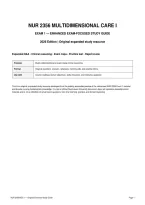
NUR 2356 MULTIDIMENSIONAL CARE I
EXAM 1 — ENHANCED EXAM-FOCUSED STUDY GUIDE
2026 Edition | Original expanded study resource
Expanded Q&A • Clinical reasoning • Exam traps • Practice test • Rapid review
Purpose Build understanding and exam-ready clinical reasoning.
Format Original questions, answers, rationales, memory aids, and practice items.
Use with Course readings, lecture objectives, skills resources, and instructor guidance.
This is an original, expanded study resource developed from the publicly accessible preview of the referenced NUR 2356 Exam 1 material
and broader nursing-fundamentals knowledge. It is not an official Rasmussen University document, does not reproduce locked/premium
material, and is not a collection of actual exam questions. Use it for learning, practice, and clinical reasoning.
NUR 2356 MDC 1 — Original Enhanced Study Guide Page 1
, CONTENTS
SECTION 1 — HOW TO USE THIS GUIDE
SECTION 2 — FOUNDATIONAL NURSING PROCESS & PRIORITIZATION
SECTION 3 — COMMUNICATION & CULTURALLY RESPONSIVE CARE
SECTION 4 — SAFETY, ENVIRONMENT & INFECTION PREVENTION
SECTION 5 — MOBILITY, IMMOBILITY & BODY MECHANICS
SECTION 6 — PAIN ASSESSMENT & MANAGEMENT
SECTION 7 — BASIC CARE, ELIMINATION & URINARY HEALTH
SECTION 8 — VITAL SIGNS & BASIC ASSESSMENT
SECTION 9 — HERBAL SUPPLEMENTS & PATIENT TEACHING
SECTION 10 — ETHICS, LEGAL RESPONSIBILITIES & PROFESSIONAL PRACTICE
PRACTICE EXAM — 30 ORIGINAL QUESTIONS
RAPID REVIEW & MEMORY SHEET
NUR 2356 MDC 1 — Original Enhanced Study Guide Page 2
, SECTION 1 — HOW TO USE THIS GUIDE
Q1. How should this guide be used for efficient exam preparation?
Answer: Use active recall rather than passive rereading. First answer each question without looking at the answer, then
read the rationale and explain why every distractor is wrong. Mark questions you missed and revisit them after a delay. Pair
this guide with your assigned readings, lecture material, skills practice, and instructor-specific objectives.
Q2. What is the best way to study a large nursing topic?
Answer: Break it into a repeatable sequence: definition → assessment findings → priority concern → nursing interventions
→ patient teaching → complications → evaluation. This prevents memorizing isolated facts and trains the clinical reasoning
needed for application questions.
Q3. Why are rationales more important than simply memorizing correct answers?
Answer: A rationale explains the clinical principle behind an answer. If the wording changes on an exam, understanding
the principle lets you identify the best response even when the question is unfamiliar.
SECTION 2 — FOUNDATIONAL NURSING PROCESS & PRIORITIZATION
Q4. What is the assessment phase of the nursing process?
Answer: Assessment is the systematic collection, validation, organization, and documentation of patient information. It
includes subjective data, objective data, health history, physical findings, and relevant contextual information.
Q5. What is subjective data?
Answer: Subjective data are symptoms or experiences reported by the patient or another appropriate source, such as pain,
nausea, dizziness, or 'I feel short of breath.' They cannot be directly measured by the nurse in the same way as objective
findings.
Q6. What is objective data?
Answer: Objective data are observable or measurable findings, such as temperature, blood pressure, respiratory rate,
oxygen saturation, edema, skin color, or a laboratory value.
Q7. What is the purpose of validation during assessment?
Answer: Validation helps the nurse determine whether collected information is accurate, complete, and consistent.
Unexpected or conflicting findings should be reassessed rather than automatically accepted or ignored.
Q8. What is the purpose of the planning phase?
Answer: Planning uses assessment information to establish priorities, formulate measurable outcomes, select appropriate
nursing interventions, and organize individualized care.
Q9. What makes a nursing outcome measurable?
Answer: A measurable outcome identifies the patient behavior or clinical result, the desired level, and a time frame when
appropriate. For example: 'Patient will report pain at or below 3/10 within 60 minutes of intervention.'
Q10. What occurs during implementation?
Answer: Implementation is the action phase. The nurse carries out appropriate interventions, provides education,
coordinates care, documents care, and modifies actions when patient status changes.
NUR 2356 MDC 1 — Original Enhanced Study Guide Page 3
EXAM 1 — ENHANCED EXAM-FOCUSED STUDY GUIDE
2026 Edition | Original expanded study resource
Expanded Q&A • Clinical reasoning • Exam traps • Practice test • Rapid review
Purpose Build understanding and exam-ready clinical reasoning.
Format Original questions, answers, rationales, memory aids, and practice items.
Use with Course readings, lecture objectives, skills resources, and instructor guidance.
This is an original, expanded study resource developed from the publicly accessible preview of the referenced NUR 2356 Exam 1 material
and broader nursing-fundamentals knowledge. It is not an official Rasmussen University document, does not reproduce locked/premium
material, and is not a collection of actual exam questions. Use it for learning, practice, and clinical reasoning.
NUR 2356 MDC 1 — Original Enhanced Study Guide Page 1
, CONTENTS
SECTION 1 — HOW TO USE THIS GUIDE
SECTION 2 — FOUNDATIONAL NURSING PROCESS & PRIORITIZATION
SECTION 3 — COMMUNICATION & CULTURALLY RESPONSIVE CARE
SECTION 4 — SAFETY, ENVIRONMENT & INFECTION PREVENTION
SECTION 5 — MOBILITY, IMMOBILITY & BODY MECHANICS
SECTION 6 — PAIN ASSESSMENT & MANAGEMENT
SECTION 7 — BASIC CARE, ELIMINATION & URINARY HEALTH
SECTION 8 — VITAL SIGNS & BASIC ASSESSMENT
SECTION 9 — HERBAL SUPPLEMENTS & PATIENT TEACHING
SECTION 10 — ETHICS, LEGAL RESPONSIBILITIES & PROFESSIONAL PRACTICE
PRACTICE EXAM — 30 ORIGINAL QUESTIONS
RAPID REVIEW & MEMORY SHEET
NUR 2356 MDC 1 — Original Enhanced Study Guide Page 2
, SECTION 1 — HOW TO USE THIS GUIDE
Q1. How should this guide be used for efficient exam preparation?
Answer: Use active recall rather than passive rereading. First answer each question without looking at the answer, then
read the rationale and explain why every distractor is wrong. Mark questions you missed and revisit them after a delay. Pair
this guide with your assigned readings, lecture material, skills practice, and instructor-specific objectives.
Q2. What is the best way to study a large nursing topic?
Answer: Break it into a repeatable sequence: definition → assessment findings → priority concern → nursing interventions
→ patient teaching → complications → evaluation. This prevents memorizing isolated facts and trains the clinical reasoning
needed for application questions.
Q3. Why are rationales more important than simply memorizing correct answers?
Answer: A rationale explains the clinical principle behind an answer. If the wording changes on an exam, understanding
the principle lets you identify the best response even when the question is unfamiliar.
SECTION 2 — FOUNDATIONAL NURSING PROCESS & PRIORITIZATION
Q4. What is the assessment phase of the nursing process?
Answer: Assessment is the systematic collection, validation, organization, and documentation of patient information. It
includes subjective data, objective data, health history, physical findings, and relevant contextual information.
Q5. What is subjective data?
Answer: Subjective data are symptoms or experiences reported by the patient or another appropriate source, such as pain,
nausea, dizziness, or 'I feel short of breath.' They cannot be directly measured by the nurse in the same way as objective
findings.
Q6. What is objective data?
Answer: Objective data are observable or measurable findings, such as temperature, blood pressure, respiratory rate,
oxygen saturation, edema, skin color, or a laboratory value.
Q7. What is the purpose of validation during assessment?
Answer: Validation helps the nurse determine whether collected information is accurate, complete, and consistent.
Unexpected or conflicting findings should be reassessed rather than automatically accepted or ignored.
Q8. What is the purpose of the planning phase?
Answer: Planning uses assessment information to establish priorities, formulate measurable outcomes, select appropriate
nursing interventions, and organize individualized care.
Q9. What makes a nursing outcome measurable?
Answer: A measurable outcome identifies the patient behavior or clinical result, the desired level, and a time frame when
appropriate. For example: 'Patient will report pain at or below 3/10 within 60 minutes of intervention.'
Q10. What occurs during implementation?
Answer: Implementation is the action phase. The nurse carries out appropriate interventions, provides education,
coordinates care, documents care, and modifies actions when patient status changes.
NUR 2356 MDC 1 — Original Enhanced Study Guide Page 3