
[STUDY GUIDE] • HIGH-YIELD PRACTICE & REVIEW EDITION
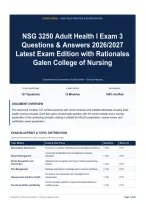
NSG 3250 Adult Health I Exam 3
Questions & Answers 2026/2027
Latest Exam Edition with Rationales
Galen College of Nursing
Comprehensive Examination Question Bank • Concept Mapping
TOTAL QUESTIONS EXAM TOPICS RATIONALES
127 Questions 12 Modules 100% Verified
DOCUMENT OVERVIEW
This document contains 127 verified questions with correct answers and detailed rationales covering adult
health nursing concepts. Each item pairs a board-style question with the correct answer and a concise
explanation of the underlying principle, making it suitable for NCLEX preparation, course review, and
certification exam preparation.
EXAM BLUEPRINT & TOPIC DISTRIBUTION
Systematic breakdown of subject domains and exam coverage.
Topic Module Scope & Core Focus Questions Share (%)
Neurological Assessment Focuses on cognitive functioning and neurological conditions. 11 Qs 8.7%
Covers the identification and management of seizure
Seizure Management disorders. 11 Qs 8.7%
Stroke Recognition and Addresses the recognition and care of clients experiencing
Intervention strokes. 11 Qs 8.7%
Pain Management Explores approaches to manage pain in various conditions. 11 Qs 8.7%
Focuses on the assessment and management of
Osteoporosis and Bone Health osteoporosis. 11 Qs 8.7%
Covers concepts related to impaired functional ability and
Functional Ability and Mobility mobility issues. 11 Qs 8.7%
Confidential • Student Study Edition • Practice & Review Guide Page 1 of 60
,STUDENT STUDY & MASTERY EDITION PRACTICE & REVIEW GUIDE
Medication Administration Focuses on safe medication administration practices. 11 Qs 8.7%
Addresses cognitive decline and disorders in elderly
Cognitive Impairment in Aging populations. 10 Qs 7.9%
Emergency Care Protocols Covers protocols for emergency situations and acute care. 10 Qs 7.9%
Focuses on the assessment and management of eye and ear
Eye and Ear Disorders conditions. 10 Qs 7.9%
Covers essential elements of patient education for various
Patient Education health issues. 10 Qs 7.9%
Injury Assessment and
Management Focuses on the assessment and management of injuries. 10 Qs 7.9%
Total Exam Coverage 12 Integrated Topic Modules 127 Qs 100.0%
Confidential • Student Study Edition • Practice & Review Guide Page 2 of 60
,STUDENT STUDY & MASTERY EDITION PRACTICE & REVIEW GUIDE
TOPIC 1: NEUROLOGICAL ASSESSMENT
11 Questions • 8.7% of Exam • Focuses on cognitive functioning and neurological conditions.
QUESTION 1
Which of the following are key functions of the left hemisphere of the brain? Select all
that apply
a. spoken language
b. scientific functions
c. spacial orientation
d. creativity
e. number skills
Answer: A, b, e.
Rationale: The left hemisphere is typically dominant for language processing, including speech production and
comprehension, as well as logical reasoning, mathematical calculations, and analytical thought.
Spatial orientation and creativity are more often associated with the right hemisphere.
QUESTION 2
What is the highest score on the Glasgow Coma Scale?
Answer: 15.
Rationale: The Glasgow Coma Scale (GCS) assesses eye opening, verbal response, and motor response, with a maximum
possible score of 15 representing fully intact consciousness. This assessment tool quantifies the level of consciousness in
response to stimuli.
QUESTION 3
The client is admitted to the ED after a motorcycle accident. The client was not wearing
a helmet when their head struck the pavement. The nurse identifies the concept as
impaired intracranial regulation. Which interventions should the ED nurse implement in
the first 5 minutes? Select all that apply.
a. Stabilize the client's neck and spine.
b. Contact the organ procurement organization to speak with the family.
c. Elevate the head of the bed to 70°.
d. Perform a Glasgow Coma Scale (GCS) assessment.
Confidential • Student Study Edition • Practice & Review Guide Page 3 of 60
, STUDENT STUDY & MASTERY EDITION PRACTICE & REVIEW GUIDE
e. Ensure the client has a patent peripheral venous catheter in place.
f. Check the client's driver's license permission to receive blood.
Answer: A, d, e.
Rationale: Immediate interventions focus on airway patency, cervical spine stabilization, and neurological assessment to
manage potential intracranial pressure increases and prevent further injury.
Establishing IV access is critical for potential resuscitation and medication administration in a head-injured patient.
QUESTION 4
Which diagnostic evaluation tool would the nurse use to assess the client's cognitive
functioning? Select all that apply.
a. The Geriatric Depression Scale (GDS).
b. The St. Louis University Mental Status (SLUMS) scale. The Mini-Mental
c. Status Examination (MMSE) scale.
d. The Manic Depression vs. Elderly Depression (MDED) scale.
e. The Functional Independence Measurement Scale (FIMS).
Answer: B & c.
Rationale: The SLUMS and MMSE are validated instruments specifically designed to screen for cognitive impairment by
assessing domains like orientation, memory, and attention. The GDS and MDED are designed to assess depression, and
FIMS evaluates functional abilities, not direct cognitive status.
QUESTION 5
The client diagnosed with a brain abscess is experiencing a tonic-clonic seizure. Which
interventions should the nurse implement? Rank in order of performance.
1. Assess the client's mouth.
2. Loosen restrictive clothing.
3. Administer phenytoin IVP.
4. Turn the client to the side.
5. Protect the client's head from injury.
Answer: 4, 5, 2, 3, 1.
Rationale: Protecting the airway by turning the client to the side and preventing head injury are immediate priorities during a
tonic-clonic seizure, followed by ensuring adequate breathing by loosening restrictive clothing and administering
anticonvulsants. Assessing the mouth is a lower priority as it can be done after the seizure has subsided.
Confidential • Student Study Edition • Practice & Review Guide Page 4 of 60
NSG 3250 Adult Health I Exam 3
Questions & Answers 2026/2027
Latest Exam Edition with Rationales
Galen College of Nursing
Comprehensive Examination Question Bank • Concept Mapping
TOTAL QUESTIONS EXAM TOPICS RATIONALES
127 Questions 12 Modules 100% Verified
DOCUMENT OVERVIEW
This document contains 127 verified questions with correct answers and detailed rationales covering adult
health nursing concepts. Each item pairs a board-style question with the correct answer and a concise
explanation of the underlying principle, making it suitable for NCLEX preparation, course review, and
certification exam preparation.
EXAM BLUEPRINT & TOPIC DISTRIBUTION
Systematic breakdown of subject domains and exam coverage.
Topic Module Scope & Core Focus Questions Share (%)
Neurological Assessment Focuses on cognitive functioning and neurological conditions. 11 Qs 8.7%
Covers the identification and management of seizure
Seizure Management disorders. 11 Qs 8.7%
Stroke Recognition and Addresses the recognition and care of clients experiencing
Intervention strokes. 11 Qs 8.7%
Pain Management Explores approaches to manage pain in various conditions. 11 Qs 8.7%
Focuses on the assessment and management of
Osteoporosis and Bone Health osteoporosis. 11 Qs 8.7%
Covers concepts related to impaired functional ability and
Functional Ability and Mobility mobility issues. 11 Qs 8.7%
Confidential • Student Study Edition • Practice & Review Guide Page 1 of 60
,STUDENT STUDY & MASTERY EDITION PRACTICE & REVIEW GUIDE
Medication Administration Focuses on safe medication administration practices. 11 Qs 8.7%
Addresses cognitive decline and disorders in elderly
Cognitive Impairment in Aging populations. 10 Qs 7.9%
Emergency Care Protocols Covers protocols for emergency situations and acute care. 10 Qs 7.9%
Focuses on the assessment and management of eye and ear
Eye and Ear Disorders conditions. 10 Qs 7.9%
Covers essential elements of patient education for various
Patient Education health issues. 10 Qs 7.9%
Injury Assessment and
Management Focuses on the assessment and management of injuries. 10 Qs 7.9%
Total Exam Coverage 12 Integrated Topic Modules 127 Qs 100.0%
Confidential • Student Study Edition • Practice & Review Guide Page 2 of 60
,STUDENT STUDY & MASTERY EDITION PRACTICE & REVIEW GUIDE
TOPIC 1: NEUROLOGICAL ASSESSMENT
11 Questions • 8.7% of Exam • Focuses on cognitive functioning and neurological conditions.
QUESTION 1
Which of the following are key functions of the left hemisphere of the brain? Select all
that apply
a. spoken language
b. scientific functions
c. spacial orientation
d. creativity
e. number skills
Answer: A, b, e.
Rationale: The left hemisphere is typically dominant for language processing, including speech production and
comprehension, as well as logical reasoning, mathematical calculations, and analytical thought.
Spatial orientation and creativity are more often associated with the right hemisphere.
QUESTION 2
What is the highest score on the Glasgow Coma Scale?
Answer: 15.
Rationale: The Glasgow Coma Scale (GCS) assesses eye opening, verbal response, and motor response, with a maximum
possible score of 15 representing fully intact consciousness. This assessment tool quantifies the level of consciousness in
response to stimuli.
QUESTION 3
The client is admitted to the ED after a motorcycle accident. The client was not wearing
a helmet when their head struck the pavement. The nurse identifies the concept as
impaired intracranial regulation. Which interventions should the ED nurse implement in
the first 5 minutes? Select all that apply.
a. Stabilize the client's neck and spine.
b. Contact the organ procurement organization to speak with the family.
c. Elevate the head of the bed to 70°.
d. Perform a Glasgow Coma Scale (GCS) assessment.
Confidential • Student Study Edition • Practice & Review Guide Page 3 of 60
, STUDENT STUDY & MASTERY EDITION PRACTICE & REVIEW GUIDE
e. Ensure the client has a patent peripheral venous catheter in place.
f. Check the client's driver's license permission to receive blood.
Answer: A, d, e.
Rationale: Immediate interventions focus on airway patency, cervical spine stabilization, and neurological assessment to
manage potential intracranial pressure increases and prevent further injury.
Establishing IV access is critical for potential resuscitation and medication administration in a head-injured patient.
QUESTION 4
Which diagnostic evaluation tool would the nurse use to assess the client's cognitive
functioning? Select all that apply.
a. The Geriatric Depression Scale (GDS).
b. The St. Louis University Mental Status (SLUMS) scale. The Mini-Mental
c. Status Examination (MMSE) scale.
d. The Manic Depression vs. Elderly Depression (MDED) scale.
e. The Functional Independence Measurement Scale (FIMS).
Answer: B & c.
Rationale: The SLUMS and MMSE are validated instruments specifically designed to screen for cognitive impairment by
assessing domains like orientation, memory, and attention. The GDS and MDED are designed to assess depression, and
FIMS evaluates functional abilities, not direct cognitive status.
QUESTION 5
The client diagnosed with a brain abscess is experiencing a tonic-clonic seizure. Which
interventions should the nurse implement? Rank in order of performance.
1. Assess the client's mouth.
2. Loosen restrictive clothing.
3. Administer phenytoin IVP.
4. Turn the client to the side.
5. Protect the client's head from injury.
Answer: 4, 5, 2, 3, 1.
Rationale: Protecting the airway by turning the client to the side and preventing head injury are immediate priorities during a
tonic-clonic seizure, followed by ensuring adequate breathing by loosening restrictive clothing and administering
anticonvulsants. Assessing the mouth is a lower priority as it can be done after the seizure has subsided.
Confidential • Student Study Edition • Practice & Review Guide Page 4 of 60

