
1|Page
NR547 MIDTERM EXAM — ORIGINAL
ADVANCED PRACTICE QUESTIONS 1–
100 WITH DETAILED RATIONALES
INTRODUCTION
This NR547 Midterm practice question bank is designed to help graduate-level nursing students
strengthen clinical reasoning, pharmacologic decision-making, patient assessment, medication
safety, and application of course concepts in complex clinical situations. Rather than relying on
simple recall, the questions emphasize interpretation of patient findings, prioritization, adverse-
effect recognition, drug interactions, contraindications, monitoring parameters, and selection of
appropriate interventions.
The bank uses a four-option multiple-choice format with one best answer for each scenario. The
questions are intentionally challenging and are written to require the student to connect multiple
clinical findings before selecting an answer. Detailed rationales explain the reasoning behind the
correct option and distinguish it from the alternatives.
Students should use these questions as a study and self-assessment resource alongside their
NR547 course materials, instructor guidance, assigned readings, and current clinical references.
The goal is to identify knowledge gaps, practice clinical reasoning, and improve readiness for a
midterm examination rather than memorize isolated answers.
CONTENT AREA OVERVIEW
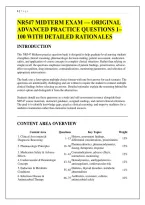
Content Area Questions Key Topics Weight
1. Clinical Assessment & History, assessment findings,
1–15 15%
Diagnostic Reasoning differential considerations, prioritization
Pharmacokinetics, pharmacodynamics,
2. Pharmacologic Principles 16–30 15%
dosing, therapeutic response
3. Medication Safety & Adverse Contraindications, adverse effects,
31–42 12%
Effects interactions, monitoring
4. Cardiovascular & Hematologic Hemodynamics, antihypertensives,
43–54 12%
Concepts anticoagulants, cardiovascular risk
5. Endocrine & Metabolic Diabetes, thyroid disorders, metabolic
55–65 11%
Conditions abnormalities
6. Infectious Disease & Antibiotics, resistance, cultures,
66–75 10%
Antimicrobial Therapy antimicrobial safety
,2|Page
Content Area Questions Key Topics Weight
7. Respiratory & Gastrointestinal Asthma, COPD, GERD, GI
76–85 10%
Conditions pharmacotherapy
8. Neurologic, Psychiatric & CNS medications, older adults,
86–94 9%
Special-Population Considerations pregnancy, polypharmacy
9. Integrated Clinical Decision- Complex cases, prioritization, treatment
95–100 6%
Making modification
QUESTIONS 1–100
CONTENT AREA 1 — CLINICAL ASSESSMENT &
DIAGNOSTIC REASONING
Q1:
A 58-year-old patient presents with fatigue, dizziness, and intermittent palpitations. The patient
recently started a new medication for hypertension. Blood pressure is 96/58 mmHg while
standing and 118/70 mmHg while supine. Which finding should receive the greatest attention
when evaluating the medication's contribution?
A) Mild fatigue after exercise
B) A significant orthostatic blood-pressure decrease associated with symptoms
C) The patient's preference for morning dosing
D) A resting respiratory rate of 16/min
Rationale: The correct answer is B because symptomatic orthostatic hypotension can indicate
excessive antihypertensive effect and increases fall and syncope risk. Option A is nonspecific.
Option C concerns administration preference rather than an immediate safety issue. Option D is
within a typical resting range and does not explain the presentation.
Q2:
A patient presents with fever, confusion, tachycardia, and hypotension. Which clinical reasoning
approach is most appropriate?
A) Focus only on the patient's reported chief complaint
B) Wait for all laboratory results before initiating evaluation
C) Recognize the combination as potentially indicating systemic instability and prioritize
urgent assessment
D) Assume the symptoms are caused by anxiety
Rationale: The correct answer is C because fever, altered mental status, tachycardia, and
hypotension can represent serious systemic illness. Option A is too narrow. Option B delays
,3|Page
potentially necessary intervention. Option D incorrectly attributes objective signs of instability to
anxiety.
Q3:
A patient reports new unilateral calf swelling and pain after prolonged immobility. Which
additional finding would most increase concern for venous thromboembolism?
A) Bilateral ankle itching
B) New unexplained dyspnea and pleuritic chest pain
C) Mild chronic back pain
D) Increased appetite
Rationale: The correct answer is B because unilateral calf symptoms may indicate DVT, while
sudden dyspnea and pleuritic chest pain raise concern for pulmonary embolism. The other
findings do not provide the same clinical connection.
Q4:
A patient reports intermittent chest discomfort occurring during exertion and resolving with rest.
Which feature is most clinically significant?
A) Pain occurs after drinking water
B) A reproducible relationship between exertion and symptom onset
C) Symptoms occur only when lying down after eating
D) The patient has occasional headaches
Rationale: The correct answer is B because exertional symptoms relieved by rest are concerning
for myocardial ischemia and require cardiovascular evaluation. The alternatives do not
establish the same relationship.
Q5:
A patient with diabetes reports sweating, tremor, confusion, and weakness after taking insulin
without eating breakfast. What is the most likely immediate problem?
A) Hypernatremia
B) Hypoglycemia
C) Hypercalcemia
D) Diabetic ketoacidosis
Rationale: The correct answer is B because autonomic symptoms such as sweating and tremor
followed by neuroglycopenic symptoms such as confusion are characteristic of hypoglycemia.
Diabetic ketoacidosis generally involves hyperglycemia and metabolic acidosis.
Q6:
, 4|Page
A patient reports progressive fatigue, cold intolerance, constipation, and weight gain. Which
laboratory assessment would be most directly relevant?
A) Troponin
B) D-dimer
C) Thyroid-stimulating hormone
D) Serum amylase
Rationale: The correct answer is C because the symptom cluster is compatible with
hypothyroidism, for which TSH is a central screening assessment in most patients. Troponin
evaluates myocardial injury, D-dimer relates to thromboembolism, and amylase evaluates
pancreatic injury.
Q7:
A patient presents with polyuria, polydipsia, weight loss, and blurred vision. Which diagnostic
assessment is most directly relevant?
A) Serum uric acid
B) Blood glucose and glycated hemoglobin
C) Serum bilirubin alone
D) Troponin alone
Rationale: The correct answer is B because the symptoms strongly suggest hyperglycemia and
possible diabetes mellitus. HbA1c provides information about longer-term glycemic exposure.
Q8:
A patient taking several medications develops dizziness shortly after adding a new prescription.
What is the most appropriate first step?
A) Immediately discontinue every medication
B) Perform a complete medication reconciliation and evaluate temporal relationships
C) Assume the newest medication is always responsible
D) Ignore the symptom unless syncope occurs
Rationale: The correct answer is B because medication reconciliation identifies duplicate
therapy, interactions, dosing problems, and temporal relationships. Automatically stopping all
medications could create additional risk.
Q9:
A patient has persistent abdominal pain and develops guarding and rebound tenderness. Which
interpretation is most appropriate?
NR547 MIDTERM EXAM — ORIGINAL
ADVANCED PRACTICE QUESTIONS 1–
100 WITH DETAILED RATIONALES
INTRODUCTION
This NR547 Midterm practice question bank is designed to help graduate-level nursing students
strengthen clinical reasoning, pharmacologic decision-making, patient assessment, medication
safety, and application of course concepts in complex clinical situations. Rather than relying on
simple recall, the questions emphasize interpretation of patient findings, prioritization, adverse-
effect recognition, drug interactions, contraindications, monitoring parameters, and selection of
appropriate interventions.
The bank uses a four-option multiple-choice format with one best answer for each scenario. The
questions are intentionally challenging and are written to require the student to connect multiple
clinical findings before selecting an answer. Detailed rationales explain the reasoning behind the
correct option and distinguish it from the alternatives.
Students should use these questions as a study and self-assessment resource alongside their
NR547 course materials, instructor guidance, assigned readings, and current clinical references.
The goal is to identify knowledge gaps, practice clinical reasoning, and improve readiness for a
midterm examination rather than memorize isolated answers.
CONTENT AREA OVERVIEW
Content Area Questions Key Topics Weight
1. Clinical Assessment & History, assessment findings,
1–15 15%
Diagnostic Reasoning differential considerations, prioritization
Pharmacokinetics, pharmacodynamics,
2. Pharmacologic Principles 16–30 15%
dosing, therapeutic response
3. Medication Safety & Adverse Contraindications, adverse effects,
31–42 12%
Effects interactions, monitoring
4. Cardiovascular & Hematologic Hemodynamics, antihypertensives,
43–54 12%
Concepts anticoagulants, cardiovascular risk
5. Endocrine & Metabolic Diabetes, thyroid disorders, metabolic
55–65 11%
Conditions abnormalities
6. Infectious Disease & Antibiotics, resistance, cultures,
66–75 10%
Antimicrobial Therapy antimicrobial safety
,2|Page
Content Area Questions Key Topics Weight
7. Respiratory & Gastrointestinal Asthma, COPD, GERD, GI
76–85 10%
Conditions pharmacotherapy
8. Neurologic, Psychiatric & CNS medications, older adults,
86–94 9%
Special-Population Considerations pregnancy, polypharmacy
9. Integrated Clinical Decision- Complex cases, prioritization, treatment
95–100 6%
Making modification
QUESTIONS 1–100
CONTENT AREA 1 — CLINICAL ASSESSMENT &
DIAGNOSTIC REASONING
Q1:
A 58-year-old patient presents with fatigue, dizziness, and intermittent palpitations. The patient
recently started a new medication for hypertension. Blood pressure is 96/58 mmHg while
standing and 118/70 mmHg while supine. Which finding should receive the greatest attention
when evaluating the medication's contribution?
A) Mild fatigue after exercise
B) A significant orthostatic blood-pressure decrease associated with symptoms
C) The patient's preference for morning dosing
D) A resting respiratory rate of 16/min
Rationale: The correct answer is B because symptomatic orthostatic hypotension can indicate
excessive antihypertensive effect and increases fall and syncope risk. Option A is nonspecific.
Option C concerns administration preference rather than an immediate safety issue. Option D is
within a typical resting range and does not explain the presentation.
Q2:
A patient presents with fever, confusion, tachycardia, and hypotension. Which clinical reasoning
approach is most appropriate?
A) Focus only on the patient's reported chief complaint
B) Wait for all laboratory results before initiating evaluation
C) Recognize the combination as potentially indicating systemic instability and prioritize
urgent assessment
D) Assume the symptoms are caused by anxiety
Rationale: The correct answer is C because fever, altered mental status, tachycardia, and
hypotension can represent serious systemic illness. Option A is too narrow. Option B delays
,3|Page
potentially necessary intervention. Option D incorrectly attributes objective signs of instability to
anxiety.
Q3:
A patient reports new unilateral calf swelling and pain after prolonged immobility. Which
additional finding would most increase concern for venous thromboembolism?
A) Bilateral ankle itching
B) New unexplained dyspnea and pleuritic chest pain
C) Mild chronic back pain
D) Increased appetite
Rationale: The correct answer is B because unilateral calf symptoms may indicate DVT, while
sudden dyspnea and pleuritic chest pain raise concern for pulmonary embolism. The other
findings do not provide the same clinical connection.
Q4:
A patient reports intermittent chest discomfort occurring during exertion and resolving with rest.
Which feature is most clinically significant?
A) Pain occurs after drinking water
B) A reproducible relationship between exertion and symptom onset
C) Symptoms occur only when lying down after eating
D) The patient has occasional headaches
Rationale: The correct answer is B because exertional symptoms relieved by rest are concerning
for myocardial ischemia and require cardiovascular evaluation. The alternatives do not
establish the same relationship.
Q5:
A patient with diabetes reports sweating, tremor, confusion, and weakness after taking insulin
without eating breakfast. What is the most likely immediate problem?
A) Hypernatremia
B) Hypoglycemia
C) Hypercalcemia
D) Diabetic ketoacidosis
Rationale: The correct answer is B because autonomic symptoms such as sweating and tremor
followed by neuroglycopenic symptoms such as confusion are characteristic of hypoglycemia.
Diabetic ketoacidosis generally involves hyperglycemia and metabolic acidosis.
Q6:
, 4|Page
A patient reports progressive fatigue, cold intolerance, constipation, and weight gain. Which
laboratory assessment would be most directly relevant?
A) Troponin
B) D-dimer
C) Thyroid-stimulating hormone
D) Serum amylase
Rationale: The correct answer is C because the symptom cluster is compatible with
hypothyroidism, for which TSH is a central screening assessment in most patients. Troponin
evaluates myocardial injury, D-dimer relates to thromboembolism, and amylase evaluates
pancreatic injury.
Q7:
A patient presents with polyuria, polydipsia, weight loss, and blurred vision. Which diagnostic
assessment is most directly relevant?
A) Serum uric acid
B) Blood glucose and glycated hemoglobin
C) Serum bilirubin alone
D) Troponin alone
Rationale: The correct answer is B because the symptoms strongly suggest hyperglycemia and
possible diabetes mellitus. HbA1c provides information about longer-term glycemic exposure.
Q8:
A patient taking several medications develops dizziness shortly after adding a new prescription.
What is the most appropriate first step?
A) Immediately discontinue every medication
B) Perform a complete medication reconciliation and evaluate temporal relationships
C) Assume the newest medication is always responsible
D) Ignore the symptom unless syncope occurs
Rationale: The correct answer is B because medication reconciliation identifies duplicate
therapy, interactions, dosing problems, and temporal relationships. Automatically stopping all
medications could create additional risk.
Q9:
A patient has persistent abdominal pain and develops guarding and rebound tenderness. Which
interpretation is most appropriate?

