
C O M P R E H E N S I V E S T U DY G U I D E & R E V I S I O N N O T E S
11th Grade Biology: Cell Structure, Function &
Transport Mechanisms
Subject: Biology Level: 11th Grade / Fifth Year (International) Category: High-Yield Exam Notes
1. Introduction to Cell Theory
The cell is the fundamental structural and functional unit of all living organisms. Cell theory
forms the cornerstone of modern biology:
• All living organisms are composed of one or more cells.
• The cell is the basic unit of structure, function, and organization in organisms.
• All cells arise from pre-existing cells through cell division.
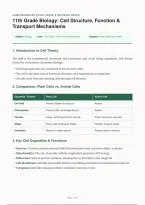
2. Comparison: Plant Cells vs. Animal Cells
Organelle / Feature Plant Cell Animal Cell
Cell Wall Present (Made of cellulose) Absent
Chloroplasts Present (Site of photosynthesis) Absent
Vacuole Large, central permanent vacuole Small, temporary vacuoles
Shape Fixed, rigid rectangular shape Flexible, irregular shape
Centrioles Absent (in higher plants) Present (aids in division)
3. Key Cell Organelles & Functions
• Nucleus: Contains genetic material (DNA/chromosomes) and controls cellular activities.
• Mitochondria: The site of aerobic cellular respiration; generates ATP energy.
• Ribosomes: Sites of protein synthesis, floating free or attached to the rough ER.
• Cell Membrane: Partially permeable barrier controlling movement of substances in and out.
• Cytoplasm: Jelly-like substance where metabolic reactions occur.
Page 1 of 2
11th Grade Biology: Cell Structure, Function &
Transport Mechanisms
Subject: Biology Level: 11th Grade / Fifth Year (International) Category: High-Yield Exam Notes
1. Introduction to Cell Theory
The cell is the fundamental structural and functional unit of all living organisms. Cell theory
forms the cornerstone of modern biology:
• All living organisms are composed of one or more cells.
• The cell is the basic unit of structure, function, and organization in organisms.
• All cells arise from pre-existing cells through cell division.
2. Comparison: Plant Cells vs. Animal Cells
Organelle / Feature Plant Cell Animal Cell
Cell Wall Present (Made of cellulose) Absent
Chloroplasts Present (Site of photosynthesis) Absent
Vacuole Large, central permanent vacuole Small, temporary vacuoles
Shape Fixed, rigid rectangular shape Flexible, irregular shape
Centrioles Absent (in higher plants) Present (aids in division)
3. Key Cell Organelles & Functions
• Nucleus: Contains genetic material (DNA/chromosomes) and controls cellular activities.
• Mitochondria: The site of aerobic cellular respiration; generates ATP energy.
• Ribosomes: Sites of protein synthesis, floating free or attached to the rough ER.
• Cell Membrane: Partially permeable barrier controlling movement of substances in and out.
• Cytoplasm: Jelly-like substance where metabolic reactions occur.
Page 1 of 2

